
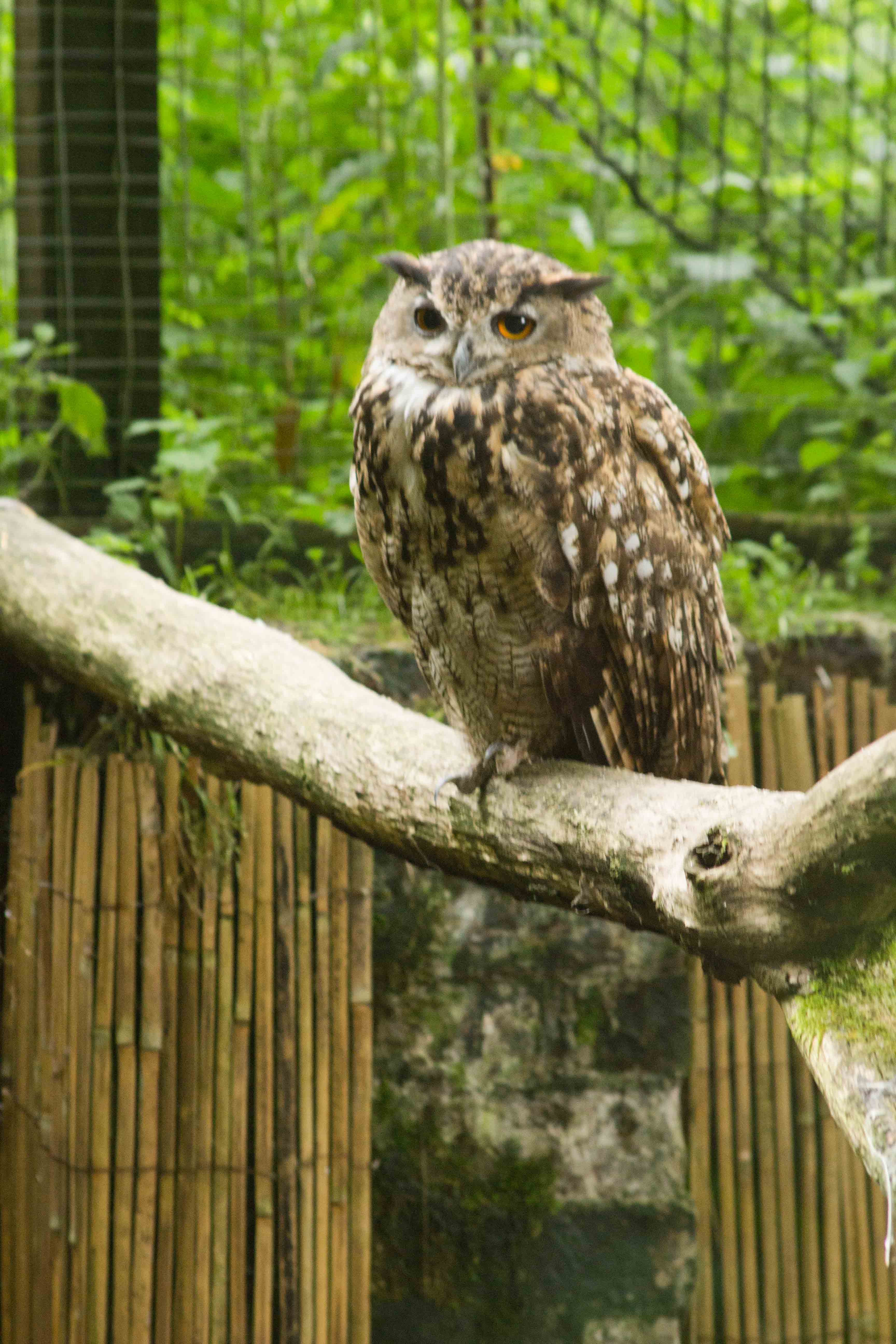
ABOUT THE EURASIAN EAGLE-OWL
Eagle Owls occupy a variety of habitats, from coniferous forests to warm deserts. Rocky landscapes are often favoured. Adequate food supply and nesting sites seem to be the most important prerequisites.
Usually most active at dawn and dusk, the Eurasian eagle-owl has a powerful, fast flight, which is somewhat reminiscent of that of a buzzard. Hunting occurs from an open perch or in flight, and the owl may also search rock crevices for roosting birds, take both adult and young birds from nests, or even plunge into water to capture fish. The diet mainly consists of mammals, up to the size of adult hares or even young deer, as well as birds up to the size of herons and buzzards, and occasionally amphibians, reptiles, fish and insects.
The Eurasian eagle-owl usually begins breeding from late winter. The nest might be located on a sheltered cliff ledge, in a cave or crevice, in the old nest of another species (such as storks or large birds of prey), or occasionally in a tree hole or on the ground. The species has always been considered to be monogamous, but some cases of bigamy have been recorded recently. A breeding pair may use the same nest site over several years. Between one and five eggs are laid, and are incubated by the female for 34 to 36 days, during which time the male brings food to the nest. The young owls first leave the nest at around five weeks, but cannot fly until about seven weeks old, and remain dependent on the adults for a further three to four months, not generally starting to disperse until approximately 170 days old. The Eurasian eagle-owl reaches sexually maturity at 1 year, and may live up to 21 years or more in the wild, or to an impressive 60 years in captivity.
The Eurasian eagle-owl has one of the largest ranges of any eagle-owl, being found across much of Europe, through the Middle East, Russia and Asia, and as far east as China, Korea and Japan. Although generally absent from Britain and Ireland, small numbers are now beginning to breed in Britain.
This owl usually inhabits natural rocky areas with cliffs and ravines, as well as quarries and buildings, patches of woodland or scattered trees. It also occurs in open forest, taiga, wooded steppe, semi-desert, and farmland with suitable rocky areas, and can be found at elevations of up to about 2,000 metres in Europe and 4,500 metres in Central Asia and the Himalayas. More recently, this species has started to colonise urban habitats and is now breeding in several towns in Europe.
 Arts, reviews & current affairs