
(8) Friday, August 6 –
. Image of the day –
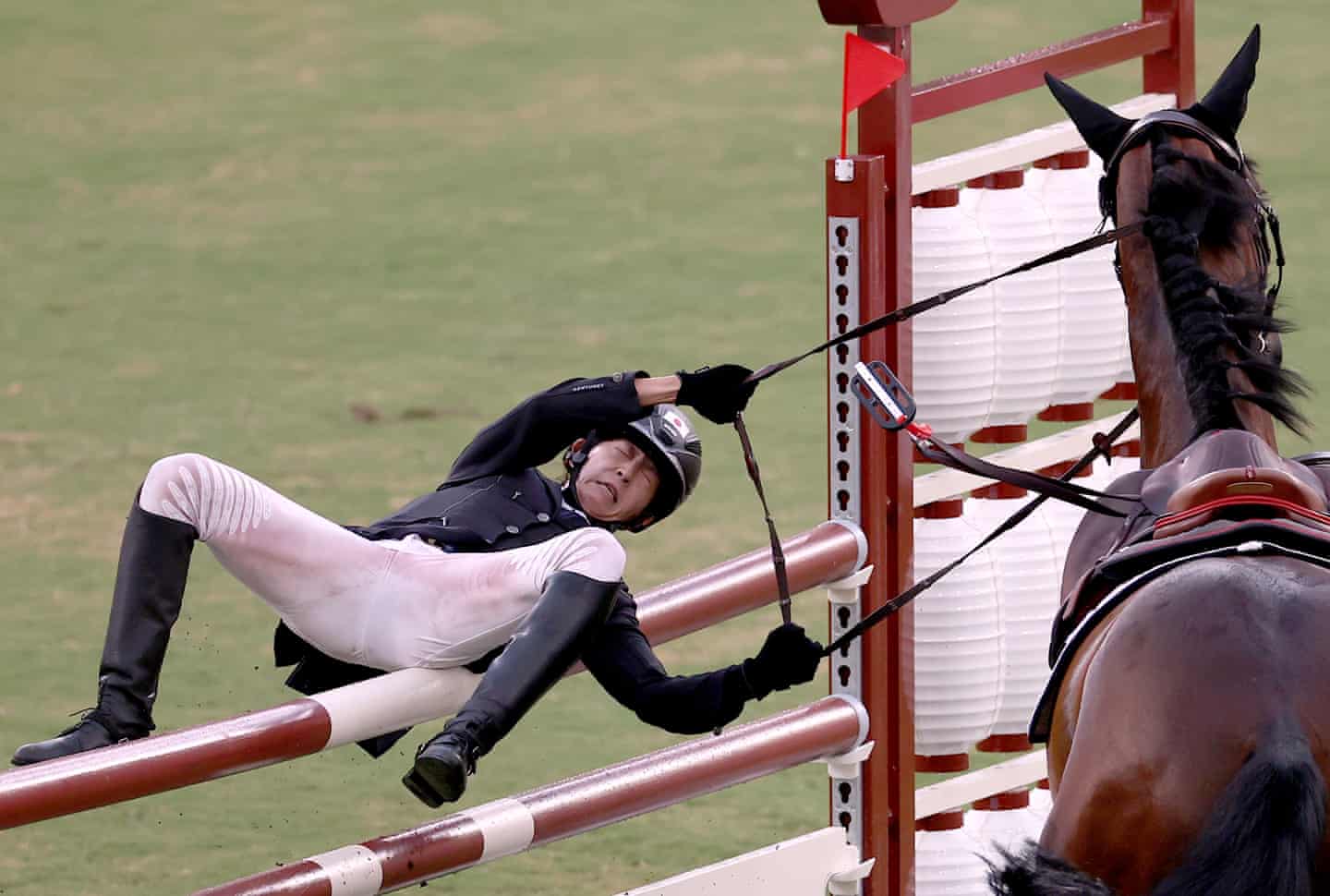
. Shaunae Miller-Uibo of the Bahamas wins gold again in the women’s 400 metres
Shaunae Miller-Uibo romped to gold in the women’s 400m final in Tokyo with a blistering performance.
There were concerns surrounding the Bahamian star who won gold in Rio five years ago – following her performance in the semi final, leading to her recalibrating ahead of the final in Japan.
However, she left little doubt as to who reigns supreme in the women’s 400m, blitzing her competition with a time of 48.36seconds to repeat her feat in Brazil.
Marileidy Paulino of the Dominacan Republic took second place with a time of 49.20 seconds while United States star Allyson Felix took bronze – her 10th Olympic medal in what has been a glittering career for the 35-year-old.
Felix’s bronze made her the most decorated woman in Olympic track and field history, edging ahead of Jamaica’s Merlene Ottey.
She has also equalled compatriot Carl Lewis’s Olympic medal count and is widely expected to contend in Saturday’s 4x400m relay final for one more shot at the podium in her fifth and final Games.
Meanwhile, Team GB’s Jodie Williams, 27, ran strongly having vowed to compete for gold in Friday’s final.
Williams set a new personal best of 49.97 seconds in the semi final and clocked the exact same time in the final, which was only good enough for sixth.
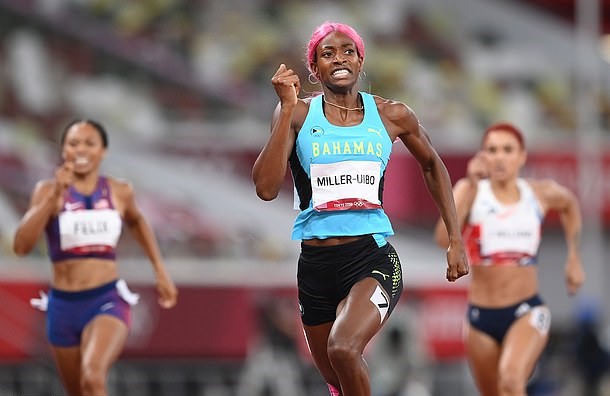

. Italy win gold in the men’s 4x100m relay
Team GB men’s 4×100 relay team agonisingly missed out on a gold medal by 0.01 seconds as Italy came from behind to overtake them on the line in Tokyo.
The British quartet thought they had the gold when CJ Ujah, Zharnel Hughes and Richard Kilty put them in the lead at the final changeover, but Nethaneel Mitchell-Blake was overtaken on the line by Italy’s Filippo Tortu.
Filippo Tortu ran the final leg for Italy and he looked like a man possessed. He believed in himself and hunted down the British runner Nethaneel Mitchell-Blake, leaning over the line to clinch gold. It was an outrageous finish.
1. Italy – 37.50
2. Great Britain – 37.51
3. Canada – 37.70
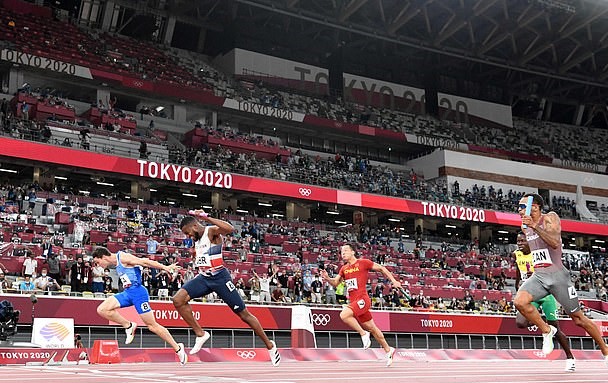


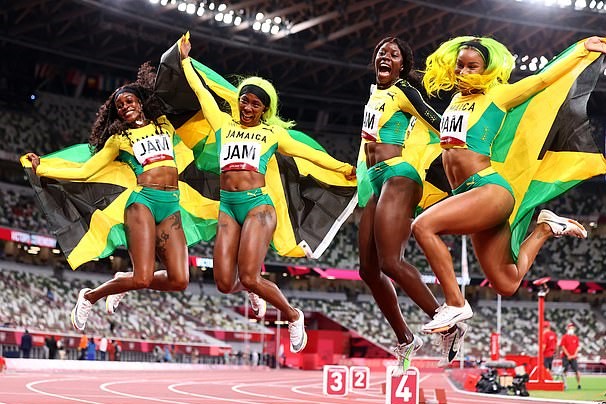
. Jamaica win the women’s 4x100m relay final
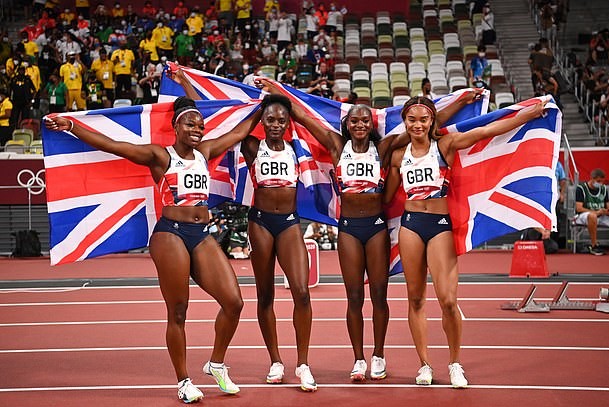
Dina Asher-Smith completed her Olympic comeback with 4×100 metres relay bronze in Tokyo.
The 200m world champion ran the third leg as the British women clocked 41.88 seconds at the Olympic Stadium behind Jamaica and the USA.
Asha Philip and Daryll Neita add to the relay bronze they won in Rio while Imani-Lara Lansiquot claims her first Olympic medal.
Asher-Smith’s individual Olympic dreams were wrecked by a hamstring injury she suffered at the British trials in June.
She failed to reach the 100m final after running a time of 11.05secs – well below her 10.83s personal best – and then pulled out of the 200m.
The 25-year-old returned on Thursday to help the squad reach the final, qualifying fastest in a new national record of 41.55s.

. Faith Kipyegon (Kenya) wins gold in the women’s 1500m and sets a new Olympic Record
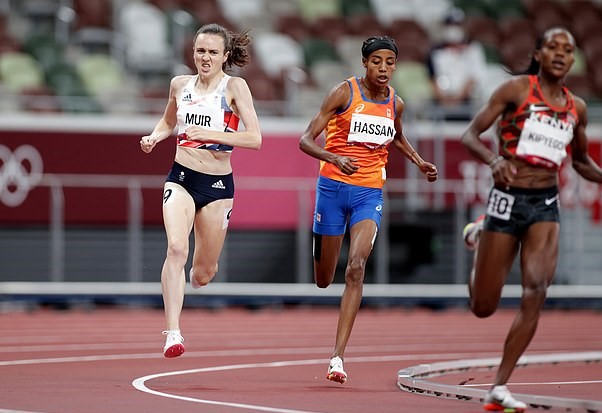
Laura Muir (GBR) ended her wait for a major global outdoor medal after taking a brilliant silver in the 1500m.
The Scot ran 3:54.50 – a new British record – in Tokyo as Kenya’s Faith Kipyegon claimed gold, defending her title, with Sifan Hassan winning bronze.
It ended Hassan’s remarkable triple bid on the track having already won the 5000m. She will also run in the 10,000m on Saturday after missing out on an unprecedented hat-trick of wins.
The 28-year-old hit the front inside the first lap with Kipyegon and Muir responding along with Canada’s Gabriela DeBues-Stafford.
But Kipyegon took the lead early in the final lap and Muir moved into second with 200m to go. Kipyegon recorded a new Olympic Record of 3:53.11.
Muir’s medal in Japan ends a run of several near misses at major championships.
She came seventh in the 1500m in Rio after fading despite being in medal contention with 200m to go; the disappointment followed in the 2017 World Championships, where she finished fourth by 0.07 seconds.
Since then she has become a quadruple European indoor champion, European champion in 2018 and claimed silver at the World Indoor Championships.
Muir also came fifth at the World Championships in Doha in 2019 after seeing her preparation hampered by an Achilles problem but finally reached the podium at the Olympic Stadium.
Muir paid tribute to her coach Andy Young, adding: ‘I started working with him in 2011 so almost a decade next month and he’s sacrificed basically the last 10 years for that four minutes back there. I just cannot thank him enough.’

. Cheptegei (Uganda) wins gold in the men’s 5000m
Uganda’s Joshua Cheptegei, the world record holder, won the men’s 5,000 metres gold at the Tokyo Olympics to add to his 10,000m silver from last week.
The 24-year-old set the pace early in the 12-and-a-half-lap race but was soon overtaken by a host of his competitors on a balmy evening at the Olympic Stadium.
But with about 600m remaining he found a different gear to surge past the pack and retake the lead to win in 12:58:15.
Mohammed Ahmed of Canada clinched the silver while American Paul Chelimo claimed the bronze medal with a season’s best time of 12:59:05, falling over the line after struggling at the end.
Britain’s Butchart, taking part in his second Olympic final, kept up with the main group for most of the race but fell away with around three laps to go. However, the 29-year-old from Dunblane did manage to record a season-best time of 13:09.97.
Cheptegei came into the race as one of the favourites to take the gold after setting the world record for the 5,000m in Monaco last year.
Cheptegei ran in last Friday’s 10,000m race as the world-record holder in that event as well, but was pipped to a gold by Ethiopian Selemon Barega, who won with a time margin of 0.41 seconds.
He has taken over the Olympic title held by Great Britain’s Sir Mo Farah, who opted not to compete in this event for the Tokyo Games.
Here are the finalists:
Luis Grijalva (Guatemala)
Justyn Knight (Canada)
Nicholas Kipkorir Kimeli (Kenya)
William Kincaid (USA)
Mohamed Katir (Spain)
Mohammed Ahmed (Canada)
Dawit Fikadu (Bahrain)
Jacob Kiplimo (Uganda)
Jimmy Gressier (France)
Birhanu Balew (Bahrain)
Paul Chelimo (USA)
Joshua Cheptegei (Uganda)
Milkesa Mengesha (Ethiopia)
Oscar Chelimo (Uganda)
Grant Fisher (USA)
Andrew Butchart (Great Britain)


. Modern Olympic Pentathlon
Gold: K French (Great Britain)
Silver: L Asadauskaite (Lithuania)
Bronze: S Kovacs (Hungary)
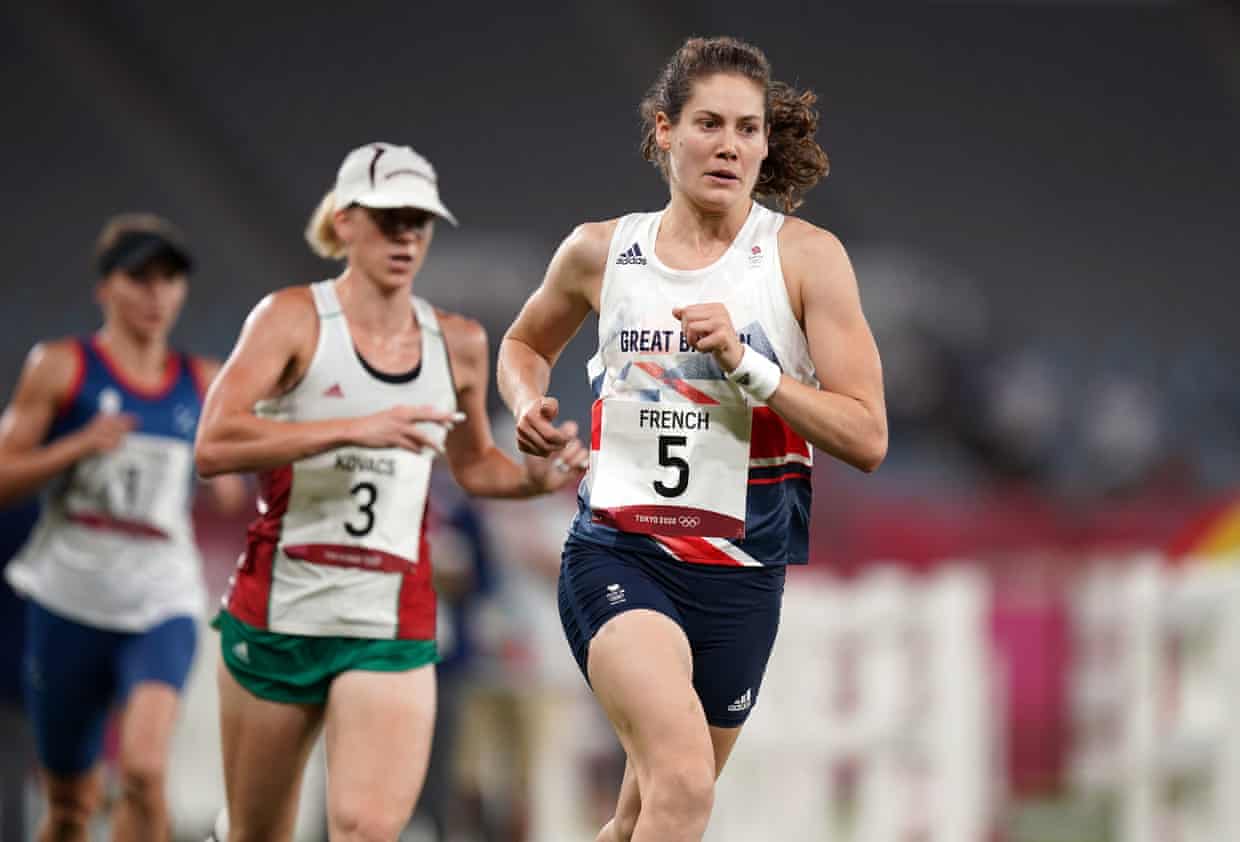
Kate French put Britain on top of the Olympic women’s modern pentathlon podium, erasing a 15-second deficit on the final two of the five events – shooting and cross-country – to snatch Tokyo gold.
French, fifth at the Rio Olympics on 2016, charged into the lead after the first of four laps around the 800-metre circuit and was on target in each of four shooting rounds to romp to victory over Laura Asadauskaite of Lithuania, who came from 52 seconds back to take silver.
Sarolta Kovacs of Hungary grabbed the bronze.
Modelled on the skills of the ideal soldier, pentathlon is the only sport created especially for the modern Olympics, being introduced by Games founder Baron Pierre de Coubertin in Stockholm in 1912. It has remained relatively unchanged ever since.
In 1964, when the Games were last staged in Tokyo, modern pentathlon was staged over five days but this time the 200 metre swim, fencing, equestrian show jumping, shooting and running events were crammed into one action-packed afternoon in Tokyo Stadium.

. (Images ad-hoc from elsewhere: Women’s Boxing)
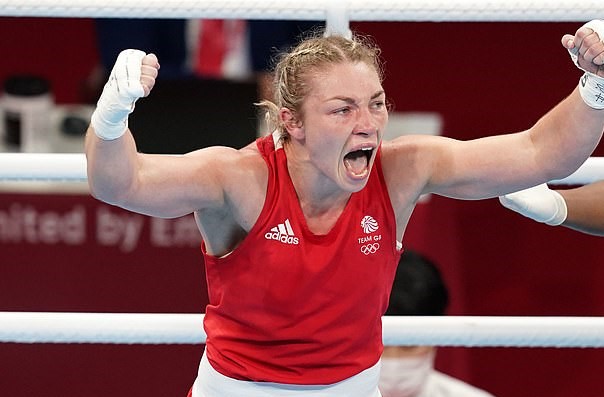
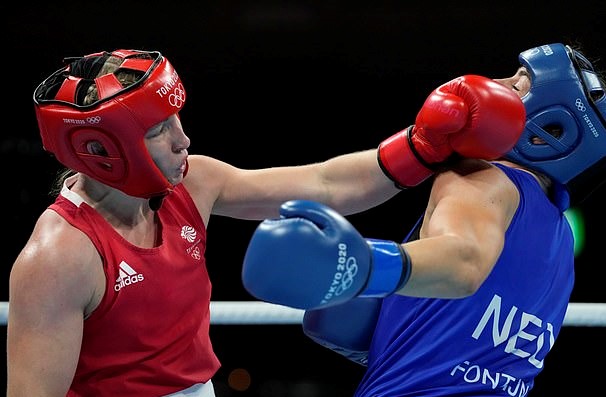
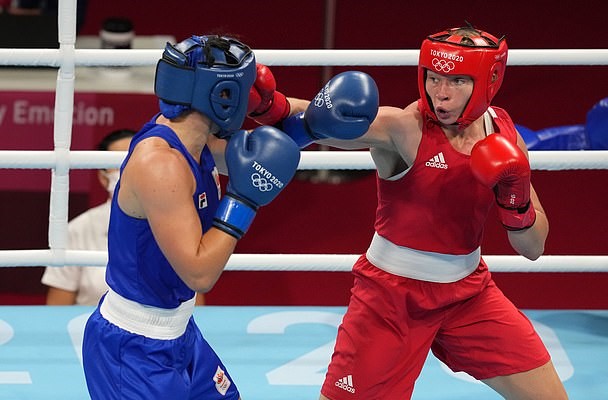
Lauren Price booked her place in the women’s middleweight final with a brilliant victory
Lauren Price wins her middleweight semi-final and is through to the gold medal bout. Price, the Welsh world champion and Commonwealth Games gold medalist, beat Dutchwoman Nouchka Fontjin by split decision.
Price fought her way back after being deducted a point and will face Li Qian in Sunday’s final after the Chinese boxer easily accounted for Zenfira Magomedalieva in the other semi-final.
With four boxing medals already won by Britain and Galal Yafai fighting for gold on Saturday, Price will take the haul to six, a post-war record. Only the colour is to be decided.
. Dawid Tomala (Poland) wins gold in the 50km walk. The race looks set to be dropped from future Olympics’ games
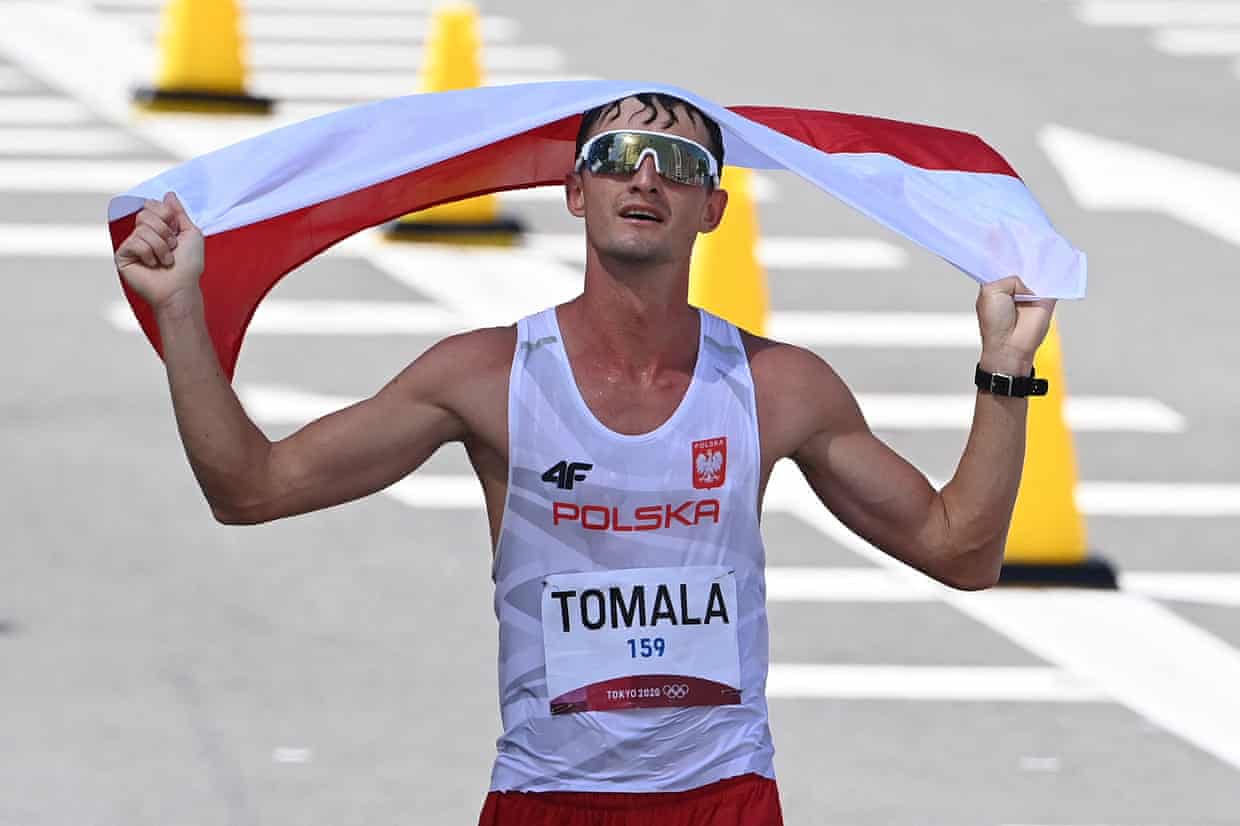
It was an almost flawless race in horrible conditions over a brutal 50km. He raises the Polish flag as he crosses the line. Germany’s Hilman takes silver. Canada continue their brilliant Olympics as Evan Dunfee comes from nowhere to take bronze from Spain’s Marc Tur.
The 50-kilometre race walk, which only men compete in, was dropped from the Olympic lineup for the 2024 Paris Games and may never return. It’s been a part of every Olympics bar one since Los Angeles in 1932, but will be replaced by a mixed race walk event – the exact format of which is yet to be decided by the International Olympic Committee. The men’s and women’s individual 20-kilometre race walks will remain Olympic events.
But for the 89-year-old 50K walk, it’s been overtaken by the likes of skateboarding, a flash new arrival in Tokyo, and breakdancing – coming soon in Paris.
The racers on Friday walked laps of the Sapporo Odiri Park for nearly four hours in temperatures hanging around 30 degrees Celsius (86 degrees Fahrenheit) after a 5.30 a.m. start to earn their medals. It was the longest event on the schedule at the Olympics. These walkers go nearly 8 kilometres further than the marathon runners.
Yes, they were “only walking.” And, yes, their hips wiggled, as they always do, in an amusing way. But their arms pumped back and forth, their legs warped and their feet were a constant blur for those four or so hours in a sport that’s far more punishing than it may seem at first glance. They did it all while observing race walking’s golden rule: A part of a foot must be in contact with the road at all times.
If we’re talking dedication, consider one thing: How much time do you have to invest in a sport that takes four hours to complete? Ten walkers out of the 59 who started didn´t make it to the finish in Sapporo after dropping out. It took Claudio Villanueva Flores of Ecuador in last place nearly five hours to finish, and he was a morale-crushing 29 minutes behind the guy who came second-to-last.
Tomala lay on his back at the finish, an ice pack in one hand that he had needed to keep his body from overheating to the point of shutting down, but a broad smile on his face nevertheless. Hibbert slumped to his knees, but cracked a smile, too.

Tomala said he had always wanted to do the 50K walk and follow in the footsteps of his idol, the great Polish walker Robert Korzeniowski, who won three Olympic golds in the 50-kilometre race (and one in the 20-kilometre walk). Tomala tried a 50K in 2017, but didn’t finish. He didn’t know if he had it in him. It took him four years to try again, but he did one in March at a race in Slovakia, and he won. That convinced him to change from the 20K to the 50K for the Olympics.
Effectively, race walking’s most extreme event is being dropped by the IOC because it has struggled to capture attention and hold interest. But tell that to Tomala, maybe the last Olympic champion ever in the 50-kilometre race walk.
“I needed something new, something special,” he said. “I thought the 50-kilometre would be good and now I know it is.”
 Arts, reviews & current affairs