
COURTAULD GALLERY
Intro: A first-of-its-kind Courtauld exhibition brings together the French artist’s haunting seaside paintings
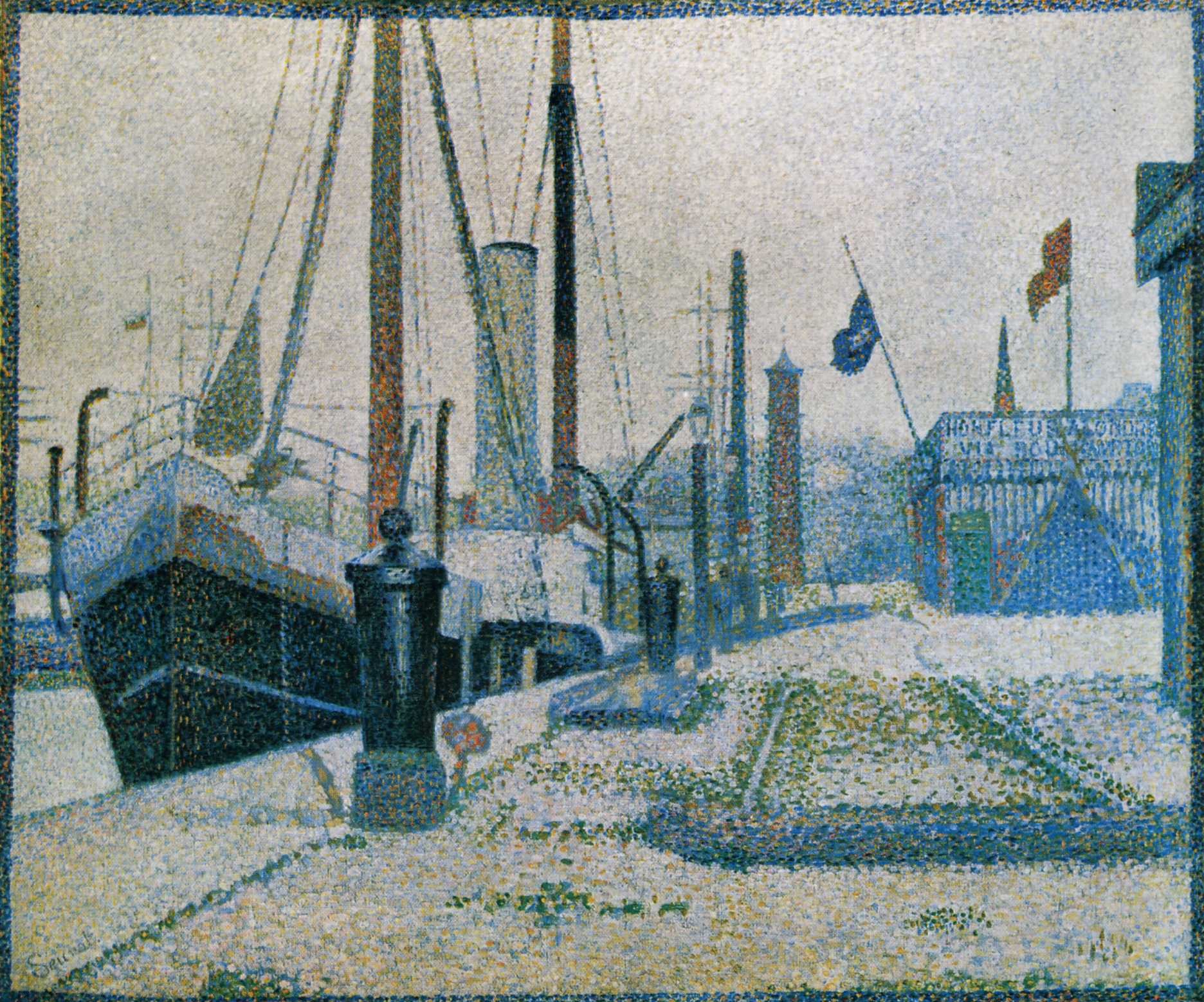
Never before has there been an exhibition of seascapes by Georges Seurat, which is odd, given that the short-lived French artist’s “marines” make up the bulk of his output. So, the Courtauld in London – which excels at jewel-like exhibitions based on enterprising scholarship – deserves praise for mounting one. Let’s be clear, though. Seurat’s chilly Channel views are magnificently weird. But if that puts you off attending and buying a ticket at the exhibition, you should at least give the show and gallery a chance.
Seurat is remembered above all as the painter of interminable dots. By the time of his death in 1891, at the age of 31, he had produced only a handful of major canvases, mostly speckled with tiny spots and flecks of pigment, applied according to a rigorous and quasi-scientific method. (A Sunday on La Grande Jatte – 1884 (1884-86), in the Art Institute of Chicago, is undoubtedly the most famous.) As he result, he came across as an automaton. Compared with other modern artists, he’s uptight and hard to love.
Some will not be sure whether the Courtauld’s show of 26 works – including attractive oil sketches and preparatory drawings in Conté crayon, alongside 17 canvases – will convince sceptics that Seurat had a heart. His dotty views of ports and the open sea, produced on the northern coast of France over five summers between 1885 and 1890, contain anthropomorphic elements: masts, semaphores, bollards, buoys. But, with one or two matchstick-like exceptions, these seascapes are devoid of people.
The effect is rather uncanny, as if his subject were a model village. By representing glittering sunshine, fluttering pennants, and sailboats bobbing about on enticing, turquoise water, these pictures suggest summer holidays. But where are the holidaymakers? Seurat’s contemporaries sensed a “penetrating melancholy” in his seascapes, which, for all their luminosity, appear to anticipate the eerie landscapes of Giorgio de Chirico.
Nonetheless, Seurat was clever and original. Earlier artists, tackling marine themes, depicted seething waves; Seurat’s seas are calm as a millpond. His canvases are expertly composed and executed. They seem to contain the seeds of geometric abstraction and Op Art, even Minimalism.
Conceived during his final summer, and set at dusk, The Channel of Gravelines: An Evening (1890) is a meticulous mini-symphony in shades of purple, rose, and pink. In it, are established curious and yearning dynamics between inanimate objects – including, in the foreground, a lamppost and two prominent anchors that seem to move in concert, like synchronised swimmers. Seurat rejected the idea that his works contained “poetry”, arguing: “I apply my method and that is it.” Yet, others will say that if this wistful and mysterious painting isn’t what poetry looks like, then what does?
 Arts, reviews & current affairs