Mental Health, Psychology, Science

Schools of Thought: Humanistic Psychology

HUMANISTIC PSYCHOLOGY

THE move towards cognitive psychology came about through frustrations with what were seen as the limitations of psychoanalysis and behavioural psychology. In the 1950s, another movement within psychology also began to gain ground – one that rejected all the main strands of psychology: psychoanalysis, behavioural psychology, and the emerging cognitive psychology approach. This fourth approach has become known as humanistic psychology.

Rather than seeing the human psyche as a minefield of conflicting parts of the self, driven by primitive urges (as the psychoanalytic approach was characterised), or viewing the self as the result of myriad stimulus-response exchanges that make us who we are (as behaviourists do), or seeing the reasons for our beliefs and actions as residing in our perception and cognition of what’s around us (as the cognitive psychologists are doing), humanist psychologists view the individual as a whole person with their own free will, desires, responsibilities, passions, aims, and aspirations. In short, all the kinds of things that make us human. For the humanists, the concept of mental health for far too long had been obsessed with reducing negative states such as anxiety or depression. The humanists wanted mental health to be all about striving for something better, like happiness or fulfilment.

What do you really want from life?

Two key thinkers are the pioneers of the humanist psychologist movement. One is Abraham Maslow, best known for his 1954 concept of the “hierarchy of needs,” which dates from 1943, and which presents an image of what people really want from life – and the idea for striving for something for its own sake. Having established lower-order needs – such as food, shelter, belonging, self-esteem – we seek knowledge, meaning, and, ultimately, the realisation of our full potential.

The second, Carl Rogers, shared Maslow’s view that humankind seeks this higher state of self-actualisation, making the most of our talents or education or skills. And along with that, we seek positive regard, which can be love, or simply respect, from others. In his 1961 book On Becoming a Person, he discussed some of the conditions necessary to achieve this state – a discussion that was to form the basis of a client-centred therapy (later renamed “person-centred” therapy). At its heart is the concept of unconditional positive regard – the kind of parental love that children can enjoy no matter what they might do, and which gives them a freedom to take risks and discover what they like doing. In cases where children receive only conditional positive regard, parental love may only be won through good behaviour or excellent performance, with the risks of the child becoming a perfectionist or neurotic later in life. Client-centred therapy could redress this by the therapist providing the unconditional positive regard, and allowing the client to start finding their own way toward their self-actualising goals.

The “I” and the “me”

For Rogers, an important theoretical aspect was the self concept. There are two parts to it: the “I” that does stuff, and the “me” that the “I” sometimes thinks about, such as when we say “I am ashamed of myself.” The self concept develops as we grow up, and we are happiest, Rogers believed, when we have congruence between the “I” and the “me” – that is, minimal conflict between the perceived self and the kind of behaviours we actually find ourselves doing.

Rogers developed his “Q Sort” test – a kind of personality test using a deck of flash cards – to measure levels of this congruence, which allowed for some degree of quantitative testing to demonstrate correlation between congruence of the self concept, and other measures of well-being or social adjustment.

Nonetheless, humanistic psychology is often characterised as being more of a qualitative than quantitative strand of psychology. By contrast, positive psychology is a related branch that also has as its goal not simply a reduction of psychological pain, but more positively, the advancement of well-being – looking, for example, at the science of happiness, or how creativity is stimulated: in many respects, another route to the summit of Maslow’s hierarchy of needs.

. See also Positive Psychology

Standard
Arts, Health, Mental Health, Psychology

Tell a New Story

RESILIENCE

WHILE we can’t control exactly what happens in life, we can control what we tell ourselves about what’s happened. Emotionally robust people have the ability to reframe situations, even when they seem challenging or scary. By looking for value and meaning in stressful events they are able to see “bad” experiences in a positive light. For example, instead of seeing obstacles as stopping you from achieving your goals, you see them as opportunities to adapt and grow.

Instead of fearing failure, you see failure as a necessary stepping stone on the way to success. Reframing is a powerful way to transform your thinking and boost your mental toughness. It won’t change the situation, but it will put things into a healthier perspective and keep you motivated to keep going. Try it and see what a big difference it makes.

If at First You Don’t Succeed…

It is a continuous effort – not talent or intelligence – that holds the key to success in life. Successful people understand this. As a result, they are action-orientated. Of course, sometimes it makes sense to quit, but don’t make the mistake of giving up too early. Walt Disney’s first animation company went into liquidation and he was reputedly turned down 302 times before he got financing for creating Disneyland. Equally, J.K. Rowling was, in her own words, “as poor as possible” before she found success with Harry Potter, but only after 12 publishers rejected her manuscript.

Ask yourself, are you looking for a quick fix? Do you have a tendency to give up when things get tough? Or do you persevere and keep trying to find a way to make things work? Commit to keep going until you reach your goal.

LET IT OUT

HONOUR your feelings and recognise that difficult emotions such as anger, depression and loneliness are a natural part of the human experience. Let your emotions out by having a good cry if you need to. Crying can help you to regain your emotional balance as it releases toxins that have built up in the body due to stress. You should find that you feel calmer and less anxious afterward.

Another good way to express your feelings is through a creative outlet such as painting, blogging or playing a musical instrument. Creative activities can reduce stress and help you to process your experiences and feelings. The options for self-expression are endless. Whether you write poems, take photographs or draw sketches, creative pursuits offer you the space to deal with a range of emotions in a healthy and constructive way. Find something that gives you release.

(Podcast ends)


Acquiring Resilience

BEND BUT DON’T BREAK

NOBODY likes feeling stressed, but some people are particularly skilled at coping with upsetting events and carrying on. What is the secret to building resilience, and how can we develop it our ourselves?

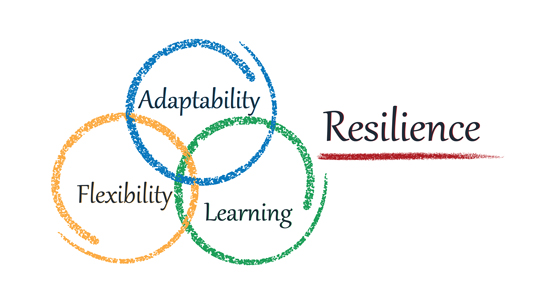
WHAT is resilience? The word comes from a Latin verb, resilire, meaning “to leap back”. A resilient person is not someone who never suffers, but one who can suffer and spring back again. It’s a quality that can help us to successfully endure stressful times: studies have confirmed that resilient individuals show a similar increase of the “stress hormone” cortisol when under pressure. We can all benefit from a more resilient attitude.

. A resilient personality?

If some people cope with stress particularly well, does that mean they were simply lucky to have a resilient personality – and if we weren’t born resilient, should we simply resign ourselves to unhappiness? In fact, the opposite is true. Resilience is not a personality trait, and no one is immune to the challenges of life. It is, rather, as a European team of psychologists put it in 2013, “a dynamic and adaptive process”. Essentially, we can learn to be resilient. How we choose to react to adversity can make a big difference. Rachel Dias, a renowned Latin American psychologist, describes it well: “Resilience is not invulnerability to stress, but, rather, the ability to recover from negative events.”

. The Power of Self-Efficacy

A major pillar of resiliency is what psychologists call “self-efficacy”: the belief that our actions have the power to affect our circumstances. There are four key-ways to build self-efficacy, so be alert to opportunities that can increases your sense of confidence and control in the face of stress:

. Persevering through failures

. Finding good role models

. Interpreting our feelings positively

. Social persuasion – for example, if someone says you’re resourceful, maybe they’re right

. Creating a buffer

When we face the stressors that are an inevitable part of life, resilience can limit its impact. A 2015 Brazilian study of people caring for family members with dementia – an unquestionably stressful role –identified a strong collection of traits, resources, and attitudes that built resilience and heightened the caregivers’ sense of wellbeing. These resources include building up good coping strategies, focusing on the positive, self-efficacy, being fully engaged in daily activities and having strong social support.

When we gain resilience we enjoy lower stress, improve our confidence, and have better mental health.

Standard
Health, Psychology, Science

Psychology: How can I improve my memory recall?

 MEMORY

Intro: Some people are gifted with an elephant-like memory, others with a Dory-like recall. The key to a better memory is to repeat, repeat, repeat, with a touch of emotion  

THE PHOTOGRAPHER of the “documentary” that is your life story is an inch-long, slug-shaped region in the brain called the hippocampus, nestled within the head of the coiling snake of the emotional limbic circuit. Your emotions – good and bad – are the gatekeeper of what makes it in, and what gets left on the cutting-room floor. You won’t remember what you ate for breakfast last Wednesday because it wasn’t exciting, but if your lover got down on one knee to propose to you that morning, the fact you were eating a bowl of oatmeal at the time will be forever remembered, as clear as day.

That’s why dry lectures and seminars, dreary news bulletins, and boring books leave your head almost as soon as they are over. You’ll forget an arbitrary fact – such as 1769 being the year French ruler Napoleon Bonaparte was born – by the time you turn the page because it has no significance to you. However, if you’re a lover of all things locomotive, then you may have noted to yourself that this was the same year that the steam engine was invented, making Napoleon’s birthday easier to remember. The frontal lobe pathways for new memories and information will sprout from your established memory patterns, much like a new branch budding from an old grape vine.

Crucially, memories are only packaged into long-term storage once you have brought them back to mind at least once. Everyone loves stories – they are the lynchpin of our understanding of the world, and many people often entertain friends with fond memories that begin with “remember the time when…” and reminisce with family over tales from childhood. Each time you recall the memory, its neural pathways become strengthened and thickened, and more likely to weather the passage of time.

Your memory is at its worst when your body clock is slumping, for most of us, this will be the late afternoon and early evening. However, for night owls this will be in the morning.       

Even though memories are famously fallible – where we are often left grasping at straws after a disagreement when both parties are adamant their version of events is true – there are various things we can do to improve memory recall. Keeping a diary is one such method which should be used to record memories as soon as possible after the event, before they are contaminated by emotions or misty recollections. Telling stories is another effective method because repeating anecdotes to others will help form very strong memories by tying positive emotions to them, making the memory more likely to be stored long-term. Another method to improve memory includes creating mind maps which help to make visual connections between pieces of information that you want to learn. The more connections you make within a topic, the more likely you’ll retain information.

Why can I still remember skills, even years later?

When it comes to learned skills, especially those involving repeated movements, your brain’s most primal regions are like a memory-foam mattress

TEN, TWENTY, THIRTY, or more years may have passed since you last mounted your childhood BMX, but you haven’t forgotten how to ride. Like writing, swimming, driving, or typing on a keyboard, the ability stays with you, long after the hours of learning are forgotten. Sometimes called “muscle memory” (correctly termed procedural memory), muscles themselves have little to do with it.

Rather, these skills are stored in the cerebellum, far from your conscious memories of events. A large-wrinkled region tucked under the back of the brain, the cerebellum is under the orchestration of a curved tadpole-shaped structure in the middle of the brain called the basal ganglia.

With each attempt at a skill, slowly but surely, a path of neural connections forms in the brain. Through repetition and practice, these abilities build a well-trodden walkway deep inside your brain’s circuitry. The weeds of time are slow to obscure this path, so you will be able to retrace your steps and get back into the saddle well into your old age, even if you’re a bit rusty. It takes an estimated 20 hours of deliberate, focused practice to gain basic skills in a new hobby. Expert craftspeople and athletes take somewhere in the region of 10,000 hours firming up brain pathways before they reach the top of their game.

It’s not only the highly skilled who rely on procedural memory: most of what you do everyday is executed on “autopilot”, such as brushing your teeth or getting dressed. These tasks require very little conscious thought because they run via the basal ganglia rather than being under the direct control of the frontal, decision-making brain regions, which are free to focus on other things. If we didn’t have these programs, we would have to concentrate every time we tie our shoelaces.

These “unthinking” skills become so well established that they actually outperform our conscious brain’s ability for that task. When we try to think too much about something we’re good at, we can “choke”, which has been an athlete’s undoing on the day of the big event.

The Unforgettable Brain of Molaison

In 1953, pioneering neurosurgeon Dr William Scoville performed neurosurgery on Henry Molaison. Henry was alert as his skull was opened and portions of his brain removed, but anaesthetised. At the time no one knew what the hippocampus did, but Dr Scoville had a misguided hunch that this structure was the reason for the epilepsy that had plagued Henry. Sadly, the operation left the 27-year-old unable to ever make a new conscious memory.

Henry’s epilepsy mercifully settled, and his personality and intellect were unaffected, but he would forget events after a few minutes. Incredibly though, his “habit hub” (basal ganglia) and procedural memory circuitry were intact. He was able to learn new skills even though he instantly forgot how he had learned them.

Through studying Henry’s brain, scientists found that our regular memory and our “muscle” memory are stored in separate areas. From what we’ve learnt from his brain, patients suffering memory loss can be rehabilitated faster by teaching them new techniques and skills.

. Appendage

Standard