Arts, Films

Film Review: The Father (12A)

REVIEW

Intro: Anthony Hopkins and a top-notch ensemble may touch a raw nerve in The Father, but this Oscar-winning portrait of dementia deserves its lavish accolades

UNLESS you have been oblivious to the film screen these past two months or so, you will know by now that The Father is about dementia.

Specifically, it’s about dementia as interpreted by the Oscar-winning Sir Anthony Hopkins, who also has a BAFTA to show for his endeavours.

Film Trailer

The driving force behind this film, however, is French playwright Florian Zeller, who adapted and directed his own 2012 stage hit for the big screen. He, too, won an Academy Award and a BAFTA, shared with his accomplished co-writer Sir Christopher Hampton (Dangerous Liaisons, Atonement). The Father is not short of lavish accolades.

For the screenwriters, the question is whether audiences will adore it as much as film critics. To do so, they will need to see it, but I am not entirely sure that, with cinemas now blessedly open again, such a heartrendingly moving but fundamental film about dementia will be a wildly popular choice.

That the film is packed with thunderous resonance for so many people might count against it at the box office. Cinematic escapism, for anyone who has watched or witnessed the mental deterioration of an ageing relative or friend, it is emphatically not.

That said, it should be watched. There have been numerous films over the past decade or so in which dementia has played a central role. But even the best of them, such as Alexander Payne’s 2013 comedy Nebraska (or on television, the lacerating Elizabeth Is Missing, with Glenda Jackson), have shone a bright light on this debilitating condition from the outside looking in.

The captivating cleverness of Zeller’s film, though it only gradually dawns, is that it projects from the inside looking out.

We first encounter Anthony (Hopkins) in a handsome flat in London’s Maida Vale. His gentle middle-aged daughter, Anne (Olivia Colman), breaks it to him that she has fallen in love and is moving to Paris, so he will need a new live-in-carer. The last two, it seems, have quit.

Anthony, though sweet and mellow one moment, can be cruel and cantankerous the next. Looking after him is clearly a challenge. Every time he mislays his watch, he is certain someone has stolen it.

But there is still evidence of his intelligence and charisma. He is soothed, too, by classical music. Then he meets a man in his flat, Paul (Mark Gatiss), who claims to be Anne’s husband.

Anthony breaks it to him that she has met someone else and is relocating to Paris. “Oops-a-daisy,” he adds, childishly amused by his own mischief-making.

Then it sems that the flat is not his apartment at all but belongs to Anne and Paul. Did she really mention Paris? As Zeller continues to undermine our certainties, he plays even with the casting as he introduces Olivia Williams and Rufus Sewell as the daughter and son-in-law, it becomes clear what he is doing.

We’re experiencing Anthony’s confusion ourselves. This device gathers pace and intensity, but never in a mannered or laboured way. It is very adroitly handled.

II

THROUGHOUT it all, it is impossible to take your eyes off Hopkins, even with such a splendid cast of characters around him. There’s an almost upbeat scene when Laura (Imogen Poots) arrives to be interviewed for the carer’s job, and Anthony dazzled by her youth and prettiness, becomes flirtatious. “Ding dong,” he says, coming over all Leslie Phillips.

He declares that Laura reminds him of his other daughter, Lucy, the one he never sees yet who remains his favourite. Then, having beguiled Laura with charm, he crushes her with cruelty.

It is a mesmerisingly powerful performance, the throbbing heart (and ailing mind) of a beautifully observed film.

The Father might not entirely resonate with everyone who has seen the pitilessness of dementia. This family, for example, is ineffably middle-class and affluent, with no suggestion that anyone needs to worry about the financial implications of Anthony’s increasing needs. Also, the Poots character, for someone meant to have a record of caring for old people, seems strangely clueless.

Despite these minor gripes, The Father is well worth all the acclaim that has been heaped upon it.

Verdict: Fully deserving of the acclaim ★★★★

Standard
Arts, Films, Society

Film Review: The Assistant cert 15

REVIEW

The-Assistant-Share

The Assistant follows one day in the life of Jane (Julia Garner), a recent college graduate and aspiring film producer, who has recently landed her dream job as a junior assistant to a powerful entertainment mogul.

THE Assistant is not the first film to broach the subject of sexual harassment by powerful men in the entertainment industry, which spawned the #MeToo movement, and it certainly won’t be the last. But it will always be one of the best.

Last year’s Bombshell, which starred Charlize Theron, Nicole Kidman and Margot Robbie, which chronicled the downfall of Roger Ailes, the head of Fox News, who was eventually forced to resign not because of his long history of sexual advances, but rather because they had been made public, made headlines in equally pressing fashion for a number of film critics.

The Assistant is much less starry and takes a very different, far subtler approach, fictionalising events over the course of a single day in a New York City workplace that is unmistakably modelled on the offices of producer Harvey Weinstein’s company Miramax.

Film trailer

Nor, at risk of giving away spoilers, is there any comeuppance in this story. The unnamed and unseen Weinstein-type character is omnipotent: everyone in the organisation dances to his tune.

Another way in which Australian screenwriter-director Kitty Green’s excellent film differs from Bombshell is that it’s told not from the perspective of a victim – at least, she’s not a victim yet – but from that of a bright young assistant only five weeks into the job.

Gradually, she has learnt that one of her many tasks, along with answering the phone, visiting the photocopier and booking flights, is enabling her boss’s trysts with much younger women, and sometimes literally scrubbing the “casting couch” after them.

She is wonderfully played by Julia Garner, recognisable to anyone who watches the brilliant Netflix series Ozark as that drama’s hard-as-nails hillybilly Ruth.

Here, she’s Jane, not that anyone deigns to call her by her name. As the junior – and as a woman – she is treated dismissively even by her fellow (male) assistants. She works such long hours that she forgets her father’s birthday.

But in what often seems almost like a fly-on-the-office-wall documentary and runs to only 87 minutes (significantly, Green’s background is mostly in factual film-making), she accepts all this as the price of an entry-level job in an exciting industry.

Jane is in almost every shot but doesn’t say much. Her thought processes are what matters here, and both Green and Garner deserve enormous credit for somehow making them so eloquent.

The picture’s best and most important scene comes when she decides she needs to raise some kind of alarm, and goes to see the head of human resources, exquisitely played (in little more than a cameo) by Matthew Macfadyen.

I felt it best not to describe that encounter here because it is pivotal to the film, and by extension highly enlightening in explaining why and how some influential men managed to get away with such ugly behaviour for so long.

– The Assistant is streamed on various platforms, including Curzon Home Cinema, certificate 15.

Verdict: Subtle but a powerful production. Eerily effective. ★★★★

Standard
Arts, Films

Film Review: Tolkien (12A)

REVIEW

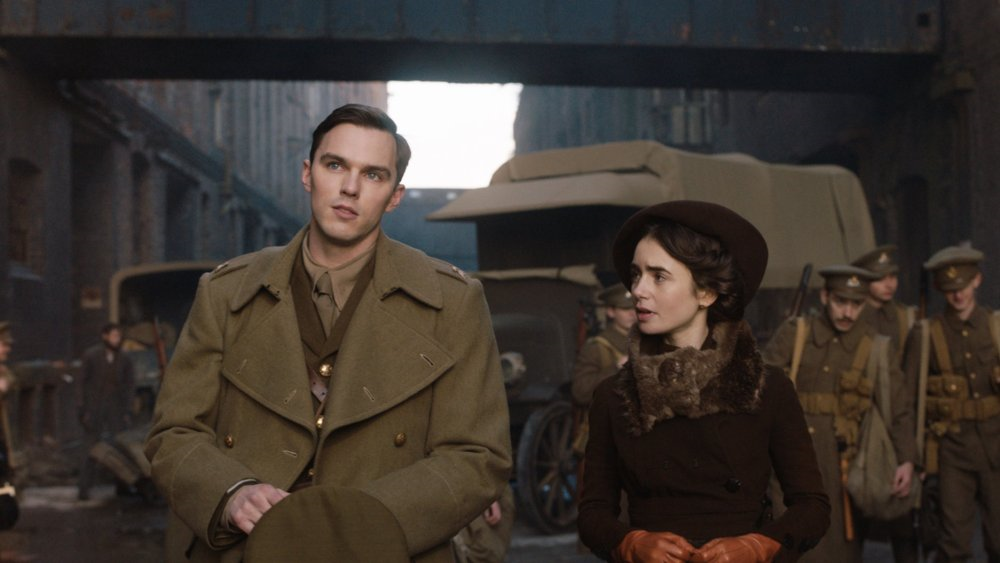
Nicholas Hoult in Tolkien, a sober affair that is driven by love and friendship.

TOLKIEN is driven by love. It is about the passion that J.R.R. Tolkien (Nicholas Hoult), creator of The Hobbit and The Lord Of The Rings, had for his wife, Edith (Lily Collins). In telling the story of his early years, it also chronicles his love for his friends, and for language itself. It is a likeable picture, a bit anodyne in parts, rather clunky in others, but it has a great heart.

Film Trailer (approx. 2.5 minutes)

It opens on nightmarishly familiar images of the Somme, and then whisks us back in time to show us young Ronald’s eventful early childhood. Around the turn of the 20th century, his widowed mother – the person who auspiciously first filled his head with stories of dragons and derring do – falls on what she calls “impecunious circumstances”, and uproots Ronald and his younger brother from a rural idyll to soot polluted Birmingham.

But then she dies, and his guardian, a kindly Catholic priest (Colm Meaney), moves the orphaned Ronald (played at this stage by Harry Gilby) to a kind of middle-class orphanage owned by a pompous matron (Pam Ferris). That’s where he falls for Edith, who becomes the love of his life.

Finnish director Dome Karukoski’s film explores their burgeoning relationship, and her influence on him, but also dwells on his coterie of schoolfriends, with whom Ronald forms a club, a fellowship, devoted to “changing the world through the power of art”.

His brilliant mind and academic prowess continues to broadens at Oxford, where he is mentored by a venerable professor of Middle English, sweetly played by Derek Jacobi. It is, though, his friends who influence him most, and he becomes especially attached to one of them, aspiring poet Geoffrey Bache Smith (Anthony Boyle).

Later, in one of the flits back and forth to the Somme, we see him and Geoffrey endlessly calling each other’s name on the battlefield. In scenes that are meant to be deeply poignant, cynics may wonder whether they shouldn’t perhaps be attempting to kill enemy soldiers rather than trying to locate each other like Leonardo DiCaprio and Kate Winslet in the briny at the end of Titanic. Tolkien, for all its slight deficiencies, is a highly watchable film.

Aptly, for a biopic of perhaps the greatest of all fantasy writers, it is nicely written, by Stephen Beresford – who scripted the hugely engaging 2014 film Pride – and David Gleeson.

And while it no doubt takes plenty of dramatic licence, it is hard to see what might offend the author’s surviving relatives, who have strenuously objected to it being made at all.

Verdict: Big-hearted biopic

★★★

Standard