
BODY HEALTH
Intro: Carrying around a bottle of water is a badge of healthy living and we’re told to drink at least 8 glasses a day – however, experts say this advice has more holes than a leaky bucket
“EXPERTS” urge us to drink water to flush out toxins and combat the effect of ageing, but like so many health myths, the 8 glasses-a-day (or 2.5 litres) advice seems to have sprung from a misunderstanding. The US Food and Nutrition Board published advice in 1945 that a “suitable allowance of water for adults is 2.5 litres daily”. Had thirsty health-seekers not gulped down this snippet straight away, they would have read the next sentence, which stated that most of this will come from food. Healthy adults, they advised correctly, had no need to drink beyond their thirst. Nevertheless, the idea stuck, and the bottled water industry pours great efforts into continuing to persuade us to drink 2.5 litres a day.
On a day-to-day basis, forcing yourself to drink that much water is unnecessary and doesn’t give credit for the body’s highly attuned ability to keep you on an even keel. Your brain’s thirst centre continuously samples the blood to make you feel thirsty before you become dehydrated. Although over-drinking is rarely dangerous in normal circumstances, drinking large amounts of water during endurance sports may dilute body salts to perilously low levels, and can even be fatal.
Studies show there’s no health benefit to drinking more than the amount we need to satisfy our thirst (except perhaps the extra exercise from more trips to the toilet!)
Doctors recommend that adults living in a temperate climate and leading a sedentary lifestyle should drink 1.5 litres of water-based drinks to make up for water lost through sweating, urination, and even the water vapour in their breath – the rest of the water you need will be obtained by eating a balanced diet.
You need to up your water intake if you’re sweating from exercise, hot weather, or if unwell with a fever, diarrhoea, or vomiting. The elderly may need encouragement to drink, because the thirst centres in their brains become sluggish in old age; similarly, young children are less aware of their thirst drive, and need to have scheduled drink breaks through the day.
WATER IN AND OUT
– Water in (typically):
. 60% of water comes from drinks
. 30% comes from food
. 10% comes from cells as a by-product of making energy
– Water out (typically):
. 60% of the water you lose is from urine
. 25% is lost as water vapour as you breathe out
. 8% is lost through sweating
. 4% is lost in your faeces
. 3% is lost through saliva, tears, mucus, and blood
– Appendage (how the body uses water)
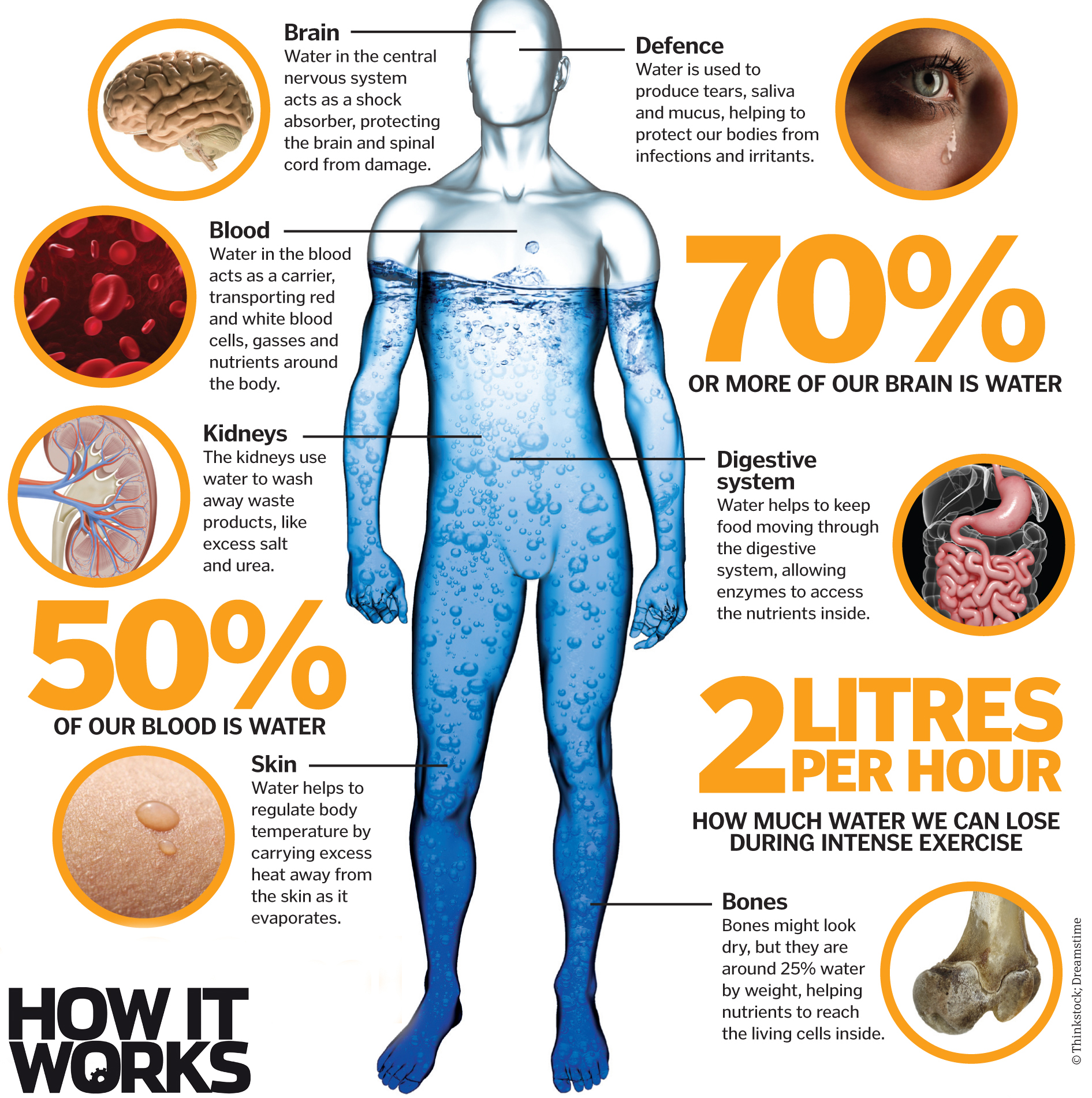
. Should I drink until my pee is clear?
You may be familiar with the idea that the colour of your pee can tell if you are drinking enough. But don’t make the mistake of thinking that clearer is always better.
We may not know its name, but many of us are familiar with Armstrong charts from gym changing rooms or doctors’ surgeries. Named after their scientist creator, they are designed to tell you whether or not you are dehydrated by comparing the colour of your urine with yellowy-brown coloured stripes.
The chart suggests that you should drink more if your urine matches the darker stripes and stop when your pee matches the palest colours. These types of charts are very useful as an early warning of dehydration, especially in the elderly, infirm, or very young. But it’s a big mistake to think that paler is always better, and that you should drink until urine runs completely clear. By doing this, there’s a good chance that you’re putting yourself well on your way to fluid overload. If your urine is completely clear, it’s an ominous sign that your kidneys are having to work overtime to remove excess water from your system.
Totally clear urine is a signal that your body is trying to get rid of excess fluid.
– Colour Matching Guide

– It’s healthiest for your pee to match the colours of the second or third colours down from the top of this chart (i.e. a pale straw yellow or translucent yellow).
 Arts, reviews & current affairs