
Arts, Christianity, Religion, Society

The competitive Corinthian mindset

Unity in diversity

1 Corinthians 1:10-17; 3:1-19

IN 1996, there were 243 Christian denominations recorded in the UK Christian Handbook, an almost threefold increase in 20 years.

In one sense “the body of Christ” is divided today in a way that not even the Corinthians could imagine (1:10). Their divisions were caused by quarrelling and jealousy (3:3), yet another manifestation of the proud and competitive Corinthian mindset.

While it can be argued that the main historic denominations formed out of major theological rifts (such as the conflict over salvation by faith or works which spawned the Lutheran and Calvinist churches), sadly the “quarrelling and jealousy” of leaders has caused the modern multiplication of church groups (cf. 1:12; 3:4).

Consumer choice has become society’s holy grail, and independence its lowest common denominator. The disease also infects the church as we choose churches with subtly different spiritual flavours. To outsiders, it must look as if Christianity has many religions.

The New Testament urges leaders to sort out their differences. There is only one church, although it not restricted to one denomination (the “true” church is not an organisation but a fellowship of believers).

Today we can maintain the unity of our own group by learning to appreciate people’s different approaches to spiritual life which reflect our diversity. We can also find ways to work with others to present a united front to society. This is, however, harder work than sniping at each other.
Standard

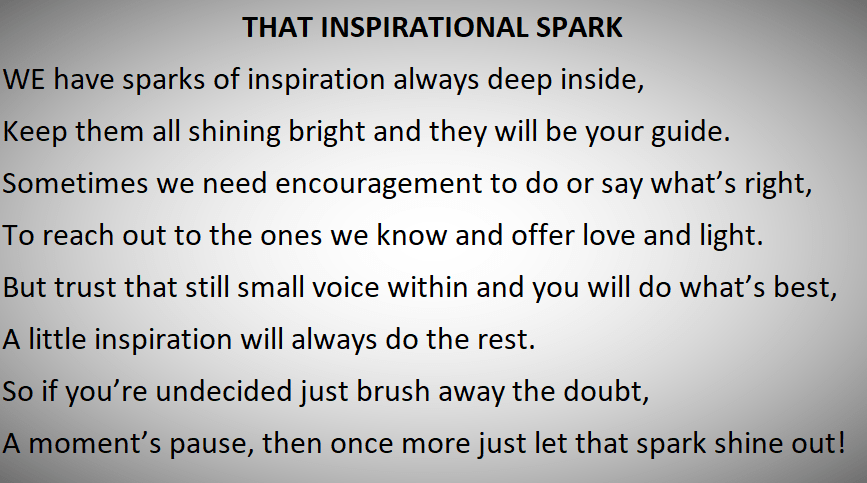
That Inspirational Spark

Arts, Poetry

That Inspirational Spark

Image
Christianity, Religion, Society

God’s love is unchanging

Failure is an opportunity to serve

John 18:15-27; 21:1-19

THE deflating knowledge that we’ve blown it can paralyse any further action. If it involved letting others down, we can’t face seeing them again. We feel awful. Peter must have shared that experience after he denied Jesus.

Jesus’ treatment of him is deeply encouraging. He doesn’t simply offer forgiveness (it is implicit) but does something far better. First, he comes to Peter in a familiar way: on the lake, where Peter is. What had first convinced Peter of Jesus’ divinity? A miraculous catch of fish (Luke 5:1-11). So, Jesus says, in effect, ‘Peter, I’m still the same, and I’m still with you.’

And then Jesus re-commissions him, the triple charge surely being a deliberate reference to Peter’s threefold denial: the restitution was complete, the slate was wiped clean. He was forgiven, he could begin again, and he had a ministry to fulfil.

Having failed himself, he could ‘feed the lambs’ – the new believers who would join the church – with greater sensitivity. Peter, who comes over as quite hard, thoughtless and insensitive, wouldn’t be quite the same again after this; he would be more compassionate.

Christians fail like Peter because they are human. Jesus’ example shows that we cannot hold their confessed sins against them. Compassion, forgiveness and restoration are to be complete, not partial. We are to have short memories for failings and long memories for achievements – not the other way round.

God’s love is unchanging, so we can be reassured that failure in serving Christ does not mean the end of our service for Christ.

Standard