
Arts, Books, Environment, Research

Book Review: Elegy For A River

LITERARY REVIEW

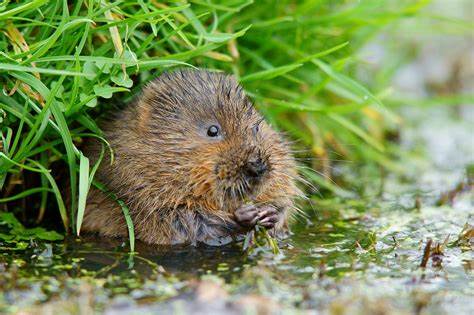
The water vole inspired one of the best loved characters of Wind In The Willows, but in real life they are as vicious as they are cunning. They’re also in danger of vanishing for ever.

IN Evelyn Waugh’s novel Scoop, William Boot is the hapless hero, who famously observed in his nature notes column for the fictional Daily Beast: “Feather footed through the plashy fen passes the questing vole.”

Such sentiments show how little Mr Boot really knew about voles. They are not feather footed and they do not quest but move with a sort of rapid waddle, says Tom Moorhouse, who knows a great deal more about the behaviour of the water vole.

Mr Moorhouse, a researcher at Oxford University’s zoology department, was offered the chance to study voles for a doctorate in 1999. His first discovery was that catching voles from a rowing boat is nobody’s idea of having a good time.

Motorboats sped past and threatened to overturn him; he was heckled by jeering champagne drinkers idling on narrow boats; and was bitten by voles in their fury at being caught.

On one trip he was rowing home through torrents of rain when one of his rowlocks snapped so that he had to punt, using his oar as a makeshift pole. It was at this moment that he passed a tourist, sitting on the embankment under an umbrella. His recollection: “I was sodden, chilled, late, tired, aggravated, filthy and smelt strongly of vole urine. The tourist took a photograph.”

Despite this, he writes very affectionately – even wittily – about voles and their nature, a model even for the sensible, kindly Ratty of Wind In The Willows. They have been living on our riverbanks for at least 14,800 years, although numbers dropped by an astonishing 99 per cent in the years between 1939 and 1998. And all because of the demand and fashion for fur coats.

In the 1920s, American mink were imported into Britain. Some of these minks, understandably reluctant to be turned into fashionable items, escaped.

For a while, their numbers were kept down by otters, who not only kill mink but are known to chew off certain parts of their anatomy to teach these incomers a lesson they won’t forget. But when otters were killed off in turn by farm pesticides washing into rivers, the mink had a free hand.

It was the author’s job to breed voles in captivity and then introduce them to 12 rivers in Oxfordshire. He did this with some success, not that everything ran entirely smoothly.

To keep track of the voles, researchers fitted the little creatures with tiny radio collars. This had an extraordinary consequence – the number of female babies dropped by half.

It seems that the collars were causing stress in the mothers, and a natural hormonal mechanism kicked in which raised the male birth rate. Female voles occupy distinct territories, while male voles roam widely in search of a good time. In times of crisis – a food shortage or, as we now know, when a zoologist fits a radio collar – it makes sense to give birth to more males, who will spread far and wide without amassing or building territory. Such is the wonder and cleverness of nature.

After such a discovery, Mr Moorhouse found himself lambasted in the media. “Scientists studying the causes of the water vole’s decline are to blame,” said one accusing newspaper headline.

Moorhouse concluded that the vole population will never truly recover until American mink are largely eradicated.

He then turns his attention to another weedy British native under threat from a brash American rival.

The white-clawed crayfish has been almost wiped out by the burly and aggressive signal crayfish, imported in 1976 for a scheme to harvest home-grown crayfish.

This idea could not have been more damaging. According to Moorhouse, there are now probably billions of signal crayfish in our rivers and streams, and they have ferocious appetites.

They eat small invertebrates, fish eggs, frog and toad spawn. They churn-up river beds, which is why rivers are not as clear as they used to be. “Signal crayfish have made rivers emptier of everything except signal crayfish,” he says.

And, yet, was this all for nothing? There is no thriving trade in British crayfish. We actually import crayfish from China, where it is cheaper to prepare them for sale in supermarkets.

What’s particularly enjoyable about this book is its upbeat tone. The author clearly enjoyed his research work, even when he was being bitten, jeered at, and sunburned.

Up to his waders in the rivers of Oxfordshire and beyond, it’s only towards the end of his cheerful journey that he strikes a gloomy note. What, he wonders, has all the effort been for?

“For all the real-world, on-the-ground, species-saving impact that my research has had, I could pretty much have just spent my time bumbling amiably around the British countryside,” he says. “My research achieved almost nothing of practical value.”

The problem is money. As it always is. He estimates that adequate conservation measures would cost around £71.2billion ($100 billion) a year worldwide. It sounds a lot, but he claims that America spends double that annually on fizzy drinks.

Moorhouse suggest that, if insurance agencies invested £7.1billion a year on coastal habitats, it would save them an annual bill of £37billion in claims for flood damage. If the seafood industry invested a similar amount, their profits would rise by £37.8billion.

Expressed in such terms the case is very convincing, but will government and big business really be persuaded in the current economic (Covid-19 pandemic) circumstances?

Standard
Arts, Health, Psychology

Resilience: Focus on Your Strengths

EMBRACING YOUR STRENGTHS

MANY people base their self-worth on external factors such as what others think of them or what job they do. As a result, their confidence is extremely unstable – an “off” remark or by having a bad day can cause their self-esteem to plummet. The key to resilience is to base your sense of self-worth on who you authentically are.

One way of doing this is to identify and focus on your unique strengths. Think of a time when you did something you were proud of. Now think about the strengths, skills, and talents you used to make this happen.

These are your signature strengths. Know that you carry these with you wherever you go. You can deploy these strengths whenever you are faced with a challenge, such as moving home, starting a new relationship or changing career. Embracing your strengths will give you confidence in your ability to handle any challenge that comes your way.

Standard
Government, Health, Japan, Society

Tokyo Olympics: Can the Games still go ahead?

OLYMPIC GAMES

IN ten weeks, the rescheduled Olympic Games are set to get underway. Yet, as the days count down, the opposition grows. A state of emergency in Japan’s capital city has been extended until the end of the month, with citizens there increasingly angry and hostile towards staging what they believe will be a “superspreader” event.

The plans of the organisers appear foolhardy rather than foolproof, with the playbooks of coronavirus protocols raising more questions than answers – the greatest of them being: Can the Olympics really go ahead?

Many residents in Tokyo have expressed disquiet and feel their views have been neglected by organisers. They have said it is a “recipe for disaster” if the Games go ahead and feel scared for their fellow citizens as the virus remains virulent and extremely dangerous.

While comprehensive playbooks have been published for athletes, officials and media, volunteers have received just a two-page pamphlet encouraging them to wear masks, use hand sanitiser and stay socially distanced.

Volunteers and residents are not expected to be subjected to the same level of coronavirus testing as other participants and will not be deemed as being in the “bubble”, so will be able to use public transport and visit restaurants and bars.

There is a firm belief that there is a significant risk for volunteers who have contact with people in the Olympic bubble, then go home to their families on public transport, who could very well be the ones who are contributing to this superspreader event.

From a moral standpoint, it is inconceivable that the Games should be held during a global pandemic, wasting money when so many people in the world are still dying.

What is really worrying the Japanese public is that little more than two per cent of the population have received the vaccine so far. Alarm bells are ringing that the Olympics are taking a priority over the vaccination programme.

A recent opinion poll showed 72 per cent of Japanese citizens want the Games to be cancelled or postponed again. Meanwhile, an online petition headlined, “Stop Tokyo Olympics”, has garnered more than 300,000 signatures since it launched last week.

Expert opinion

Professor Kentaro Iwata, who heads the division of infectious diseases at Kobe University Hospital, said: “This is not the right time and place to hold the Olympic Games. Some nations such as India are completely out of control. Many lives of people are at stake. Putting it altogether, this is not the right time to celebrate a huge human sport activity.”

Professor Iwata shot to prominence at the start of the pandemic when he boarded the coronavirus-hit Diamond Princess cruise ship and posted a YouTube video highlighting the poor infection control measures. Now he is similarly critical of the measures in place for Tokyo 2020.

“The measures are fairly sufficient to protect the athletes but the security of the surrounding people – such as coaches, drivers, media – are not really guaranteed under these measures,” says Iwata, who believes all spectators should be banned from the Games, not just those from overseas.

It recently emerged that Tokyo 2020 organisers had asked for 500 extra nurses to leave their hospitals and volunteer at the Games, with 10,000 medical professionals needed at the event overall.

Professor Iwata added: “They are trying to hold the Games and not minding the health of people because of the financial incentives.”

Holding the Games could set back the global fight against Covid-19. A risk of new variants of concern emerging and of infections being taken back to other countries should be of real concern, and particularly what happens after the Olympics.

Team GB athletes

Team GB’s top talent seemingly have no such concerns about how secure their bubble might be.

Olympic champion swimmer Adam Peaty says, “You are only as safe as your own behaviour… I don’t think it’s any different from being here. It’s about trusting the organisers but really it comes down to your own behaviour and making sure you are doing everything possible to not get Covid-19.”

Athletes will not have to quarantine when they arrive in Tokyo, but they will have daily coronavirus tests. They must wear masks except when eating, drinking, sleeping, training, or competing, and their movement will be restricted to their accommodation, training and competition venues.

Team GB have asked the Government if their athletes can receive both doses of the vaccine before they go to Japan, but they also have the option of using Pfizer jabs donated to the International Olympic Committee.

Team GB insists they are a very conditioned team in terms of Covid mitigation and have said they have every confidence that all 370 Team GB athletes will be on the start line fit and well and 100 per cent ready to compete.

Standard