Health, Science

Do I need to drink eight glasses of water a day?

BODY HEALTH

Intro: Carrying around a bottle of water is a badge of healthy living and we’re told to drink at least 8 glasses a day – however, experts say this advice has more holes than a leaky bucket

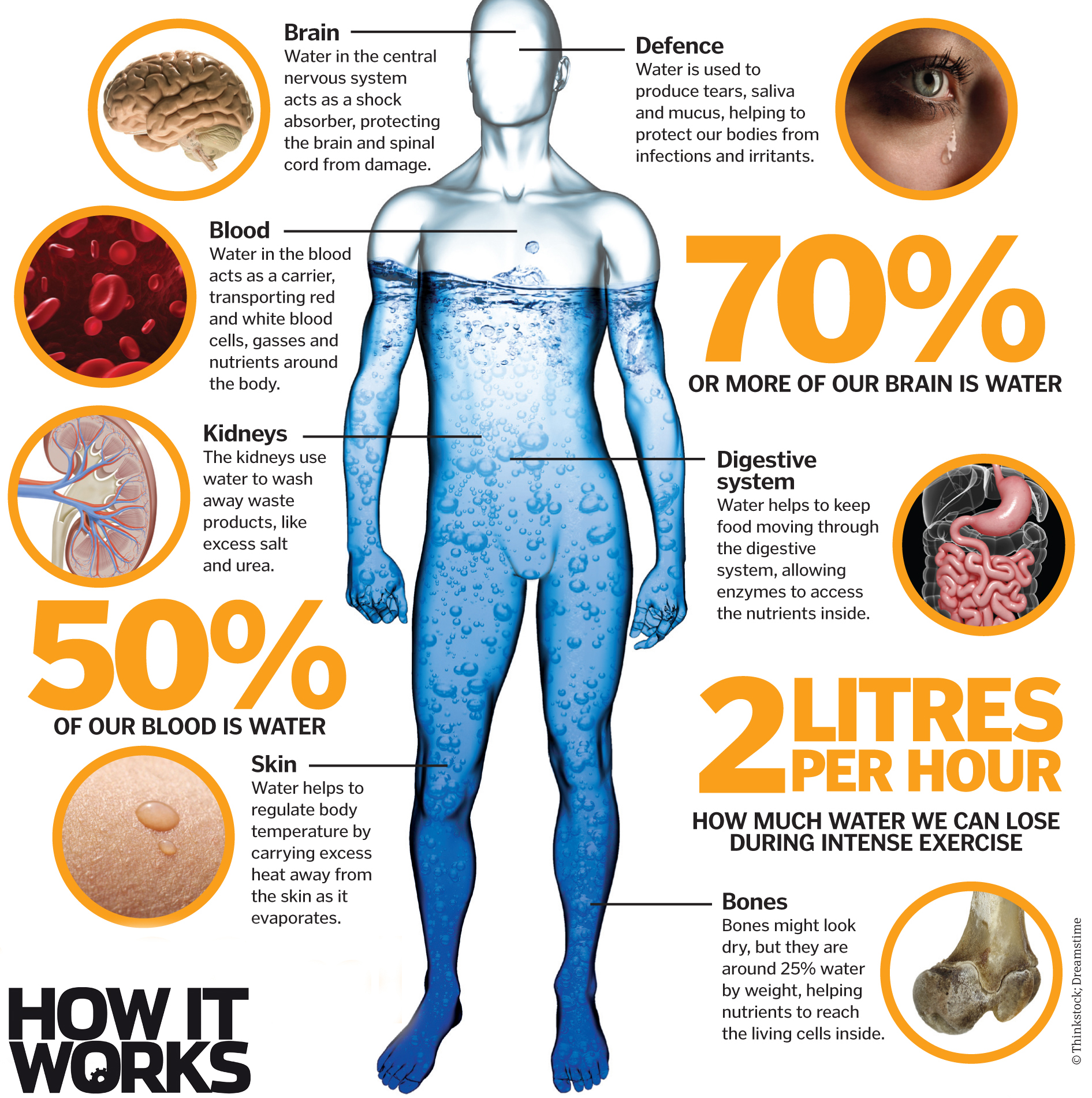
“EXPERTS” urge us to drink water to flush out toxins and combat the effect of ageing, but like so many health myths, the 8 glasses-a-day (or 2.5 litres) advice seems to have sprung from a misunderstanding. The US Food and Nutrition Board published advice in 1945 that a “suitable allowance of water for adults is 2.5 litres daily”. Had thirsty health-seekers not gulped down this snippet straight away, they would have read the next sentence, which stated that most of this will come from food. Healthy adults, they advised correctly, had no need to drink beyond their thirst. Nevertheless, the idea stuck, and the bottled water industry pours great efforts into continuing to persuade us to drink 2.5 litres a day.

On a day-to-day basis, forcing yourself to drink that much water is unnecessary and doesn’t give credit for the body’s highly attuned ability to keep you on an even keel. Your brain’s thirst centre continuously samples the blood to make you feel thirsty before you become dehydrated. Although over-drinking is rarely dangerous in normal circumstances, drinking large amounts of water during endurance sports may dilute body salts to perilously low levels, and can even be fatal.

Studies show there’s no health benefit to drinking more than the amount we need to satisfy our thirst (except perhaps the extra exercise from more trips to the toilet!)

Doctors recommend that adults living in a temperate climate and leading a sedentary lifestyle should drink 1.5 litres of water-based drinks to make up for water lost through sweating, urination, and even the water vapour in their breath – the rest of the water you need will be obtained by eating a balanced diet.

You need to up your water intake if you’re sweating from exercise, hot weather, or if unwell with a fever, diarrhoea, or vomiting. The elderly may need encouragement to drink, because the thirst centres in their brains become sluggish in old age; similarly, young children are less aware of their thirst drive, and need to have scheduled drink breaks through the day.

WATER IN AND OUT

Water in (typically):

. 60% of water comes from drinks

. 30% comes from food

. 10% comes from cells as a by-product of making energy

Water out (typically):

. 60% of the water you lose is from urine

. 25% is lost as water vapour as you breathe out

. 8% is lost through sweating

. 4% is lost in your faeces

. 3% is lost through saliva, tears, mucus, and blood

Appendage (how the body uses water)


. Should I drink until my pee is clear?

You may be familiar with the idea that the colour of your pee can tell if you are drinking enough. But don’t make the mistake of thinking that clearer is always better.

We may not know its name, but many of us are familiar with Armstrong charts from gym changing rooms or doctors’ surgeries. Named after their scientist creator, they are designed to tell you whether or not you are dehydrated by comparing the colour of your urine with yellowy-brown coloured stripes.

The chart suggests that you should drink more if your urine matches the darker stripes and stop when your pee matches the palest colours. These types of charts are very useful as an early warning of dehydration, especially in the elderly, infirm, or very young. But it’s a big mistake to think that paler is always better, and that you should drink until urine runs completely clear. By doing this, there’s a good chance that you’re putting yourself well on your way to fluid overload. If your urine is completely clear, it’s an ominous sign that your kidneys are having to work overtime to remove excess water from your system.

Totally clear urine is a signal that your body is trying to get rid of excess fluid.

Colour Matching Guide

– It’s healthiest for your pee to match the colours of the second or third colours down from the top of this chart (i.e. a pale straw yellow or translucent yellow).

Standard
Arts

Allowing life to rise up

LIFE’S CYNICISM

IN 1928, novelist and schoolmaster Ernest Raymond compiled a book of his favourite passages from literature, offering his thoughts as part of the narrative. At one point he comments on the tendency for cynicism among the literary greats of his time.

“But if despair is the truth for the majority,” he wrote, “it is no truth for me. Something instinctive and elemental rises up in me to resist such doctrines. I believe that indignant force to be life itself, rising to prove itself more good than bad!”

It’s a decision we have always made for ourselves. Personally, I hope as many people as possible agree with Mr Raymond – and life!


ROBERT LOUIS STEVENSON was not a notably religious man. Asked once by a priest if he was Christian, he denied the charge. But there is no doubt he was a spiritual man.

Travelling through France on a donkey, he spent a night sleeping under the stars on a wooded hillside. Waking, he had a strong feeling that he had been gifted something special. After loading his packs and walking off, he dropped coins on the grass to the amount of a night’s lodgings, hoping some poor person would find them.

Whether it was God or nature he was thanking did not concern him. He simply felt he ought to give thanks.

It’s a deep part of us, this need to give thanks, whether it be by prayer, by good deeds or by loving one another.

Standard
Britain, Economic, Energy, Environment, Government, Society

The looming crisis of an energy shortage

ENERGY RESERVES

NEVER in history have modern societies relied so heavily on secure supplies of electricity. Half a century ago, when the nation was last subjected to major power cuts, the effect was mainly on heating and lighting.

Now, however, the computer revolution has changed that completely.

People shop online, we work online, and much study is also done online. International trade and financial transactions depend entirely on a functioning computer network.

The same is true of everything from the police to the transport system. And a power shutdown or outage of only a few hours, even if scheduled, could do lasting damage.

In the same period, we have grown accustomed to a more or less regular and reliable power supply.

Thanks partly to investments made decades ago, the country still has a significant amount of reliable nuclear-generated electricity, plus a small, dwindling reserve of coal generation.

But both these sources are shrinking, because we have phased out coal for a greener environment and because we have failed to plan effectively to replace ageing nuclear plants. A great deal of our remaining energy now depends on gas, much of it imported.

The revolutionary switch to renewable energy, made in response to global warming and the climate change crisis, has been for some years the main focus of planning and building.

This is excellent when it works, but it is completely dependent on the caprice of weather, or on the simple realities of climate.

Solar power, predictably, is of little use here in winter. Wind power can vanish without warning or can be made unusable because the wind is actually too strong for safe generation. Proud announcements that the country has generated 50 per cent of its power through wind on any given day should be greeted with caution. On a windless day, that figure could be tiny.

Some of these problems are alleviated, but not solved, by connectors from our neighbours.

These can rescue us at awkward moments, but France, for instance, has run into major maintenance problems with its elderly nuclear generators, and winter weather simply increases pressure on scarce resources, everywhere. Up to a point, sudden shortages may be dealt with by paying large consumers to switch off, or by bringing in banks of costly and far-from-green diesel generators.

But the risk of actual power cuts, especially in weather such as we have recently been experiencing, is worryingly high.

We really are not very far away from imposed power cuts in our homes and offices, which – as well as leaving the old and vulnerable in the cold and the dark – will do serious damage to the economy.

So, it is perplexing to find that the Government has been relying on predictions by the Met Office in making its plans and calculations. Not only is the Met Office honest about the difficulty of long-distance forecasting, but winters in the UK can be very severe indeed.

Who knows what we would do if Britain once again faced a relentless long-term freeze such as that of 1962-63, itself the coldest since that of 1895?

Events such as the “Troll of Trondheim” often come with little warning. So do interruptions in supply, hugely important now we are no longer self-sufficient in gas.

The one thing that the Government can do is to be prepared for all eventualities. It has been many months since the poor state of our reserve capacity was revealed.  Let us hope that Ministers and officials have not wasted a single second in getting ready.

Standard