
MUSICAL-THEATRE
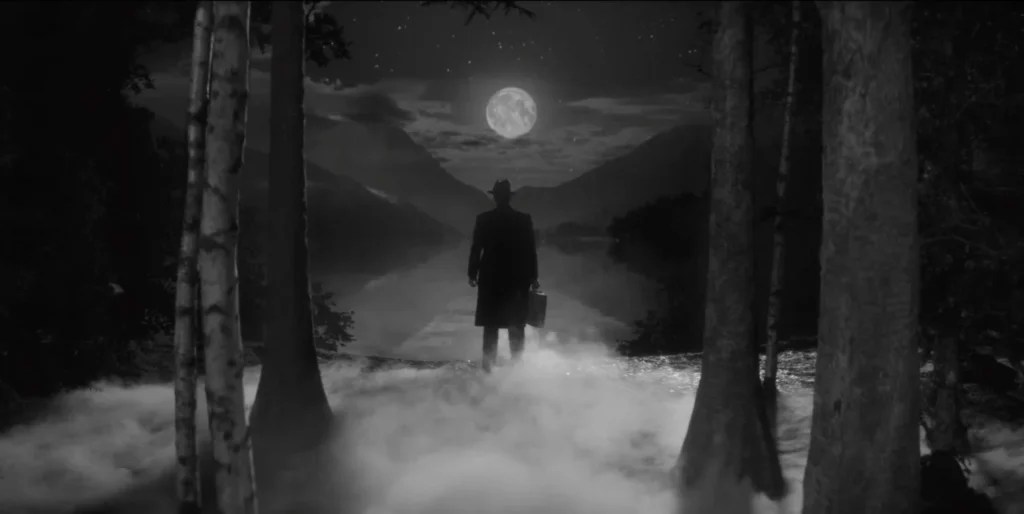
This powerfully imagined and atmospheric new piece of music-theatre, with an outstanding cast of Welsh singers, is a rare creation that blends film, opera, and drama. A screening such as this rarely makes it to television.
Originally an opera commissioned by OPRA Cymru, first shown as a film at the Edinburgh Film Festival last summer, Fires of the Moon (Channel 4/S4C) is not an example of an opera setting a book, but rather a free imagining of some scenes from Un Nos Ola Leuad (1961) by Caradog Prichard – a modern classic that has become familiar in translation as One Moonlit Night. It was a novel initially criticised for its unrelenting view of Welsh life but became accepted as a realistic reflection of a changing world.
Haunting and elegiac, the visual style conjures up the bleak landscapes of Wales – slate quarries, gloomy pubs, shining lakes and distant hills, with the evocative steam engine of Blaenau Ffestiniog puffing through. In the 1950s, a son Hogyn returns by train to visit his mother who, a generation ago, was confined to an asylum. But why? The story unravels from a youthful romance between Hogyn and Jini, replayed in a cinema that he watches with Jini as the usherette, and the tale pulls no punches in its depiction of an unforgiving society.
Commencing with what sounds like a deliberate homage to the music of Elgar’s The Dream of Gerontius (and even a nod to his unfinished Third Symphony), the beautifully judged score by Gareth Glyn nourishes the narrative. Most will not know how well the Welsh text is reflected musically, except that its subtitled vocal lines sit perfectly within the framework that Glyn creates in his idiom, at once romantic and eclectic, that draws on everything from film music to Britten and Berg.
The orchestral playing by the Welsh National Opera Orchestra is vividly textured and strongly audible under conductor Iwan Teifion Davies (who is also the co-librettist with Patrick Young). The scenario by Marc Evans, though arguably lacking in contrast, allows for a choral number in the pub, a tense tea-time scene, and an intricate quartet in the car on the way to the gloom of the asylum.
Tenor Huw Ynyr is outstanding as the grown Hogyn, as is Dylan Jones as Hogyn the child, writing the story on the old typewriter as well as living it. Annes Elwy is Jini; the tormented figure of Mam is powerfully drawn by soprano Elin Pritchard. The attack by her brother and the scene of her awkward removal to the Denbigh Asylum are the most painful parts of the story.
Chris Forster directs; the black-and-white cinematography under Ben Chads is consistently excellent, and the synchronisation of the voices – always the trickiest aspect of opera with the voices shot separately for film – is pretty good.
This is an absorbing piece of music-theatre which demonstrates the distinctiveness and best of Welsh music and film-making. It also offers a way forward for transforming the medium of staged opera into compelling film.
 Arts, reviews & current affairs