
Africa, Culture, Education, Government, History, Politics, Society, United Nations

The Mercator map does not give a faithful representation

UNITED NATIONS: CORRECT THE MAP

Intro: In Mercator’s design, Earth’s curvature is accommodated by making the countries close to the Equator seem smaller than they are and those nearer the North Pole bigger

Down the generations, it has been a constant fixture on practically every classroom wall.

But the traditional world map may be about to get an entirely new look.

The potential change follows a United Nations vote in favour of substituting the map we were all introduced to in childhood with one that shows Africa occupying rather more space than it currently does.

It has sparked a wave of diplomatic disagreement over whether this is a genuine attempt to give a more accurate picture – or just the latest example of politically motivated wokery.

The roots of the row actually date back quite some way – as far back as 1569, in fact – to Flemish cartographer Gerardus Mercator’s original design aimed at helping European explorers to plot their way across the oceans. While Mercator’s blueprint proved to be an excellent navigational aid, it failed to fully reflect how the world looks.

Essentially, it is all down to the Earth being round. Put simply, the laws of geometry make it impossible to give a faithful representation of a globe on a two-dimensional chart.

In Mercator’s design, the planet’s curvature is accommodated by making the countries close to the Equator seem smaller than they are and those nearer the North Pole bigger.

The upshot is that the entire African continent is shown as being roughly the same size as Greenland – despite actually being around 14 times larger.

Nonetheless, the geometric quirks of the Mercator map were warmly embraced in Victorian Britain. With major territories such as Canada lying far to the north and highlighted in vibrant red or pink on the map, the result was to make the Empire look even more far-reaching than it was.

The positioning of Britain at the centre of the world – originally because of its seafaring dominance, but later also due to the establishment of the Greenwich Prime Meridian – added to the effect.

TWO

The doubts about Mercator’s work surfaced in the late 19th century, as maps and atlases became more widely available. At the same time, people were becoming more knowledgeable about global geography and the relative size of individual land masses.

The beginnings of a backlash emerged in the 1970s as critics warned that both the development needs and economic potential of Third World nations were being underestimated as a result of the map – which was even described as an act of “cartographic colonialism”.

Fast forward to the early days of this century and the subject began featuring in mainstream television drama. In a 2001 episode of The West Wing – the NBC series based on the US presidency – a representative of the fictional Organisation of Cartographers for Social Equality had a meeting with presidential press secretary CJ Cregg (played by Allison Janney). According to a West Wing fan site, the group “felt strongly that traditional Mercator maps gave undue focus on the nations and people of the northern hemisphere”.

Nor does the White House connection end there. Some observers say Donald Trump’s obsession with Greenland, understood to be largely based on its strategic military location, is at least partly inspired by his belief that it’s a much bigger country than it actually is. 

By 2018, a group of cartographers had produced a new map called the Equal Earth projection – which has since been used by NASA. It was adopted in February this year by the 54 member states of the African Union on the grounds that it “more accurately represents the sizes of all continents, particularly Africa”.

According to the Correct The Map campaign – set up by African lobby groups in favour of the Equal Earth model – it would be possible to “fit the United States, China, India, Japan, Mexico and much of Europe into Africa and still have land to spare”.

Yet while the campaign warns that “we have based our understanding of Africa, and the world, on a map that is wrong” for more than four centuries, there is also a strong political undertone. “The Mercator map isn’t just about misrepresenting the size of the global south, it’s about power and perception,” it says.

According to one of the groups involved, from Africa No Filter, the campaign is part of a drive to stop the “world’s longest misinformation and disinformation” about Africa.

The group told the BBC: “Africa’s misrepresentation on world maps is not just a cartographic error, it’s a narrative issue.”

Kenyan geographer Kioko Muendo agrees: “Maps are more than just guides for travellers; they shape how regions are perceived politically and economically.”

At a meeting of the UN General Assembly in New York on September 4, member nations debated whether to adopt a Correct The Map resolution which described dropping the Mercator design as an act of “cognitive justice and memorial reparation”. Togo’s foreign minister Robert Dussey was one of the diplomats who argued for the change.

“A fair world begins with a fair map,” he said. “A map is never neutral. It shapes perceptions, influences how the place of peoples and continents in the world is understood.”

But US representative Yaryna Ferencevych was having none of it. In a damning volley of remarks, she told the hearing: “Instead of focusing on genuine problems of international peace, prosperity or good relations, this body is debating map projects from the 16th century and their role in promoting reparations and ‘cognitive justice’”.

Describing it as part of “a much larger and more radical ideological project”, she said: “This resolution mocks the work and purpose of this institution.”

THREE

Ms Ferencevych, a member of the US Senior Foreign Service, who has previously been posted to embassies in Afghanistan, Iraq, and the UK added: “Resolutions like this and the ideological agenda they promote are like barnacles on our work here.”

Despite her reservations, the motion was carried by a wide margin, with the UK among the 164 member states voting in support, while six abstained and one – America – voted against.

In a statement published on its website after the result was declared, the UN said: “The resolution does not ban the Mercator projection or impose a replacement. Instead, it encourages governments, schools, international organisations and technology companies to use the Equal Earth projection and other so-called equal-area maps when relative size matters, and teach the limitations of any flat map in representing a spherical planet.”

It added: “Behind that seemingly technical debate lies a larger argument about history and power: whether a map designed for European sailors in the 16th century has, over generations, distorted not only geography but perceptions of a whole, vast and complex continent.”

None of this will convince anyone at the Trump White House, of course. The maps on the wall of the Oval Office are unlikely to be changed any time soon.

And President Trump will presumably continue to believe that Greenland covers far more terrain than it actually does.
Standard
Arts, Broadcasting, Culture, Opera, Theatre

Fires of the Moon

MUSICAL-THEATRE

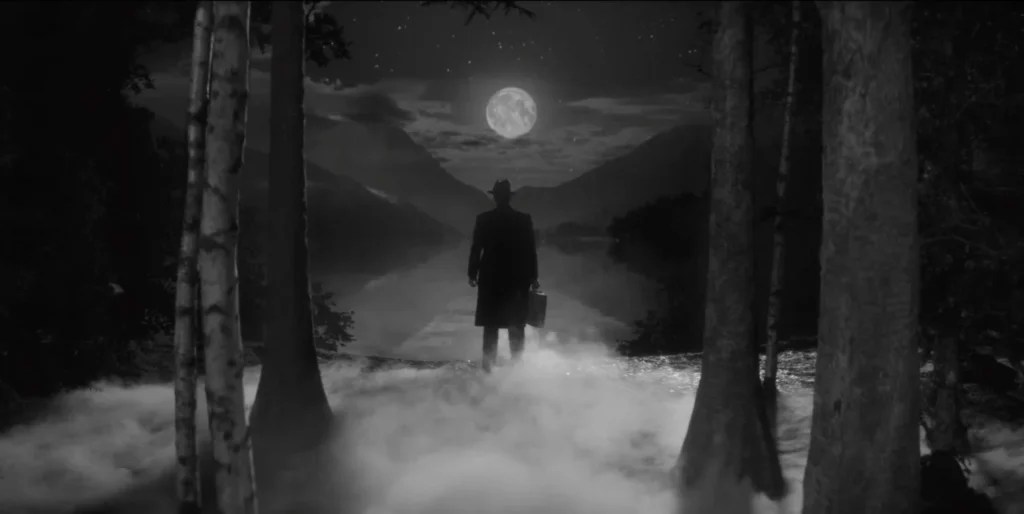
– Fires of the Moon is powerfully imagined and atmospherically shot Credit: Channel 4

This powerfully imagined and atmospheric new piece of music-theatre, with an outstanding cast of Welsh singers, is a rare creation that blends film, opera, and drama. A screening such as this rarely makes it to television.

Originally an opera commissioned by OPRA Cymru, first shown as a film at the Edinburgh Film Festival last summer, Fires of the Moon (Channel 4/S4C) is not an example of an opera setting a book, but rather a free imagining of some scenes from Un Nos Ola Leuad (1961) by Caradog Prichard – a modern classic that has become familiar in translation as One Moonlit Night. It was a novel initially criticised for its unrelenting view of Welsh life but became accepted as a realistic reflection of a changing world.

Haunting and elegiac, the visual style conjures up the bleak landscapes of Wales – slate quarries, gloomy pubs, shining lakes and distant hills, with the evocative steam engine of Blaenau Ffestiniog puffing through. In the 1950s, a son Hogyn returns by train to visit his mother who, a generation ago, was confined to an asylum. But why? The story unravels from a youthful romance between Hogyn and Jini, replayed in a cinema that he watches with Jini as the usherette, and the tale pulls no punches in its depiction of an unforgiving society.

Commencing with what sounds like a deliberate homage to the music of Elgar’s The Dream of Gerontius (and even a nod to his unfinished Third Symphony), the beautifully judged score by Gareth Glyn nourishes the narrative. Most will not know how well the Welsh text is reflected musically, except that its subtitled vocal lines sit perfectly within the framework that Glyn creates in his idiom, at once romantic and eclectic, that draws on everything from film music to Britten and Berg.

The orchestral playing by the Welsh National Opera Orchestra is vividly textured and strongly audible under conductor Iwan Teifion Davies (who is also the co-librettist with Patrick Young). The scenario by Marc Evans, though arguably lacking in contrast, allows for a choral number in the pub, a tense tea-time scene, and an intricate quartet in the car on the way to the gloom of the asylum.

Tenor Huw Ynyr is outstanding as the grown Hogyn, as is Dylan Jones as Hogyn the child, writing the story on the old typewriter as well as living it. Annes Elwy is Jini; the tormented figure of Mam is powerfully drawn by soprano Elin Pritchard. The attack by her brother and the scene of her awkward removal to the Denbigh Asylum are the most painful parts of the story.

Chris Forster directs; the black-and-white cinematography under Ben Chads is consistently excellent, and the synchronisation of the voices – always the trickiest aspect of opera with the voices shot separately for film – is pretty good.

This is an absorbing piece of music-theatre which demonstrates the distinctiveness and best of Welsh music and film-making. It also offers a way forward for transforming the medium of staged opera into compelling film.

Standard
Arts, Christianity, Culture, Poetry

TS Eliot’s ‘Ash Wednesday’

ASH WEDNESDAY

Intro: The prayers of Lent are a key guide to Eliot’s obscure sequence of poetry

Sometimes, people read TS Eliot’s sequence of six poems, Ash Wednesday, in the hope of better understanding this first day of Lent in the Western Christian Church. The poem is meditative and pivotal which marks his conversion to Anglicanism, and chronicles a journey from spiritual despair to tentative faith. 

Structured around the Lenten season, the poem moves through themes of repentance, purgation, and the desire for divine, transcendent love amidst the emptiness of modern life.

Knowledge of Ash Wednesday – and the rest of Lent – which falls on February 18 this year, is a prerequisite to understand Eliot’s poetry.

Ash Wednesday is obscure. It begins: “Because I do not hope to turn again.” This is a quotation from Guido Cavalcanti, who died in 1300, a friend of Dante’s. How the reader is meant to know that, I’m not sure.

The words had been translated by Dante Gabriel Rossetti in 1861, as: “Because I think not ever to return”, a reference to Cavalcanti’s exile from Tuscany. But Eliot knew that “to turn again” is an aspect of repentance, as the Authorised Version of the Bible in 1611 translated the Greek word metanoia, “change of mind”, found in the New Testament. The Ash Wednesday Epistle, from the prophet Joel, begins: “Turn ye even to me, saith the Lord, with all your heart.”

In St Mark’s Gospel, the first words of Jesus are: “Repent and believe the gospel,” and those are now one of the forms of words to accompany the imposition of ashes on Ash Wednesday. But in Eliot’s day the Latin formula was: Memento, homo, quia pulvis es, et in pulverem reverteris, “Remember man, that thou art dust and unto dust thou shalt return.” In his poem, Eliot, with his Cavalcanti quotation, picks up both the return to dust and the turning again or repentance.

In Ash Wednesday, Eliot incorporates unsignalled quotations from church prayers. In a letter to Bishop George Bell of Chichester in 1930, Eliot addressed Ash Wednesday’s obscurity: “Most of the people who have written to say that they couldn’t understand it seemed to be uncertain at any point whether I was referring to the Old Testament or to the New; and the reviewers took refuge in the comprehensive word “liturgy”. It appears that almost none of the people who review books have ever read any of these things!”

In Part I of Ash Wednesday Eliot quotes the popular Catholic prayer, the Hail Mary.

In Part II he uses the question “Shall these bones live?” to make reference to the extraordinarily vivid passage in Ezekiel 37, where dry bones are reclothed in flesh and live.

In Part III, on the stairs, he ends with, “Lord, I am not worthy”, a prayer in the Mass before Communion: “Lord, I am not worthy that You should enter under my roof; but only say the word, and my soul shall be healed,” an echo of the Centurion’s words in Matthew 8:8.

In Part IV, “And after this our exile” is taken from a medieval prayer, the Salve Regina, where Mary is asked to “Show unto us the blessed fruit of thy womb, Jesus.”

In Part V, “O my people, what I have I done unto thee” is taken from the Improperia or Reproaches in the Good Friday liturgy, based on the prophet Micah (5:3).

In Part VI, the last line, “And let my cry come unto Thee” is also in the Good Friday liturgy, from Psalm 102 (101 in the Vulgate) – in Latin: Domine, exaudi orationem meam, et clamor meus ad te veniat.

Before that, Eliot puts a line, “Suffer me not to be separated”, which is from the 14th-century prayer Anima Christi (taken up by Ignatius Loyola, founder of the Jesuits). The context is: “Within Thy wounds hide me /Suffer me not to be separated from Thee.”

All these would have been very familiar to a practising Roman Catholic, less so to most Anglicans and utterly unfamiliar to the leading critics of the 1930s.

Standard