
Afghanistan, Britain, Government, Politics, Society, United States

The failure in Afghanistan has been a military and political disaster

AFGHANISTAN

LET’S be in no doubt. The UK’s latest Afghan war – the fourth since 1839 – has ended in abject failure. The shameful retreat was down to a bungled withdrawal of US forces by Joe Biden, who’s lacklustre approach leaves his leadership open to criticism of weakness and inadequacy. What extraordinary and pitiful scenes the world has witnessed in recent days: bodies falling from the sky, the Taliban cheering in Kabul and the mighty America humbled. The Taliban on the ground is operating akin to the Nazis as they go door-to-door in neighbourhoods seeking retribution against those that supported the West. There is a growing sense of unease, and rightly too, as the West awaits what might come next.

Britain scuttled out at the same time, the prime minister telling MPs on the day of Mr Biden’s announcement that there can be no military victory in Afghanistan. What a shameful assessment given all that has been sacrificed in terms of blood and treasure plundered. The world is witnessing the extent of the military and political catastrophe after twenty years of miscalculation and misadventure.  

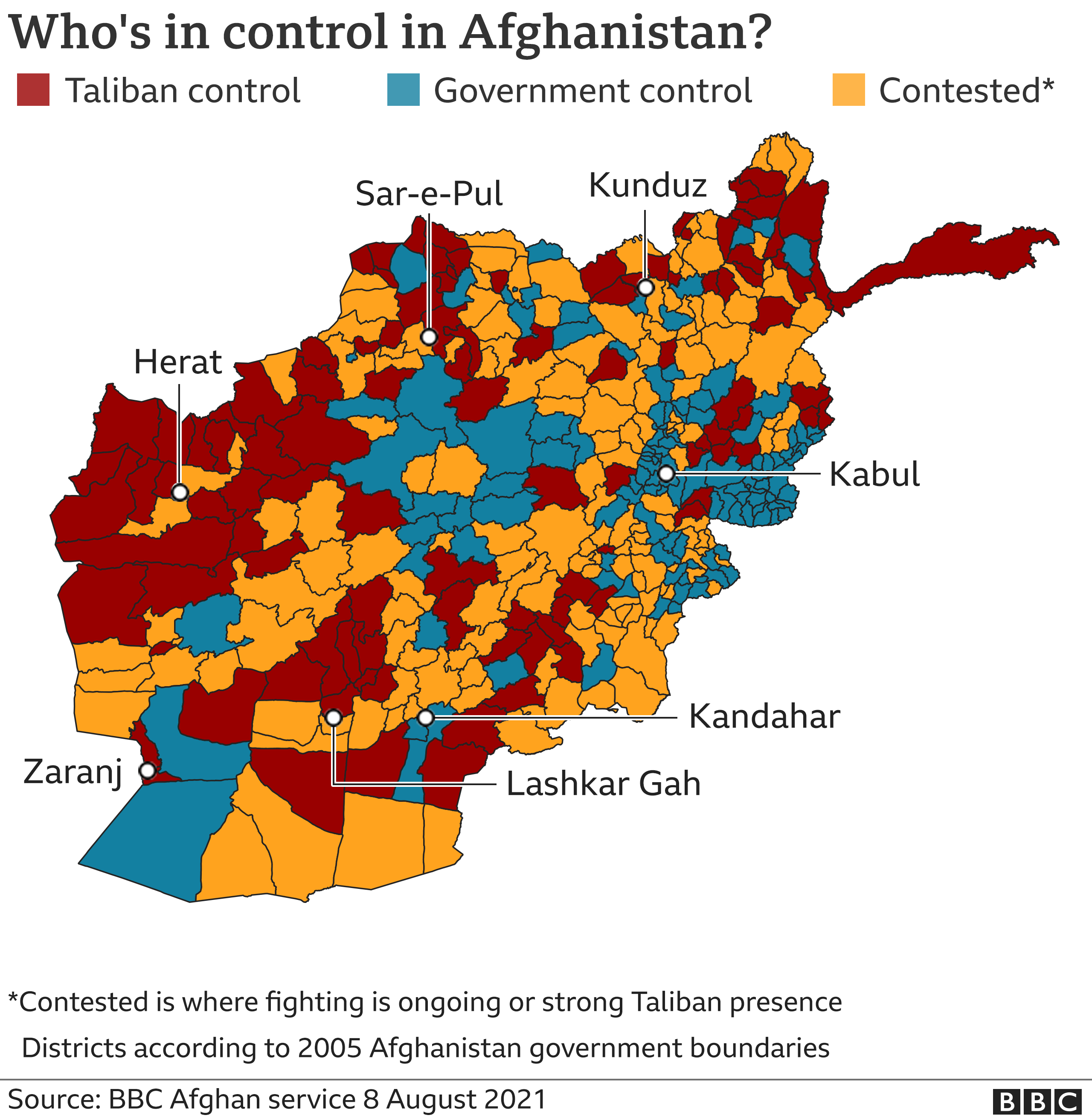
The UK is currently driven by a desire to stay close to the US. But America is a superpower, able to shrug off defeats and move on. The blow of losing Kabul is felt more deeply in Britain shorn itself of substantial global influence. And, yet, this has led the UK to take Washington’s lead in military affairs. In Afghanistan, the US judgment that a combination of special forces, local proxies and air power would wipe out domestic resistance to a military occupation was flawed. The Afghan security forces that NATO trained were exposed as a shell and collapsed at a time when it was most needed. In 20 years of relentless fighting, more than 170,000 Afghans have lost their lives. The death toll continues to rise as the barbarism of the Taliban metes out savage reprisals against local Afghans and interpreters who helped western intelligence services and the British Army in a quest for democracy and more moderate living. In June, almost 1,000 Afghans were killed in the simmering civil war. A few weeks later half the country was under Taliban control.

Western politicians prefer to tell a story of progress in Afghanistan. But that could all be unravelled now the Taliban are in control. Since 2001, the US has spent nearly $145bn (£106bn) trying to rebuild Afghanistan. By 2019, the average Afghan student received four years of schooling (twenty years ago it was just two). As prosperity was building, Afghans were known to have lived healthier and longer lives and the country is certainly wealthier than it was in 2001. But as many will soon realise the state can only function with international aid. Aid funds three-quarters of total public expenditure.

Elections were held in Afghanistan but the institutions that support democracy were not allowed to take root. One elected president, Hamid Karzai, fell out with the Americans so badly he threatened to join the Taliban himself. The other, Ashraf Ghani, fled as the Taliban advanced. Almost every other Afghan ruler in the 20th century was assassinated, lynched or deposed. A western-made “liberal democracy” has fallen into the hands of religious fanatics with close links to al-Qaeda. It must be clear by now that nations cannot be hustled at the barrel of an American gun into the postmodern age, especially when they have not been allowed to come to terms with modernity.

In Afghanistan, the battle for hearts and minds was lost long ago. Without hearts and minds, one cannot obtain intelligence, and without intelligence, the insurgents will remain undefeated.

The Royal United Services Institute, a security thinktank, describes the outcome in Afghanistan as “strategically worse than the situation prior to the 9/11 attacks – a Taliban state, with terror groups already baked into it, with nowhere else to turn for major support other than Beijing”.

The collapse of the Taliban in 2001 encouraged the US to adopt a similar strategy in Iraq and Libya. After 20 years of disastrous results, British ministers should reach for a new approach. After all, relations between London and Washington have historically never been entirely unconditional. Yet, whilst the government speaks of creating new special forces regiments and naval “littoral strike groups” for international interventions, Britain needs to learn its own history. It used to station military forces around the world to maintain its empire. It should think again before doing so for someone else.
Standard
Afghanistan, Britain, Government, Politics, Society, United States

The tragedy in Afghanistan shames the world

AFGHANISTAN

COMEBACKS have rarely been as brutally quick as the Taliban’s dramatic surge across Afghanistan since the start of July.

Eleven regional capitals have fallen to the insurgents in six days and hundreds of thousands of Afghans have fled their homes, fearing life under Islamic fundamentalism.

Funded by an annual budget believed to be in the region of $1.5bn, cash comes direct from drug-running, extortion, and the imposition of local taxes in areas and regions the Taliban control. Their forces include up to 85,000 fighters and their weaponry include AK-47 assault rifles, rocket-propelled grenades, mortars, other small rockets, anti-aircraft and anti-tank weapons, suicide bombers, Improvised Explosive Devices (IEDs), plus weapons captured from the Afghan army.

It is time to ask how a group reviled as savage religious extremists and sponsors of international terrorism could recover from utter defeat two decades ago to become Afghanistan’s rulers-in-waiting.

Does the Taliban’s apparent impending victory mean that the country is destined to hurtle back to the brutal medieval regime that ruled there in 2001?

Day by day, the plight of Afghanistan and its people grows ever more desperate.

Emboldened by the withdrawal of Western troops, the resurgent Taliban is sweeping through the country with alarming speed.

Nearly a third of the 35 provinces are under their control, with insurgents in striking distance of Kabul. The fact that 600 British troops – mostly from the Parachute Regiment – are being sent to oversee the immediate evacuation of all our nationals suggests the fall of the capital is just days away.

There are already reports of atrocities – summary executions, torture and mutilation. If the Taliban take the whole country, this wicked and hideous persecution will again become the norm.

This is not a problem the West can brush aside. American invaded after 9/11 to oust the Taliban and stop Afghanistan being a sanctuary for terror groups. Following their withdrawal, how long before the jihadis are plotting mayhem in the West?

Meanwhile, with up to 100,000 refugees fleeing each month, many will soon begin arriving in Europe seeking asylum. This is the world’s problem. Who will help Afghanistan’s fragile Government fight off the barbarians at their gate?

President Biden’s woefully nonchalant remarks that Afghans “need to fight for themselves” suggests America has shamefully washed its hands of its responsibilities.

To his credit, UK Defence Secretary Ben Wallace, a former soldier, tried to put together a British-led coalition. But without US engagement, it was never likely to happen. The lily-livered UN stands impotently by. The Islamic world is troublingly muted.

Afghanistan’s plight will be distressing to British soldiers who lost 455 colleagues trying to keep the Taliban out. Not for the first time, brave men and women who gave so much for our safety are left to rue the cost of politicians’ foreign misadventures. A tragedy that shames the world.

Standard
Afghanistan, Britain, Iraq, Society, United States

20 years after the ‘War on Terror’, abandonment leaves a bitter legacy

ESSAY

THE scene is a familiar one. On the dusty and sandy plains of Afghanistan, a trail of refugees’ head for the beleaguered capital. On the streets of Kabul itself, frequent car bombs are killing members of the government along with innocent bystanders.

In the western city of Herat, people huddle in their homes as enemy rockets pound down. And in the southern province of Helmand – where hundreds of British servicemen lost their lives in recent years – dozens of civilian bodies lie rotting on the country roads.

Such is the lawless state in Afghanistan, where the resurgent Taliban have made extraordinary territorial gains in recent days. Across much of the country, their white flag now flies unchecked.

The situation in Afghanistan now is as serious as it has ever been. It’s a quarter of a century since the Taliban swept to power claiming vast swathes of land, imposing a hideously oppressive Islamist regime that treated women as slaves and banned films, TV, music and dancing.

Perhaps more significantly, in just a few weeks it will be exactly 20 years since the terrorist attacks of September 11, 2001, in New York and Washington.

It was in reaction to these atrocities that Tony Blair and George W. Bush launched Operation Enduring Freedom, promising to dismantle the al-Qaeda training camps, overthrow the Taliban and usher the Afghan people into a brave new world of democracy.

‘Operation Enduring Freedom’. How darkly ironic that mission sounds today.

For the Afghan people, the cause of freedom now hangs by a thread. Ever since the spring, when President Joe Biden announced that the last U.S. personnel would leave at the end of this month, the Taliban have swept across much of the country again.

Only a few weeks ago, U.S. intelligence analysts reportedly warned that without Western intervention, the government in Kabul might have just six months left. And now, with an estimated 85,000 Taliban fighters pressing towards the capital, that bleak prognosis looks decidedly optimistic.

Yet this is merely part of a bigger picture.

Twenty years after the War on Terror began, it’s time that we took a long, unsparing look at what it really achieved.

To revisit reports from 2001 feels like entering a different world. At the Labour Party conference, Tony Blair tells his delegates and party members that he intends to fight for freedom “from the deserts of Northern Africa to the slums of Gaza, to the mountain ranges of Afghanistan.”

“Let us re-order this world around us,” he says grandly, as if there are no limits to his ambitions. A few weeks later, his close friend Bush appears before the U.S. Congress, pledging to dismantle an “Axis of Evil” that threatens the peace of the world. He names three regimes in particular: Iran, Iraq and North Korea.

How arrogant, how criminally naïve this sounds today. The regime in Iran is more hard-line, its position apparently as secure as ever. North Korea, too, remains stubbornly defiant, having built an estimated stockpile of some 40 nuclear weapons.

As for Iraq, that desperately sad story has become only too familiar. However you measure it, the carnage since the Anglo-American invasion of 2003 has cost at least 150,000 lives, and perhaps more than a million according to some estimates.

I say ‘has cost’, rather than ‘cost’, because Iraq is still not at peace. It has never been at peace. Even now, the Baghdad government and its Western sponsors are fighting a low-level Islamist insurgency, with bombings and killings almost every single day. What, then, is the verdict on the so-called War on Terror?

There’s no doubt that some of its progenitors, at least, had noble motives. When Blair says he genuinely wanted to export Western freedoms to Afghanistan and Iraq, it’s not hard to disbelieve.

But the verdict must be utterly damning.

How can this naïve, undefined, unachievable crusade go down in history as anything other than a catastrophic failure?

Take the cost in lives first. Some 456 British servicemen and MoD civilians were killed in Afghanistan, and a further 179 in Iraq. And for what?

As the Taliban surge towards Kabul, many of the bereaved must be asking themselves: was it all in vain?

Then there’s the financial cost. In June this year, the Ministry of Defence admitted that the war in Afghanistan cost British taxpayers a staggering £22 billion, with the campaign in Iraq estimated to have cost a further £10 billion.

The grim irony, of course, is that our politicians blew all that money just before the financial crisis of 2007-08, from which the Western economy has never fully recovered. And given that Britain was about to be plunged into a long period of economic austerity, many will argue that we should have saved it for other things.

One of the greatest costs of all, though, is much harder to measure. It’s the price in moral capital and political credibility, which Britain and the U.S. are still paying to this day.

Remarkably, the invasion of Afghanistan was much closer in time to the end of the Cold War than it is to us today. The U.S. was the world’s unchallenged “hyper-power”, the march of democracy seemed unstoppable, and some American thinkers were even proclaiming the “end of history”.

The events of the last two decades, however, turned that story on its head. For the Iraqi people, the Allied invasion brought a living nightmare. For the people of Afghanistan, meanwhile, it brought a gruelling, apparently interminable campaign, which now seems likely to end as it began – with the Taliban as masters of their native land.

No wonder, then, that America’s image abroad has plummeted over the last 20 years. According to the respected Pew Research Centre, people in almost ever major Western country now have an unfavourable impression of the U.S.

In Japan, its popularity has dropped by 30 per cent since 2001. In France, too, it has fallen by 30 per cent, in Germany by almost 50 per cent. And what of faith in democracy – the one thing for which Blair and Bush claimed they were fighting?

According to an extensive international study by Cambridge University, satisfaction with democracy has never been lower. In almost every country on earth, faith in the Western capitalist model has plummeted in the last 20 years – especially among the young, to whom the wars in Afghanistan and Iraq are simply incomprehensible.

And here’s another brutal irony. At the very point when Britain and the U.S. were wasting huge sums of money and with so many lives expended on their Middle Eastern misadventures, the real threats to Western democracy were hauling themselves off the canvas and preparing to rebuild.

The winners of the War on Terror were not the British and American people, and still less the natives of Afghanistan and Iraq. They were Vladimir Putin and Xi Jinping, the authoritarian strongmen of Russia and China, who watched with undisguised satisfaction as the Western powers discredited their own values.

That is the real legacy of the past 20 years: a shattering reversal of Western progress, for which we will be paying – quite literally – for the rest of our lives.

But perhaps it would be wrong to end by talking about ourselves. After all, the greatest casualties of the last two decades came among the people of Afghanistan and Iraq themselves, who have never known a single day of peace since the War on Terror began.

Nobody can say how their lives would have turned out if we had left well alone. No doubt they would have endured more than their fair share of tragedies anyway. Afghanistan has always been a turbulent and war-torn country.

What can be said, however, is that they have paid a terrible price for our politicians’ hubris and folly. And if we fail to learn that lesson, it would be the greatest betrayal of all.

. Appendage

Map highlighting who controls Afghanistan. Map Source: BBC

Standard