
INFORMATION AGE
WE live in an information age in which modern technology makes it easy to gather large amounts of information on almost every aspect of our lives. However, on its own this information is of only limited value – it needs to be organised and analysed to be of practical use.
INFORMATION about population numbers have been collected since ancient times (see Appendage), but the science of analysing and making sense of data – statistics – is relatively recent. Although now not usually considered to be a branch of mathematics, statistics relies on mathematical analysis to interpret information and is closely linked to the area of mathematics known as probability theory.
Chance and probability
The beginnings of probability theory came from the fascination that two 17th-century French mathematicians had with games of chance. Blaise Pascal and Pierre de Fermat discussed, in a series of letters, a method of calculating the chances of success in gambling games, and they were the first to give the subject of probability a scientific treatment.
What they discussed was a mathematical way of determining the probability of a particular outcome occurring in a random event, such as tossing a coin or throwing a dice. When a coin is tossed there are two possibilities: heads or tails. Each is equally likely: there is one chance in two that the coin will come up heads (or tails), or in other words the probability is 1/2. The six faces of a dice give one chance in six of throwing any particular number, a probability of 1/6. In games using more than one dice, or a deck of cards, or a roulette wheel, the calculation becomes more complex but is essentially built from basic principles and is the same. From this discussion of gambling games, a theory of probability evolved.
The idea was further developed by the next generation of mathematicians. French mathematician Abraham de Moivre discovered a pattern to the probability of outcomes, now known as normal distribution and represented graphically as the bell curve.
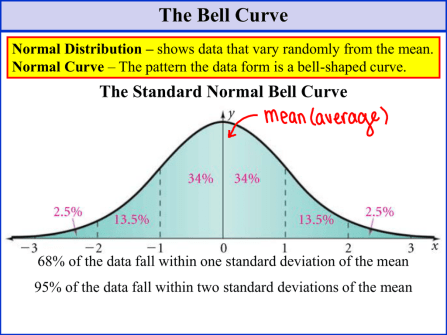
[Bell Curve: Normal distribution] – When certain values (such as height) are plotted against the number of occurrences of that value (how many people are of a specific height), the result is often a bell-shaped curve – the normal distribution. The most common value, at the peak, is the mean (average).
Detecting patterns
The pioneering work in statistics was done by de Moivre, who used data about death rates and rates of interest to devise a theory of annuities, which enabled insurance companies to compile tables of risk for life assurance based on scientific principles. This application of mathematics to data in records was at first known as “political arithmetic”, and, as patterns emerged in collections of data, research began into their underlying statistical laws. To begin with, statistics was concerned with social issues, and advances in sociology and criminology were made by the Belgian mathematician Adolphe Quetelet, who introduced the concept of the “average man”. He also believed mathematics lay at the heart of every science, and statistical analysis could be applied to data of all kinds. Perhaps the area where this had greatest effect was medicine, where an important new study, epidemiology (occurrence of disease in populations), developed from medical statistics.
As more practical use was made of probability theory and statistics, the mathematics behind them was developed by various mathematicians, including the Frenchman Adrien-Marie Legendre, the German Carl Friedrich Gauss, and the Russian Andrey Nikolaevich Kolmogorov, whose systematic approach to the subject forms the basis for much of modern probability theory.
Modern statistics
Statistics plays a key role in much of modern life. Governments collect and analyse a wide range of personal data to detect patterns that can help shape policies. Businesses use market research to gather information about potential customers and apply statistical methods to analyse the data. In science, statistics and probability are central to subjects such as quantum theory and are also essential to many other subjects, from psychology and economics to information science.
Data Samples
In practice, the data used for statistical analysis must be sound for it to produce useful results. The data must be collected using a valid method that measures what is intended, and the data must be accurate. It is also essential that the set of data is large enough and constitutes a representative sample. For example, in general public opinion polls the right questions must be asked in an unambiguous, neutral way; sufficient numbers of people must be polled; and, as a whole, the respondents must be representative of the population (for instance, in age and gender).
Applications
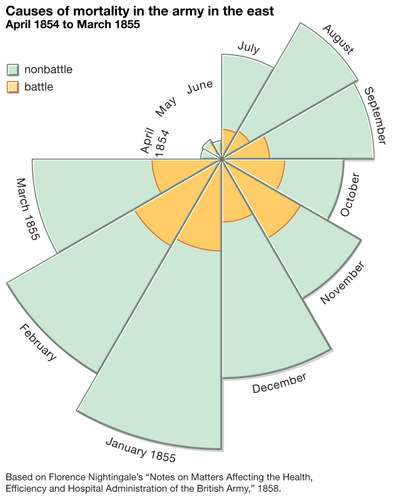
Florence Nightingale’s “coxcomb” graph – This graph devised by Florence Nightingale shows the relative causes of death among soldiers in one 12-month period during the Crimean War (1854-56).
. Coxcomb graphs – Working as a nurse for British troops during the Crimean War, Florence Nightingale kept records of troop deaths and later used the information to create what are now called “coxcomb” graphs. These highlighted the number of deaths that were not directly caused by combat but by factors such as wound infection and disease.
. Computerised Modelling – The development of probability and statistics gave scientists new ways to analyse and conceptualise the physical world.
Many natural systems are influenced by numerous factors and exhibit chaotic behaviour. For example, influences on the weather include air, land, and sea temperatures, winds, sea currents, humidity, and the amount of sunlight. Minute changes in any one of these factors can have a profound effect on the weather. Because of this, weather forecasting relies on numerical models in which statistical methods are used to arrive at predictions that have various degrees of probability of being correct.
. Quantum Theory – The currently accepted theory of the nature and behaviour of matter at the subatomic level, quantum theory uses probability as one of its fundamental tenets. For example, according to quantum theory it is impossible to know precisely the location and momentum of subatomic particles such as electrons “orbiting” the nucleus of an atom; it is only possible to specify regions – known as clouds – where particles may be located with the highest probability.
Appendage –
Early Censuses
The earliest known census dates from ancient Babylonian times, about 3800 BCE, and recorded the human population and agricultural data.
Many of the other ancient civilisations also regularly recorded population numbers, often for the purposes of taxation. In the Middle Ages, probably the best-known census is the Domesday Book, which was instigated by William I of England in 1086 to tax the recently conquered population. These early censuses were simply records of numbers because mathematical techniques for analysing data had not yet been developed.


 Arts, reviews & current affairs