PRINCE William revealed his anger at the BAFTAs on the lack of diversity among this year’s BAFTA nominees.
He announced a “full and thorough review of the entire nomination process”.
The prince, who is president of the academy, raised his concerns after all 20 stars nominated for acting gongs were white – and the shortlist for best director was all-male.
At the Royal Albert Hall, he said: “Both here in the UK and many countries across the world we are lucky to have incredible film makers… Men and women from all backgrounds and ethnicities enriching our lives through film.
“Yet in 2020 and not for the first time in the last few years we find ourselves talking again about the need to do more to ensure diversity in the sector and in the awards process. That simply cannot be right in this day and age.” He also appeared to refer to productions such as The Crown when he added: “I don’t know whether I should be proud or slightly alarmed of the winners over the last decade who have portrayed members of my own family.”
The all-white nominations in the actor, actress, supporting actor and supporting actress categories come four years after BAFTA chief executive Amanda Berry said she wanted the awards to be as “diverse as they possibly can be”.
Best film went to 1917, and Sam Mendes its director won the BAFTA Director award. Joaquin Phoenix won the Best Actor in Joker and the Best Actress Award went to Renee Zellweger in Judy.
Original Screenplay went to Parasite, with Jojo Rabbit winning the award for Adapted Screenplay. Michael Ward, star of Blue Story, won the award for Rising Star.
Supporting Actor was won by Brad Pitt, in Once Upon A Time In Hollywood, with Supporting Actress going to Laura Dern, for her part in Marriage Story.
IT was twenty years ago when Sam Mendes won a coveted Golden Globes double – best drama film and best director – for his debut feature, American Beauty.
Then, Mendes was a 34-year-old movie novice when he won in 2000, precociously brilliant but already well established as a theatre director.
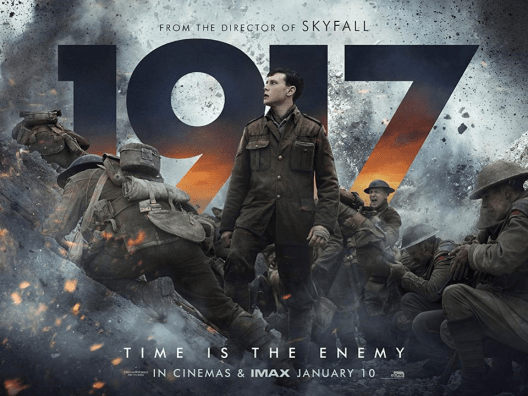
On the eve of this year’s Oscars Mendes looks as if he’s done it again. 1917 is a master stroke. He has fed two decades of film-making experience into this wonderfully powerful picture.
. Film Trailer –
During the centenary years of World War I, some terrific films were made about the conflict. The pick of them was a remarkable 2018 documentary, They Shall Not Grow Old, a treasure trove of original but newly colourised footage which showed that no big-screen dramatisation of trench warfare would ever be quite right, for one striking, if prosaic, reason: in real life, soldiers’ teeth, almost without exception, were terribly rotten.
In every other respect, however, Mendes propels his audience back to the Western Front with the same extraordinary, visceral power.
That’s due to both his skill as a film-maker and the bold simplicity of his story. Bold, because he resists the temptation to introduce layers of plot or characterisation.
He even resists the urge to tell us anew what, thanks to all those familiar animal metaphors, we already know – that our brave soldiers were lions led by donkeys, going like lambs to the slaughter.
Instead, this is an account of a perilous but straightforward mission by a pair of lance corporals, who are handed the challenge of delivering a message intended to save the lives of 1,600 men. To do so, they must cross battle-ravaged no-man’s land and the abandoned German front line at immense personal risk.
It is a partly fictionalised tale, but is inspired by the director’s late grandfather, Alfred Mendes, to whom the film is dedicated.
There are conflicting accounts of that inspiration, with some saying that Alfred Mendes himself delivered such a message. Other accounts suggest that he told his grandchildren stories about others who did so.
EITHER way, this is an intensely personal project. Mendes would undoubtedly be the first to concede his debts both to his Glaswegian co-writer Krysty Wilson-Cairns and, above all, to veteran British cinematographer Roger Deakins, who won an Academy Award for depicting the future in Blade Runner 2049 and is surely a strong contender for another – for evoking the past.
He takes us with these men on their harrowing journey by filming what appears to be (but isn’t quite) a single continuous take. The effect is thrillingly – at time knuckle-chewingly – immersive, and actually the roots of it are in Mendes’s 2015 Bond film Spectre, which began with an eight-minute take.
The director’s theatrical background is also conspicuously influential (like many of his plays), but this unfolds in real time. Mendes has packed cinematic titans Colin Firth and Benedict Cumberbatch to play the top brass.
Mark Strong and Andrew Scott play officers, too.
But, astutely, he has cast as his two lance corporals a pair of actors you may recognise but struggle to name: George MacKay and Dean-Charles Chapman (who was the sulky, mulleted best friend of the Bruce Springsteen nut in last year’s Blinded By The Light). They are the stars of this film, handily reinforcing the message that most war heroes come anonymously from the rank and file.
Chapman plays Blake, chosen because he is adept at map-reading and has a beloved older brother with the endangered division.
A General (Firth) explains tersely that the Germans have retreated, and the Field Commander (Cumberbatch) is about to order an advance, not knowing what aerial reconnaissance has shown, that the enemy has retreated only in order to lure the British into a heavily fortified trap. With phone wires cut, only messengers can stop the otherwise inevitable carnage. So Blake picks his friend Schofield (MacKay) to join him, and their grim-faced Captain (Scott) sends them off with a “cheerio” that is anything but cheerful.
After that, they are on their own; except, of course, that we are with them every step of the way – past the putrefying corpses of men and horses and even cows (shot by the Germans to remove a source of food), through booby-trapped, rat-infested trenches and on into other equally unforgettable visions of hell.
Mendes’s last two films were Skyfall and Spectre, featuring oodles of British derring-do, James Bond style. But 1917 depicts an altogether different kind of courage, forced on two ordinary young men by not only a fierce sense of duty, but an even fiercer instinct to survive.
1917 is a stunning film. Mendes deserves another top gong to be placed among his already overcrowded mantlepiece of film awards and accolades.
Verdict: A masterstroke from Mendes. An award-winning stunner

 Arts, reviews & current affairs