
Books, Business, Marketing

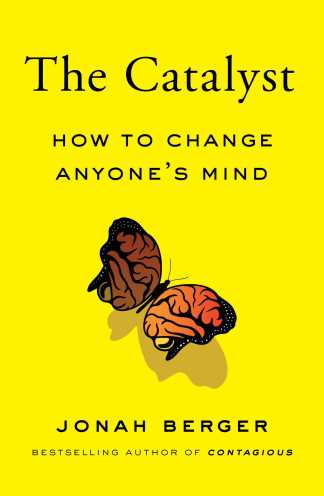
Book Review: (Business) The Catalyst

LITERARY REVIEW

Berger

The Catalyst concerns the art of persuasion

JONAH BERGER is a marketing professor at the University of Pennsylvania. His book is about changing people’s minds and he has advised large companies such as Apple and Nike. His approach is one of deftness and subtlety, one in which he doesn’t shout at anyone or by stamping on their toes.

The Catalyst is jam-packed with good ideas with very believable stories. It is perhaps written for those businessmen and women who often attend important business meetings.

When we try to change people’s minds – and we’re talking about everything here: politics, advertising, social attitudes, even the peanut butter you buy – we tend to think in terms of pushing and coercing. But as Berger demonstrates, people just hate being told what to do. “Tell them to vote one way and they’ll probably vote another way just to spite you.”

Berger recommends what he refers to as “reducing roadblocks”. Identify the obstacles and eliminate them.

The first of these he calls “reactance”. This is the anti-persuasion system that kicks in when we think someone is trying to talk us into something. “Encouraging people to persuade themselves”, says Berger. He tells an excellent story about a public health official in Florida who encouraged teenagers to give up smoking by getting the teens themselves to ask the awkward questions.

In one TV ad, they had a couple of teens ring up a magazine executive to ask him why he accepted tobacco advertising. The executive said he supported anti-tobacco ads, but when the teens asked him if he’d run the ads as a public service, he said no: “We’re in this business to make money.” The teens said, “Is this about people or about money?” The executive said, “publishing is about money,” and curtly hung up.

The TV ad worked. Within months, 30,000 teenagers in the state had stopped smoking. It was the most effective prevention programme ever, and it changed teen anti-smoking campaigns the world over.

Berger’s second obstacle is our attachment to the status quo. We like what we already have, and to make any change at all, the improvement must be worth all the fuss of doing it. Say your phone needs updating but you’re fond of your old one, even though it’s falling apart. The salesman’s job here is to highlight that simply not doing anything has costs you might not have spotted, and that change isn’t as hard as it looks.

Berger observes that if you have a product or service that is terrible, you’ll replace it instantly. But if it’s merely mediocre, you might stick with it because changing it is just too much bother.

Berger tells a rather fascinating and brilliant story about Dominic Cummings when he was heading up the Vote Leave (Brexit) campaign. He needed a campaign slogan, and initially he came up with “Take Control”. Which was all right, but he knew that referenda usually fail because people are happy with the status quo. He had to make it seem that leaving was the status quo, not remaining. Which he did by inserting the word “back”: “Take Back Control”. Berger says: “It made it seem like something had been lost, and that leaving the EU was a way to regain that.”

Next up is “Distance”, which I think should be interpreted as how far some people might be from the viewpoint you’d like them to have.

Say that the person you’re speaking to is a Trump supporter and climate change denier, and you want to convince him that transgender rights are a good idea. That’s distance, all right. Berger recommends taking small steps rather than large ones. Ask them to move a little way towards your goal, then ask them to move a bit further.

Berger’s book is full of goodness, but sometimes he’s so opaque you begin to wonder whether English is actually his first language. But that may just be because it’s written for people who use words like “reactance” in everyday conversation.

 – The Catalyst by Jonah Berger is published by Simon & Schuster, 288pp

Standard
Arts, Books

Book Review: Daughter of The Reich

LITERARY REVIEW

Daughter of The Reich

HETTY HEINRICH is the dutiful daughter of a high-ranking Nazi officer. Keen to play her part in what is dubbed as the glorious New Reich, she never imagines that her worldly beliefs and perceptions of the world will come into stark conflict when she encounters Walter, a friend from the past, who stirs dangerous feelings in her. Confused, Hetty doesn’t know who she can trust and to whom she may turn for help. This confusion is exasperated when she discovers that someone has been watching her.

Realising she is taking a huge risk – but unable to resist the intense attraction of Walter – she embarks on a secret love affair with him. They dream about when the war will be over and plan for their future. But, as the rising tide of anti-Semitism threatens to engulf them, Hetty and Walter will be forced to take extreme measures.

Daughter of the Reich is a mesmerising page-turner filled with vivid characters and a meticulously researched portrait of Nazi Germany. Inspired by the author’s own family history it is a propulsive and deeply affecting narrative. A riveting story of passion, courage and morality, Louise Fein introduces a bold young woman determined to tread the treacherous path of survival and freedom. Fein shows readers the strength in the power of love and reminds us that the past must never be forgotten.


LIKE all novels and historical accounts from this unsettling period in history the reader is likely to ask just how Hitler was able to lure the masses in following his extreme ideology.

After World War I, the Treaty of Versailles – the most important of the peace treaties which brought WW1 to an end – forced Germany to pay war reparations. These had a crushing effect on the economy and were seen by many Germans as being humiliating. Hitler, deemed by many as a mesmerising public orator, blamed all the ills of society on Jews and communist minorities, claiming they were trying to take over the world. With worldwide economic depression and high unemployment, he directly blamed the ineffectiveness of democratic government. Calling for a New Order, he promised the restoration of prosperity for all with no class divisions.

The bulk of the narrative is set within the two years preceding World War II, giving the reader a glimpse into how human beings caught in a dire situation can be manipulated and pushed into committing evil acts and atrocities.

Set in Leipzig the story begins with what life was like during the period between 1933-37. Hetty’s family had just moved to a new big house, where the previous occupants had left furniture and artwork. Hetty hadn’t yet turned twelve years of age, her father is a high-ranking SS officer, and she fails to properly understand what is happening. She becomes aware, though, that family attendance in church, for instance, is no longer permitted because of Himmler’s decree against it. And her dreams of being a doctor are no longer permissible because all women have been instructed to learn obedience and are required to concentrate on homely things. Yet, Hitler had promised “a brilliant future with no more poverty, no more class divisions. Just one, great, unified nation which will be the envy of all the world.”

For those who refuse to cooperate soon find they will lose their job, with the state declaring them unemployable with no prospect of any kind of future work. There are others who are charged with false crimes being convicted of things they didn’t do.

Within schools, debates about the population formed a central part of the curriculum. “A population of the best: the fittest, bravest, most beautiful, cleverest, and robust. The epitome of Darwin’s Theory. A people who will be superior in every way and who must spread their influence throughout the world.”

“A newspaper… is a powerful weapon. It is our duty to shape the opinion of the masses and ensure the Fatherland’s values and best interests are always in the forefront of people’s minds.”

At the age of sixteen, Hetty still struggled to make sense of it all. She falls for her brother’s best friend, Walter, a Jewish friend, who paints a touching picture for her what it means to be German. He tells her how Jews are being cornered and ill-treated and being left without provision for livelihood. He directly challenges her values and beliefs and encourages her to be whatever she wants to be. He tells her of other countries where she can study medicine as a woman and that her position in society should not be through the direction of a tyrannical system. Hetty’s struggles and states of confusion start to dissipate as she slowly starts to realise that there is another side to the world that has surrounded and enclosed her.

The story accurately depicts a distraction of lives, of hypocrisy and deception feeding lies and mistrust. This feeds hatred that pushes others to engage and commit in deplorable acts with a momentum that seems impossible to stop.

Fein invokes a heart-breaking story that is engagingly written with a very poignant message:

“How could a people, a deeply civilised, democratic nation, become so unbelievably cruel; to dehumanise one another, and commit (the most appalling) atrocities on such an unimaginable scale?”

– Daughter of the Reich by Louise Fein is published by Harper Collins

Standard
Arts, Books, Russia, Society

Book Review: Putin’s People

LITERARY REVIEW

Belton

HEGEMONY

IN Russia, the national referendum to extend Vladimir Putin’s stay in office for another 12 years has been postponed.

The proposal that he was to continue for two more six-year terms after his present mandate ends in 2024 was due to be put to the people on Wednesday, 22 April. But due to coronavirus, or Covid-19, the vote was deferred.

Given his vice-like grip on the levers of power of that vast country and the muted opposition to him, there can be little doubt which way it would have gone. He would effectively have been endorsed as president for life.

But now there is a pause – if a brief one – in his relentless pursuit of an unchallenged and supreme autocracy.

That even tough gut Vlad – “The Papa” or “The Number One” as his cronies call him – must bow to the virus is almost a relief. Because in the twenty years since he grabbed the presidency, no one at home has managed to stand in his way without being rolled over, removed, imprisoned, killed, cowed or bribed into submission.

At the same time, he has turned a clapped-out post-communist nation going nowhere into an aggressive and much feared international power. Putin’s Russia now has its insidious fingers in every political, diplomatic, military and financial pie around the world – with deeply worrying implications for all of us.

How this man seemingly from nowhere managed his Napoleonic rise from mere deputy mayor of St Petersburg to absolute power is arguably the biggest story of the 21st century so far.

In forensically unravelling it, journalist Catherine Belton, former Moscow correspondent of the Financial Times, has done a great service, producing a book that western experts on modern Russia acknowledge as vital to our understanding of the Putin phenomenon.

Her study and thesis is chilling indeed. When the Soviet Union disintegrated in 1991 and communism gave way to a makeshift form of democracy, the KGB, Moscow’s underground army of spies, crooks and secret policemen, disappeared from the radar. But they hadn’t gone for good. They weren’t defeated, only biding their time.

Their moment came when the oligarchs, who in effect ran Russia after making vast fortunes from oil, gas and mineral rights amid the economic and political chaos of the Yeltsin years, catapulted the seemingly pliable Putin into the presidency.

They promoted him as their man to sort the country out and bring it to some semblance of liberal democracy. They didn’t expect him to last more than one four-year term.

What they didn’t reckon on was that Putin was KGB to the core. He’d cut his teeth spying on the West in the old communist days, subverting Western businessmen, stealing industrial secrets, and smuggling. And it was with his old pals that his true allegiance lay.

With Putin in the driving seat, Belton argues, the KGB was back in control of Russia and its grip on the country is as strong now as it ever was in the Soviet days.

His agenda – eagerly taken up by the so-called siloviki (the word means “strongmen”) he recruited from the old ranks – was to make the nation all-powerful again, a top-down, state-run force not to be trifled with at home or abroad.

Along the way they would feather their own nests, through money-laundering, bribery, fraud, rake-offs, slush funds and theft. Putin’s Russia would become not just an autocracy but a kleptocracy.

He turned the tables on the oligarchs who’d sponsored him, strong-arming them into acquiescence. They worked for him now, not the other way round.

What emerged, writes Belton, was “a system in which all businesses of any scale were dependent on the Kremlin. Tycoons had to serve the state in order to preserve their standing and wealth”.

Those who resisted found the police knocking on their doors with arrest warrants for tax evasion, fraud or other serious crime. Backed by the state, he had them at his mercy.

Some ran – like media magnate Boris Berezovsky, only to end up dying mysteriously in England. Some went to prison – Russia’s richest man, oil tycoon Mikhail Khodorkovsky, said to be worth £12 billion, was boarding his private jet in Siberia when commandos arrested him. Most caved in and did as they were told – Roman Abramovich, says Belton, purchased Chelsea FC on Putin’s instructions, as a way of enhancing Russian prestige in the West.

CROOKED

EVEN those closest to him weren’t safe, especially if they got too big for their boots. Sergei Pugachev made billions as Putin’s favourite banker before “Papa” turned on him and looted his vast assets.

In exile, Moscow mafia thugs turned up, took him out to a yacht in the Mediterranean and demanded £280 million to guarantee the “safety” of his family.

Belton draws on published sources and deep-throat contacts to plot a course through the maze of crooked financial manoeuvres – the sleights of hand, the backroom deals, the “loans” from state banks, the kick-backs on contracts – that Putin and his courtiers got up to as they systematically drew the wealth to themselves as inexorably as iron fillings to a magnet.

They stashed their ill-gotten gains overseas, their so-called “black cash” amounting to a staggering £640 billion in all, according to one estimate, while at home they flaunted their riches, kitting themselves out with yachts and private planes and vast palaces. One of these had a garage for 15 cars and a storeroom for fur coats.

All the while, human rights, freedom and the rule of law went increasingly by the board. Local governors were stripped of their authority. Dissent was suppressed. The courts acted as an arm of the Kremlin. Judges toed the line.

Though Russia was ostensibly a democracy, the reality was that power emanated from the top down, with Putin as a feudal monarch, a tyrant, a tsar like Peter the Great, surrounded by his henchmen, his boyars, who owed their fealty and their vast riches to him.

Belton finds it shameful that the West – which had worked for and then welcomed the demise of communist rule in Russia – connived in this return to autocracy.

Bankers and brokers in London, in particular, fell over themselves to get a slice of the financial action, happy to look the other way as fortunes were hidden in offshore havens.

Peers of the realm lined up to lend their apparent respectability to the boardrooms of Russian ventures. Russian money swirling around London earned the capital the nickname of “Londongrad” or Moskva-na-Thames. In the United States, Donald Trump, before he became president, did deals with the Russians to bail out and expand his property empire.CROOKED

WEALTHY POWER-BROKER

GREED triumphed over principle, with the result that the West, by slavishly following its own money-making instincts, has allowed itself to be infiltrated. Belton warns: “The weakness of the Western capitalist system, in which money ultimately outweighs all other considerations, has left it wide open for the Kremlin to manipulate.”

Making matters worse is that the siloviki were on a mission, not just to get very rich, but to use that wealth to undermine the West. Under communism, the KGB had seen the West as its enemy. Its successors, led by Putin, feel the same way.

Under him, Russia, once a busted flush on the world stage, has become the world’s power broker again, whether openly, as in Ukraine and the Middle East, or covertly.

In its new guise, the KGB has adopted the tricks of the old KGB, causing disruption in the West wherever it can.

Its money backs political extremists, Right or Left – the cause isn’t important, only the confusion they cause. It gets up to all sorts of mischief to drive a wedge between the U.S. and Europe. It encourages unrest and dissension just to stir the pot.

In the eyes of Putin and his cronies, the Cold War has never ended, just moved into a new phase. We have clearly been warned.

– Putin’s People by Catherine Belton is published by William Collins, 640pp

Standard