
CONSTITUTION
BOTH Plato and Aristotle extended their theories into political philosophy, examining how best society could be organised. Each took a different approach and methodology in their examination and, unsurprisingly, reached a different conclusion. Plato’s Republic described his vision of a somewhat authoritarian city-state governed by specially educated philosopher-kings, whose knowledge of the Forms of virtue made them uniquely qualified to rule.
Aristotle applied a more systematic approach in his Politics. He analysed the possible forms of government, categorising them by criteria of “Who rules?” (a single autocratic person, a select few or the people?) and “On whose behalf?” (themselves, or the state?) He identified three forms of true constitution: monarchy, aristocracy and polity (or constitutional government). These all ruled for the common good, but when perverted, became tyranny, oligarchy and democracy. Given a choice, Aristotle believed that polity was the optimal form of government, with democracy the least harmful of the perverted forms.
Appendage: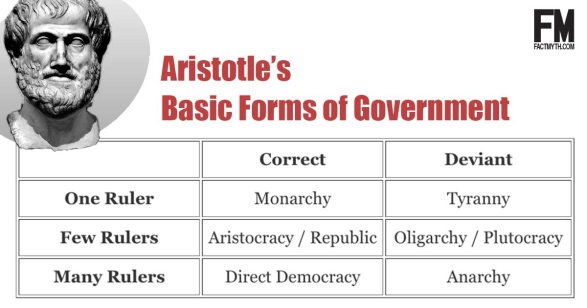
 Arts, reviews & current affairs