
Arts, Books, Philosophy, Politics

Book Review: For the People

LITERARY REVIEW

Intro: Democracy is in crisis – no thanks to arrogant liberals like AC Grayling. From Brexit to religion, this pompous and insulting philosopher has made a career out of telling the public why they’re wrong. His latest polemic’s a case in point

AC Grayling, a former professor of philosophy at Birkbeck, University of London, is a warhorse of progressive liberalism. He has campaigned for many years in favour of human rights, drug legislation, voting reform, euthanasia, and against war crimes. He is staunchly anti-Brexit and a militant atheist.

Like many people, Grayling is unhappy with the state of the world. Everywhere he looks, there are perils: war, inequality, democratic backsliding, Donald Trump. Things just aren’t going as he would like with authoritarians on the march and liberals in retreat. “Humanity is still at an infantile stage,” he laments. No one respects university professors anymore.

His latest book, For the People, sees Grayling writing in defence of liberal democracy, and in defiance of Vladimir Putin, Chinese communism, and even the populace of Clacton-on-Sea.

His basic contention is that democracy is under threat around the world. It’s losing ground at home to a cocktail of indifference and hostility, and overseas to actual authoritarianism. There are four basic issues: democracy is bleeding moral authority among its own citizens (by repeatedly disappointing voters); it’s too hospitable to big business and oligarchy (allowing “big companies and wealthy individuals… to have a vote equal to millions of other people’s votes”); it’s confronted by the rise of authoritarians in China and Russia (who make it seem like a loser’s doctrine); and it’s assailed from within by a wilfully anti-democratic new kind of politics (“populism”, which floods the minds of voters with fear and propaganda). The reader is left to contemplate the possibility of “the end of the democratic moment in history”.

There’s nothing immediately objectionable here. Grayling is correct that global democracy is in retreat and decline, and correct that this should concern all of us – and deeply. His own remedies, however, have serious flaws. The most immediate is that the publication is incredibly boring. The vision of liberal democracy that Grayling proffers is colourless and tedious. His ideal seems both to involve interminably hard work – “The price of liberty is eternal engagement,” he pens in his best schoolmasterly voice – and narrow in what it offers us. If one describable vision of a democratic commons is that of a boisterous public square full of dissent and babble, For the People proposes something more like a seminar of legal academics to which the voting public have been grudgingly invited in a non-speaking capacity.

Not coincidentally, the same is true of Grayling’s style: figureless, monochrome, and almost baroque in its repetition. One of the book’s two (rather odd) appendices comprises a report from the human rights group Council of Europe on the threat posed by the far-Right that runs to nearly 40 pages. Readers who enjoy this kind of ponderous document will find themselves very much at home among Grayling’s prose.

This brings us to the second major problem with Grayling’s book. The thrust of his title promises to save democracy, but it is with liberalism that he is truly concerned. For Grayling, the two are all but congruent; liberal democracy, we are told, is “a pleonasm: the two words in the phrase are practically synonyms”. This view is by no means the self-evident one Grayling pretends it is. There have been liberal states which were not really democracies – Britain before the Great Reform Act, for instance – and contemporary scholars often describe the rise of figures such as Trump as marking an abandonment of liberal norms via democratic mechanisms.
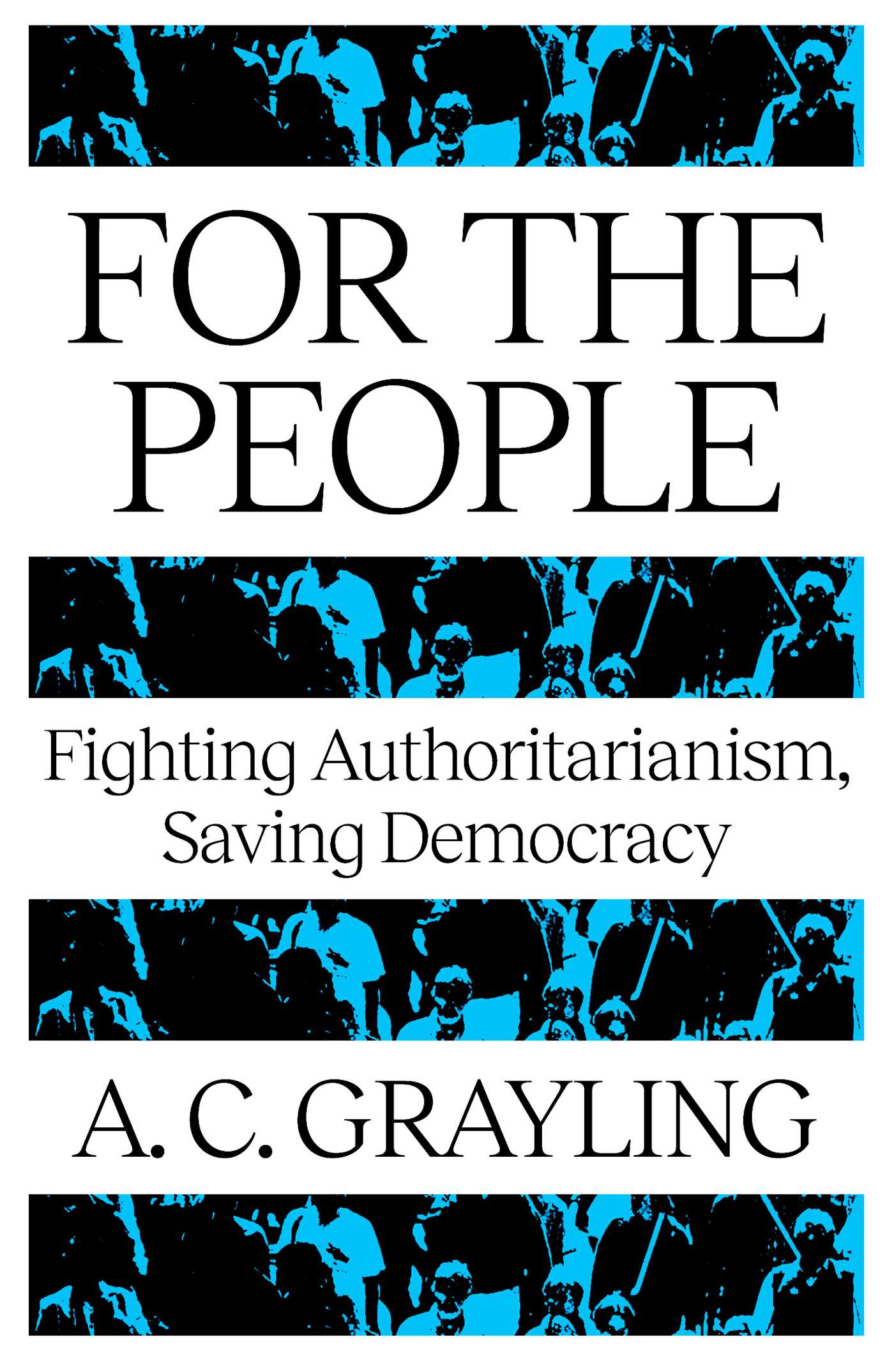
– Grayling argues that the current political systems in many Western nations have been hallowed out, leaving them vulnerable to populism, elite capture, and the ‘tyranny of the majority’

Where this book goes really off the rails, however, is in its insistence that rule of law, and thus liberalism, essentially exists on a higher plane than that of mere politics. The rule of law, for Grayling, is the “ethical” aspect of the state: it gives character to politics (voting, lawmaking), rather than politics giving character to law. What this means is not just that political actors shouldn’t break the law, but that the basic shape of that law is sacrosanct (and is not to be changed even by majority will). To make such a change, Grayling thinks, would be to fall for the “majoritarian fallacy”. It would injure both the minority who disagree and the majority who want the change; the law is what’s best for everyone, whether they like it or not.

There are shades here of Jean-Jacques Rousseau’s concept of the “general will”, described in The Social Contract of 1762. Rousseau’s general will is not the majority view of a state’s citizens; it is “not so much the number of voices, as it is the common interest which unites them”. If an individual has “a particular will contrary to or different from the general will”, Rousseau writes, the latter will overrule the former: “He will be forced to be free.”

Grayling makes much of this “common” or “best” interest, in contrast to majority opinion, by which he means the interests of those he considers stupid. “Too many,” he writes, “have a vote that can be manipulated by orchestrated misinformation and misdirection to make choices that are not in their best interests.” The public, alas, are still in that “infantile stage”. Grayling is no doubt thinking here of the Brexit referendum, the outcome of which he bitterly opposed and continues to insist should have been ignored. Yet, he campaigned enthusiastically for a “People’s Vote”, and presumably would have accepted any majority opting to rejoin the EU. The intellectual arrogance of this is ludicrous.

And it is here we have the third and greatest problem with Grayling’s position. Only a very strange form of democracy would insist that it can tell you your business, or that your own sense of your interests is wrong. When we read, then, that “the purpose of democratic government is to serve the best interests of all”, it sounds pleasant enough, until you ask the author: who will decide what my interests are? Grayling’s answer to this question is simple: AC Grayling. “The interests of the people are not hard to identify,” he declaims. But here’s the thing: they are. This is why politics exists.

At the same time, Grayling is suspiciously vague as to how your “best interests” and mine become known. There’s an appeal to JS Mill’s “harm principle” hidden away in an endnote, and a suggestion that Britain, just like Bhutan, should replace GDP with GNH (Gross National Happiness) when assessing social wellbeing; both actions suggest some utilitarian arithmetic. Suffice to say that this is not a new debate. Moral philosophers have for centuries sustained an endless back-and-forth argument about utilitarianism, the “hedonic calculus” – Jeremy Bentham’s 18th-century formula for working out how much happiness an action creates – and the plausibility of gauging happiness at the collective level and whether that is possible at all.

Grayling has an utterly blasé indifference to the fact that, for most people, most of the time, their “best interests” are not their only ones. They might not even be that important. Interests in love, in adventure, in faith, in simple curiosity: these may not reliably make us happy, but they’re central to the creatures we are. For the People dissolves this vitality into a tepid brew of committee-approved “best interests”, a safetyism of the soul. Grayling’s democracy is relentlessly boring. It lacks imagination.

Of course, liberal democracy needs defenders; but it needs better defenders than this. Grayling’s world would be a drab, antiseptic thing, where everyone gets just what the doctor ordered and your freedom would be so perfectly calibrated that you couldn’t really do anything with it. There’s no place here for despair or desire, for rebellion, ambivalence, or intrigue. Those things aren’t good for you, and Grayling has told you so. But what if the people want something else? Maybe some people just don’t want to be happy.

For the People is published by Oneworld, 288pp
Standard
Arts, Books, Christianity, Natural History, Philosophy, Religion

The beehive tells us much about the soul

THE COMPLETE BEEKEEPER

Intro: The beekeeper at Douai Abbey has applied the wisdom of bee care to living well

During the vigil on the eve of Easter Sunday, the dark church is lit only by the Paschal candle (representing Christ, “Light from Light”, as the Creed says) and by the candles lit from it and held by those present. Then an ancient chant is sung by the deacon towards the candle, and in praise of it.

This chant, the Exsultet (“Rejoice”), written between 1400 and 1600 years ago, is of an astonishing poetical character. Its text refers to Adam’s sin as felix culpa, “happy fault that earned for us so great, so glorious a Redeemer”.

It speaks of “this candle, a solemn offering, the work of bees and of your servants’ hands”. But there should be another mention of bees – of the candle flame being “fed by melting wax, drawn out by mother bees to build a torch so precious”. The natural history may be awry in calling the female workers “mother bees”, but it is good to see them given due praise. Alas, some choose an abbreviated form of the Exsultent and the mother bees perished. To make up for that shortfall, a delightful new book is being published by Gracewing: The Complete Beekeeper by Dom Gabriel Wilson, OSB (Order of Saint Benedict).  

He has been Prior of the Benedictine Abbey of Douai in Berkshire since 2022, but its beekeeper since 2015. His tenure was a turning point in beekeeping history. He was in charge during the devastating Isle of Wight disease (now known to be caused by the Acarine mite) in the early 20th century, which wiped out the native British Black Bee. His writings capture a pivotal moment when beekeeping shifted from old-world methods to more scientific, selective breeding.

The book’s title mirrors The Compleat Angler, first published by Isaac Walton in 1653, which made the angler symbolise the ideal human being living a balanced life. Similarly, Dom Gabriel feels that “within the hive lives and moves an allegory for the sacred mysteries not only of nature, but of the human soul”.

The beehive speaks to the human heart, he suggests, not by logical syllogisms but by symbol. As Pascal wrote: “The heart has its reasons which reason does not know.”

Dom Gabriel notes that the social virtues of bees were recognised in the pre-Christian world. Virgil devoted a quarter of his poem the Georgics to bees as a model of a structured, co-operative, and selfless society. Today we still wonder: “Who taught the bee to make its wax hexagons, those most perfect forms? Who instructed her to gather nectar and guard her queen, to sacrifice herself to relentless work without any thought of reward?”

Nonetheless, The Complete Beekeeper is more than natural history or self-help; it is a contemplation of spirituality. “To keep bees is … a form of devotion, akin to an intimate spiritual practice that mirrors the tending of one’s inner life.”

The author’s experience at the beehive informs this meta-science: which, governs the care of the faculty for living well – the soul. “Each hive is its own living universe. Within its wooden walls, thousands of bees work in miraculous harmony: foraging, building, cleaning, dancing, feeding the queen, and protecting the whole. So too is the soul made up of countless thoughts, memories, desires, and instincts.”

The Complete Beekeeper taps inherited wisdom. It quotes poets such as Coleridge and Hopkins, and masters of the spiritual life such as St John of the Cross, and, naturally, St Benedict. It critically considers philosophers such as Plato, Seneca, and Sartre – and of course cites beekeepers, in peace and war.

The work of making one’s soul is deadly serious, but it should not be anxious. “Bees are not tame creatures; nor is the moral life a safe one. But it is, in the end, very beautiful and full of joy.” Underneath is a confidence in the ultimate goodness of the world, which, like the garden where the beekeeper tends his hives, knows how to bud and mend, grow and yield again.

Throughout the text, Wilson weaves in the Benedictine philosophy of stewardship. He advocates for a “gentle hand,” suggesting that the best beekeeper is one who works with the bees’ instincts rather than fighting against them. This philosophy – known as the “Buckfast” philosophy – of breeding for docility and productivity became the hallmark of the Buckfast Bee.

Many associate Buckfast Abbey primarily with Brother Adam (the creator of the Buckfast Bee), but it was actually Dom Gabriel who served as the Abbey’s head beekeeper before him. The bigger picture of the book implies that if Brother Adam was the “architect” of the Buckfast Bee, then Dom Gabriel was the “master builder” who cleared the ground. The analogy should not be overlooked.


Standard
Arts, Books, Philosophy

Book Review: The Score

LITERARY REVIEW

Intro: If you feel like your life is just a game, this book explains why. As philosopher C Thi Nguyen explains, have we let metrics twist our values? The author argues that when we use simple, clear metrics to measure success, we often “capture” our complex values and shrink them down to fit those metrics

In the Domesday Book of 1086, a manuscript record of the Great Survey conducted at the behest of William the Conqueror, philosopher C Thi Nguyen tells us, English surveyors measured land by the “hide”: the area an average family needed to sustain themselves. No doubt that was a useful measure, but you need local knowledge to use it. Some places are more productive than others, so how much land, exactly, would the average family need? It could be 40 acres, or 60, or 120.

If decisions are taken locally, there’s little issue. But as soon as authority and powers begin to centralise, units such as the “hide” disappear, replaced by standardised measures that are easier to record and act upon. Local knowledge is forgotten. The more centralisation advances – and in our modern age it has only advanced – the greater the problem grows.

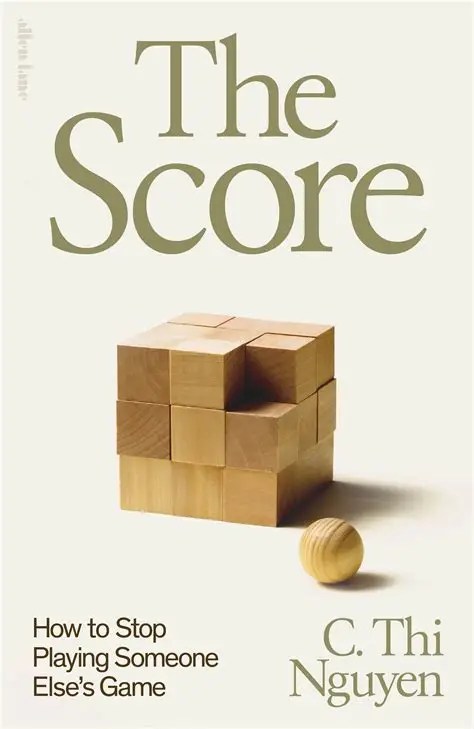
– Nguyen examines how institutions and bureaucracies use game-like scoring to control behaviour, often at the cost of our autonomy and personal joy

The Score is part polemic and part philosophical inquiry. At its heart, Nguyen’s argument is that in an effort to be objective and unprejudiced, our governments have turned metrics into targets and built rules around them. The result is that our civic life has become a superficially efficient but fundamentally amoral – not to mention inescapable – game. As well as being a philosopher, Nguyen is a lover of board games, video games, technical climbing, and even yo-yoing; or, in other words, he understands the utility of rules. Yet, he writes, that, in the desire to make life ever more frictionless and reasonable, we’ve let metrics twist our values.

Early on, for instance, he mentions a pastor who, instructed to meet a baptism quota, finds himself ignoring the pastoral needs of the rest of his flock. At least the pastor works in a setting where the problem can be aired. For most of us, fixated on annual targets in various settings, the number of likes on social media, and the steps recorded on our fitness apps, external metrics work beneath our notice, replacing our original values. ‘I have 1,000 friends and took 10,000 steps today’: supposedly makes the claimant healthy and popular.

Academia, to no one’s great surprise, is far from immune either. Nguyen argues that the US News & World Report university rankings “no longer celebrate academic distinctiveness”, because prospective students now outsource their reasoning to the US News algorithm. Do you want to fight for social justice or make a killing on Wall Street? Either way, you’ll apply to the same law school – the one at the top of the list.

More ominous examples follow. There is, for example, a US department of state metric called Tip (Trafficking in Persons), which measures the effectiveness of policies to reduce modern slavery, and sex trafficking in particular. It is well established that slavery flourishes in areas of extreme poverty. But if a country reduces its ambient poverty and, as a result, reduces sex trafficking, the Tip report’s metrics indicate failure – because conviction numbers drop off. As Nguyen explains, the metric “incentivises countries to keep sex trafficking around so that there will be plenty of traffickers to convict.”

The author’s most profound insight lies in plain sight: to quote Wordsworth, “our meddling intellect misshapes the beauteous forms of things”. Games do exactly that, and offer a refreshing refuge – for a few minutes or a few hours – from the ambiguities of the real world. The gamification of real life, on the other hand, traps us all, with no prospect of an ending.

So how do we escape a gamified world? Read more books? Take up the violin? Stick it to The Man wherever we can? Such things don’t sound like a call to revolution, and I’m not sure Nguyen’s heart is in the fight. Individuals may recover their agency – and this book will help them do so – but it’s hard to see why businesses, governments, and bureaucracies of all kinds would abandon their self-empowering rhetoric of “objective” metrics.

In the early part of the narrative, Nguyen says: “I had an entire theory about games, in which clear and simple scoring systems were the magic ingredient that opened the door to a whole world of delightful play. And I had an entire theory about metrics, in which clear and simple scoring systems killed what really mattered.” This is well put.

In an otherwise trenchant and entertaining book, critics may well point to the fact that Nguyen follows the rules of his genre very closely. Like every “popular thinker” on the shelf, he can’t resist sharing his personal journey to enlightenment. If you’ve ever read The Very Hungry Caterpillar to children, you’ll know how much young readers delight in repetition. Nguyen, to many readers, is the Eric Carle of philosophy. For those up to speed with his topic, his steady circumspection may prove exasperating.

But don’t discard him. A book, too, is a kind of game, in which “we adopt a goal in order to get the struggle that we really want.” It’s about going the long way, a particular way, using a particular method. If we truly want to understand our civic plight – and not just merely tick off some talking points – then The Score should be read. You’ll find that Nguyen has planned this particular long way round with adeptness.

– The Score: How to Stop Playing Someone Else’s Game is published by Allen Lane, 368pp    

Standard