
LITERARY REVIEW
Intro: The central argument of Brown’s thesis is that Mao was a ‘moderniser through destruction’. He believed that for a new China to be born, the old one had to be violently uprooted. The book suggests that while Mao’s methods were often catastrophic, the unified, assertive China we see today is an inescapable result of his reign
Kerry Brown writes that “Mao’s provocations… would have suited the world of social media and Twitter/X”. That’s a fertile observation. One could well imagine an @Mao account, or a podcast – The Chairman Mao Experience – attracting a huge and hungry following.
Mao Zedong was, after all, a famed dispenser of earthy aphorisms. He told an astonished hall in 1959: “Comrades… if you have to s—, s—! If you have to fart, fart! You will feel much better for it.” He was obsessed not so much with state-building as with the more intimate endeavour of moulding minds. “Simple slogans, cartoons, and speeches”, he wrote, “have produced… a widespread and speedy effect among the peasants.” Social media would have been a central platform for his rhetoric.
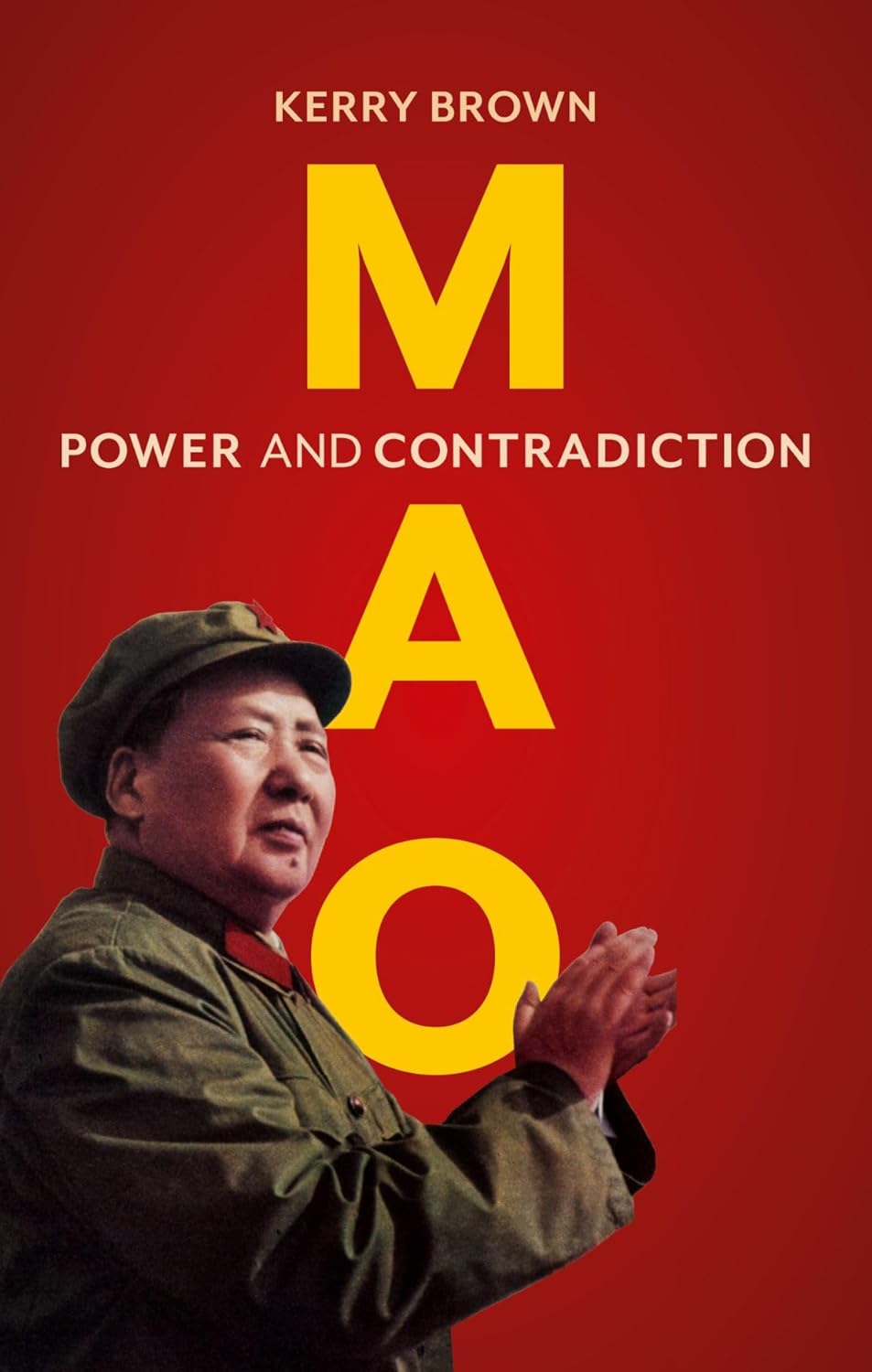
Even in death, Mao trips us up. In the half a century since his passing in 1976, biographers and historians of China have failed to reach consensus on what drove him, what degree of responsibility he bears for the tragedies of the early People’s Republic, and what his contributions were to the wealthy and successful China of 2026. He ran the country for 27 years, yet remained an enigma – associated, at various times in his life, with violence and mercy, Confucianism, and techno-utopianism. In his new biography Mao, Brown, professor of Chinese studies at King’s College, London, all but emits a sigh, surveying the task ahead: “Getting a clear sight of who Mao was… presents a massive challenge.”
Some early signs provide pointers. Young Mao, born in imperial China in 1893, was fiercely opposed to the ruling “Simple slogans, cartoons, and speeches”; yet, he was schooled in the Confucian classics, and was impressed by the importance of self-cultivation. It was a short hop from self-cultivation to the cultivation of others’ selves – in particular those of the vast mass of China’s peasantry, whose loyalty and labour were required for revolution.
Mao came to believe that Marxism offered the best blueprint for achieving this. Russia’s Bolsheviks had shown that what Brown calls “an enlightened vanguard of activists” armed with a simple critique of present injustices could rally the masses to their cause. The people of Hunan province, where Mao built his early political base, possessed, in his estimation, “no brains, no ideals, and no basic plan”. Changing that required, in Brown’s words, “the framing of social relations in elemental terms as a struggle between… two great forces”. One only had to exchange Marxism’s “capitalists” with “landlords” for China’s peasants to raise their gaze beyond their own fields and throw themselves into collective action. Mao deployed night-schools and propaganda to this end, providing just enough education to create a biddable mass that would “rise like a mighty storm, like a hurricane, a force so swift and violent that no power… [would] be able to hold it back”.
Compromise was not in Mao’s DNA. In 1921, while still a marginal figure in the party, he attended the fabled first meeting of the Chinese Communist Party in Shanghai. The location, then in the city’s French concession, is today regarded in China as sacred ground, festooned (the author tells us) with TV screens and interactive guides. And yet: so disillusioned was Mao by the CCP’s pragmatic decision to forge a temporary alliance with the Chinese Nationalists that he boycotted its second congress in 1922. (In later years, he would pretend he’d done no such thing, and only failed to locate the address where the meeting was being held.)
Mao once declared that revolution is “not a dinner party, or writing an essay, or painting a picture, or doing embroidery . . . a revolution is an insurrection, an act of violence where one class overthrows another”. Brown takes the reader on the wild ride that was Mao’s life in the 1930s and 1940s: his quick return to the fold, the rise of the CCP, its fight against Japanese invaders, then all-out civil war with Chiang Kai-shek’s Nationalists – whom Mao had driven out of China and into Taiwan by the end of 1949, thus establishing Communist rule.
Then comes the perplexing mix of success and tragic failure that were the early years of the People’s Republic of China. Greatest of all disasters was the Great Leap Forward of 1958–62, during which a staggering 50 million people may have died (reliable statistics are impossible to come by). How to explain the gargantuan folly of setting up backyard steel furnaces in villages across the country, producing shoddy tools and utensils, while people were left eating tree bark and raw wheat?
Prof. Brown points us towards “Mao Zedong Thought”, the “philosophy” that seems to have turned on a terrifying sense of China’s population as an expendable means towards utopian ends. Those village furnaces might have claimed untold lives – consuming farmers’ tools and time when they should have been tending their fields – but for Mao they were a symbol of Chinese modernity. A nuclear exchange would be regrettable, but China had so many people that no enemy could possibly kill them all. Food aid was offered to China’s neighbours during the height of the famine, because you can’t put a price on projecting an air of progress. Brown wonders whether Mao understood economics at all – whether “capitalism” was, to him, little more than “a term of abuse or criticism for those he regarded as… enemies, rather than something [of which] he had a clear understanding”.
Brown is like a trustworthy tour guide, knowledgeable and clear, but not always sure which sights we most need to see. Digressions into the lives and thinking of other figures occasionally takes up space that might have been better used in rounding out our sense of the chairman himself. Writing about a figure like Mao isn’t easy; but readers may still find themselves hankering after a more vivid personal portrait, alongside answers to some of the questions thrown up by Mao and Maoism.
For instance, important aspects of Mao’s private life are passed over rather quickly. He was often consumed by what might now be described as anxiety and low mood, over fears of his rivals plotting and scheming against him. He withdrew from public life for long periods at a time before returning with fresh and deadly energy – most famously at the time of The Cultural Revolution of 1966-76. And while we must be wary of sensationalism, it seems clear that Mao had a fondness for young women, especially during his later life. All these things might be mined for insights about one of the pivotal figures of the 20th century.
Similarly, we read about the extraordinary violence of the Cultural Revolution without being helped to understand what could make people do such things. So-called “sent-down-youth” from urban China were forced out into the countryside “to seek lived experiences of the revolution”. The results extended to forced marriage, rape, and even murder at the hands of rural Chinese who were fearful that their food and resources were under threat. Mao was the prime instigator and orchestrator of this infamous episode in Chinese history, alluding at the outset to the utopian potential of “disorder” under heaven.
Were Mao’s pathologies poisoning a nation, or coaxing to the surface its darkest inclinations? Brown is surely correct when he says that “it is hard to work out the psychology of a man who was almost constantly calculating and balancing different forces around him”. Still, a tighter curating of key moments and insights plus some judicious speculation might have helped the analysis in this book be more cohesive and compelling. As it is – and in fairness, perhaps this is true to the nature of the chairman – Mao Zedong risks once again slipping through our fingers.
– Mao by Kerry Brown is published by Reaktion, 272pp

