Energy, Government, Politics, Scotland, Society

Energy crisis: Taking back control of our energy supplies?

ENERGY ALTERNATIVES

JUST seventeen years ago the UK produced enough gas for all its domestic needs, but we are now reliant on an international market and the whims of President Putin. But there are ample alternatives to imported gas that could put the energy market on a sustainable footing:

New North Sea Gas

PRODUCTION in the North Sea has dwindled because older gas fields have become too expensive to run, and new ones have taken a long time to come on stream.

Last year about 48% of UK gas came from the North Sea, down from 100% in 2004, and this is projected to keep falling.

If the Government does not subsidise investment, then by 2025 domestic gas will only meet around one third of UK demand, making the country even more reliant on global markets.

Refinitiv, a European Gas Research body, said there are untapped gas fields in the North Sea, but that more investment is needed. It says there are up to four new gas fields that will be starting early next year, but highlights the fact that, “we’ve seen falling investment in the last 18 months.”

Restart Fracking

The Government halted fracking in England at the end of November 2019 after a series of confrontations between shale gas companies and local communities.

Supporters claim there is enough shale gas in the UK to support the country’s needs for decades.

Fracking has boomed in the US, making the country a powerhouse in global oil and gas production, and securing its energy security. The technique, also known as hydraulic fracturing, involves pumping water and sand underground at high pressure to fracture the rock and release trapped oil and gas.

Fracking has effectively been banned in Scotland since 2015, with ministers announcing in 2019 that the moratorium would be extended indefinitely.

An active fracking site near Blackpool caused several earthquakes up to a magnitude of 2.9, which left houses in the local area shaking. Opponents of fracking also complain that sites require significant infrastructure and sand and water must be transported to and fro in large trucks leading to traffic, noise and disruption.

The Government took its decision after a scientific study found there would be “unacceptable” consequences for those living near fracking sites. But it said it could agree to new sites if there was “compelling new evidence” that fracking was safe.

More Gas Storage

The UK has around 18 times less gas storage than European nations such as Italy, Germany and France, making the country extremely vulnerable to volatile prices.

A focus on renewables and developing better connectivity with neighbours such as Norway, to enable the UK to import gas effectively, meant little new storage has been built.

In fact, the Rough storage facility off the Yorkshire coast, which accounted for two-thirds of our gas capacity, was retired in 2017. Experts said politicians believed that there was no need to spend vast sums on new storage plants because prices had been stable between the summer and winter for many years.

Shetland Oil Fields

The UK could look to new oil fields – at the risk of being accused of climate hypocrisy.

The area to the west of the Shetland Islands has been named as “the place to be” by energy experts advising firms on growing Britain’s oil output. Siccar Point Energy, backed by Shell, is preparing to start drilling in the Cambo oil field, situated 75 miles to the west of the Shetlands.

It is thought to contain 800 million barrels of oil, which will be released over the next 25 years. The company previously said: “The Cambo development supports the country’s energy transition, maintaining secure UK supply.” Such words appear prophetic against the recent wild swings in gas prices, but more licences to drill oil will enrage environmental campaigners.

It could also be against the law as the Government has created legislation committing the country to a 78 per cent reduction in carbon emissions by 2035, and a 100 per cent reduction by 2050.

Go Nuclear

LAST month, ministers said they were considering a “change of focus” towards nuclear power to find a more reliable source of green energy than wind and solar.

Industry leaders have lambasted the Government for failing to replace Britain’s ageing reactors sooner, despite repeated warnings.

Next year alone the country will lose more than a fifth of its nuclear power generation when plants in Dungeness, Kent, and Hunterston, in Ayrshire, are decommissioned. There is then a procession through the 2020s as plants in Hartlepool, in County Durham, Heysham in Lancashire, and Torness in East Lothian, are retired. Any investment in nuclear energy today will not provide energy until the 2030s and the UK will need at least two large reactors and ten small plants just to maintain current levels of energy production.

There is some hope. A consortium led by Rolls-Royce, which makes nuclear reactors for submarines, has just secured a £210million investment that will allow it to put its plans for mini reactors to regulators. It hopes it can build the smaller plants, which will require £2billion investment each, more quickly than traditional reactors, and hopes to build up to 16.

In its last energy policy, published in 2017, the Scottish Government opposed new nuclear power stations being constructed.

Standard
Britain, Economic, Energy, Europe, Government, Politics, Russia, Society

Energy crisis: We’re at the mercy of Putin. It’s all our fault

ENERGY

THE Berlin Wall may have been brought down more than three decades ago, but the grim politics of the Cold War are in danger of returning to Europe.

With characteristic ruthlessness, Russian president Vladimir Putin is exploiting the energy crisis to bully his neighbours, strengthen his autocracy and intimidate the West.

His chosen weapon in this renewed campaign of hostility is Russia’s control of gas supplies: the vast gas-fields and the export pipelines that bring them directly to market.

This infrastructure, often legacy assets from the Soviet empire, give the Russian president enormous political and economic leverage in his quest for ever-greater domination of the region.

Russia’s capacity to manipulate the British and European energy markets for geopolitical ends has been dramatically illustrated during the turmoil of recent days and weeks. As the price of gas contracts soared by 40 per cent in just 24 hours last week, Gazprom, Russia’s state-backed monopoly exporter of pipeline gas, was accused of flexing its muscles by both restricting supplies to Europe and keeping its European underground storage facilities at deliberately low levels.

The sense of Russian control was further reinforced when it took just a few words from Putin himself to bring an immediate fall in gas prices.

Revelling in his position as the ultimate ringmaster and wire-puller, he said with a hint of blackmail that supplies could be increased. “This speculative craze doesn’t do us any good,” he said, adding that Europe’s leaders should “settle with Gazprom and talk it over”.

RELIANCE

PUTIN might be behaving like a mafia boss in charge of a protection racket, but British and European governments have for years disastrously played into his hands with misguided, short-term policy decisions.

To be fair, the EU has taken some steps to break the Russian stranglehold, by building new international pipelines, breaking the Kremlin’s east-west transit monopoly, and by introducing drastic reforms of the energy market that have unravelled the corrupt, exploitative business model.

Europe has also pioneered the import of liquified natural gas (LNG) from destinations such as Qatar.

Yet Europe has been increasing its reliance on supplies from outside the continent by running down its own domestic energy industries. So far, renewables have not made up the gap, especially in recent months when the wind has not been blowing.

In Britain, the problem is particularly acute because we are one of Europe’s largest gas users, while we have massively reduced gas production from the rich fields of the North Sea and Irish Sea over the past 20 years.

Nor have we made use of the vast reserves of shale gas that exist across the country, even though such resources have recently made America “energy independent” once more.

Instead, Britain has exacerbated its energy vulnerability by depending on just-in-time imports from pipelines and seaborne cargoes.

In a particular act of folly, the Tory Government in 2017 decided to close the huge storage facility on the Yorkshire coast connected to the Rough gas field, believing both that supplies of LNG would always be plentiful and also because the energy companies believed that limiting storage would boost prices and thereby profits.

Some four years later, the step has backfired catastrophically, leaving us at the mercy of Putin.

Indeed, our entire energy strategy has been marked by stinginess, wishful thinking and downright complacency.

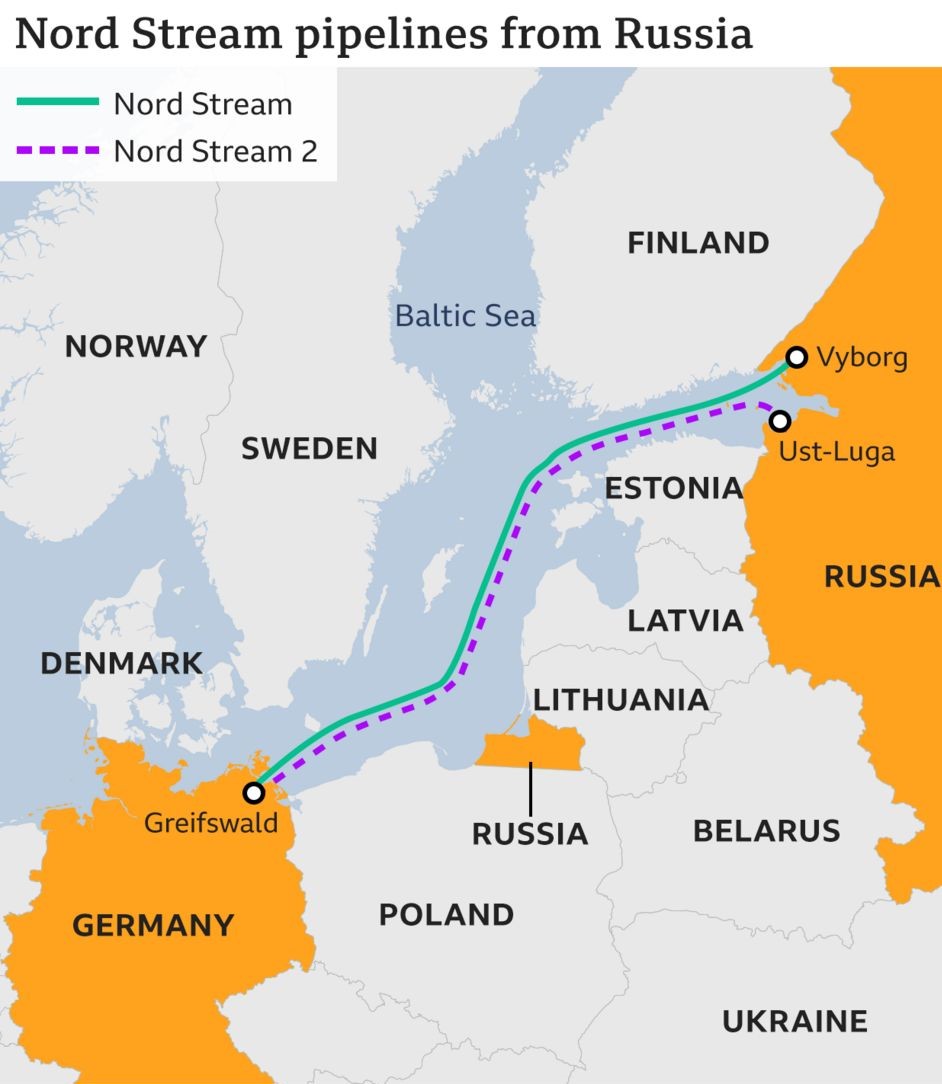
By manipulating energy markets, Putin’s immediate objective could not be clearer: he wants to pressurise Europe into approving immediately the operation of Gazprom’s controversial £8.1 billion Nord Stream 2 pipeline.

Now completed, this runs into Germany along the seabed of the Baltic Sea and bypasses Ukraine, in whose eastern regions Russia has been fighting a proxy war since 2014.

Critics say Nord Stream 2 will give too much influence to Russia over regional supplies and their prices.

But crucially, the project is backed by Germany, which puts cheap reliable supplies of Russian gas ahead of the security interests of its east European neighbours. US President Joe Biden’s administration, desperate to repair the damage done to relations with Europe under Donald Trump, has dropped American objections to the scheme.

The result is that Russia can now hold Ukraine and other Eastern European states to ransom. The Kremlin could shut down their gas without having to cut off the rest of Europe. In effect, one group of nations will be played off against the other in a fearful system of divide and rule, with Russia in command.

As Yuriy Vitrenko, the chief executive of Ukrainian energy giant Naftogaz, put it last week: “Moscow is withholding gas supplies in order to coerce Europe into accepting Nord Stream 2. Russia’s actions are the epitome of gas weaponisation. Anyone who refuses to acknowledge what Moscow is doing, especially when it does this so blatantly, is sending a dangerous message to the Russians that they can use gas to blackmail Europe and get away with it.”

TRAGEDY

GIVEN all this, it is almost inevitable that Ukraine will soon be plunged into another security crisis, perhaps even greater than the one that led to the annexation of Crimea in 2014. The fallout would be disastrous, especially in view of the fragility of Europe’s post-Covid economies.

The implications of Russia’s energy strength are brutal, leaving us relentlessly on the defensive. If, for example, Russia invaded Estonia, would NATO respond if Putin threatened to cut off Europe’s gas? The only way to break free from the shackles of energy dependency is to develop our own resources and means of storage.

In the 1970s, Western reliance on Middle Eastern oil created an era of regional conflict and economic crisis.

If today, the same were to happen because of our reliance on Russian gas, that too would be a tragedy.

. Appendage

Standard
Britain, Energy, Environment, Government, Politics, Society

Why the energy crisis? We’re sitting on a gold mine.

ENERGY

THE crisis in the nation’s energy supplies has reached a level unseen for two generations. Nine firms have been liquidated so far this year amid soaring wholesale gas prices, while companies supplying around six million homes are said to be at risk of imminent collapse.

Millions of pensioners and the most vulnerable households now face untold hardship this winter, while others can expect their bills to soar far higher than anything they are used to.

For years now, successive governments have focused on renewables and other non-polluting energy sources as a means of addressing climate change.

DRILLING

The result is that Britain faces an imminent crisis in its energy security. And the worst part? This chaotic and alarming situation should have been wholly unnecessary.

More than 50 years since the first North Sea oil was struck, the British Isles remain surrounded by unexploited oil and gas reserves; while beneath the country’s surface lie layer upon layer of shale.

With careful and environmentally sensitive modern drilling techniques, these untapped gold mines of natural resources could keep our fleet of mothballed natural-gas generators fired up until long-lasting sources of greener energy have been secured.

In decades to come, Britain may well sustain carbon-free energy solutions at huge scale in solar, water and hydrogen. We could even, as Boris Johnson once colourfully put it, become “the Saudi Arabia of wind power”.

But until those technologies have been properly invested in, many fear we now face the prospect of the lights going out just as they did in the 1970s.

Quite simply, Britain must look for alternatives. If we do not, the consequences will be grave.

British Steel is warning that prices are “spiralling out of control” amid an unbelievable 50-fold increase in quoted rates for power.

Yet while the industrial fallout from the present crisis is obviously horrendous, the potential damage to households is even greater.

The current energy “price cap” limits the annual energy bill for UK households at £1,277.

As wholesale prices spiral out of control, the pressure on the regulator to raise the cap, or see the industry strewn with failures, is now almost overwhelming.

Without an eye-watering increase in the price cap of perhaps £400 (some 30 per cent or so), even the biggest players such as Centrica, owner of British Gas which has more than 12 million customers, could be under enormous pressure.

Fixated on “net zero” as part of his political legacy, fresh from delivering his address on Climate Change to the United Nations last week and looking forward to strutting the global stage at COP26 in Glasgow, Boris Johnson has clearly failed to understand the risk to the country of relying excessively on energy purchased from abroad.

It ought to be obvious that surrendering our energy needs to the Moscow-controlled Gazprom (a huge gas supplier to Europe) and a ghastly collection of Middle-East potentates has been a grievous error. Making matters worse, a serious fire on a key undersea electricity cable from France has further limited supplies and shown the value of a reliable domestic source.

So, what are the alternative technologies that the Government should now urgently be exploring to prevent this crisis from worsening still further?

Like many in Scotland, I am sympathetic to the green objections to fracking, from despoiling of country roads to potential earth tremors in nearby urban areas, I would prefer we avoid that path if possible.

Nevertheless, we should not overstate its dangers, and we should certainly not fall victim to untruths about “earthquake” risks and other lurid allegations.

In 2017, for example, the advertising watchdog rapped environmental charity Friends of the Earth for a “misleading” leaflet that claimed fracking can cause cancer.

Meanwhile, one only has to look across the Atlantic to witness the vital strategic gains that can be reaped from regaining a measure of energy independence.

Having risen steadily for 30 years, American imports of oil are now negligible thanks to the fracking revolution, as the process releases oil as well as gas.

Washington, therefore, enjoys somewhat greater freedom in its relations with the dictatorships of the Middle East, and is no longer beholden to those who control the rivers of cheap oil that flow from Arabia’s desert sands.

EXPLORATION

When the UK Government halted fracking in November 2019, it made clear that this was a moratorium, not a permanent ban. If ever there was a moment to rethink this pause, it should be now: especially given that the evidence suggests the “earth tremors” from exploration were far less than originally measured and also confined to a much narrower area than was claimed.

But fracking is only one possibility. A less intrusive way of bringing oil and gas to these shores might be for Boris Johnson to license applications for development of the Cambo field situated some 75 miles to the west of Shetland. This contains more than 800 million barrels of oil as well as considerable potential gas deposits.

Labour leader Sir Keir Starmer may come to regret his opposition to the drilling, which would have created a reported 1,000 jobs, on “carbon emission” grounds.

Similarly, a new modern and safer coal mine in Cumbria has been held up despite the willingness of investors to plough more than £150 million into the project. Instead, coal imports to Britain have been soaring – up 45 per cent in the first quarter of 2021 on the same period last year, to a total of 1.5 million tonnes. Some 60 per cent of Britain’s imported coal comes from – where else? – Russia.

ALARMING

One of the best ways of rapidly delivering a greener and more secure energy supply would be for the Government to commit far bigger sums of money – perhaps as much as £1 billion rather than the £215 million already earmarked – to speed up Rolls-Royce’s plans for “miniature nuclear plants”.

The engineering giant has announced plans to build up to 16 of these so-called “small modular reactors”. Rather than spending decades building huge and inordinately expensive plants such as Sizewell and Hinkley Point, the smaller plants are assembled from “modules” in factories, thanks to technology that is already used in the nuclear turbines that power the Royal Navy’s submarines.

Sure, most sensible people want to see Britain and the world’s carbon emissions fall for the sake of generations to come.

But sacrificing our prosperity and the health and comfort of our people on vociferous green arguments alone – when technology exists that renders this entirely unnecessary – would be unforgivable.

Standard