
LITERARY REVIEW
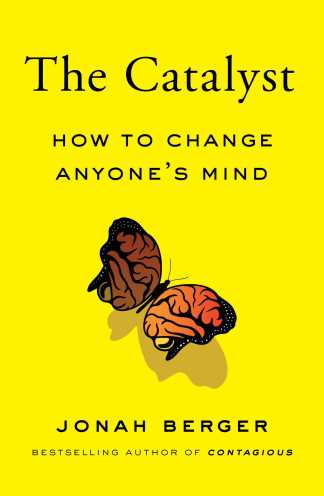
The Catalyst concerns the art of persuasion
JONAH BERGER is a marketing professor at the University of Pennsylvania. His book is about changing people’s minds and he has advised large companies such as Apple and Nike. His approach is one of deftness and subtlety, one in which he doesn’t shout at anyone or by stamping on their toes.
The Catalyst is jam-packed with good ideas with very believable stories. It is perhaps written for those businessmen and women who often attend important business meetings.
When we try to change people’s minds – and we’re talking about everything here: politics, advertising, social attitudes, even the peanut butter you buy – we tend to think in terms of pushing and coercing. But as Berger demonstrates, people just hate being told what to do. “Tell them to vote one way and they’ll probably vote another way just to spite you.”
Berger recommends what he refers to as “reducing roadblocks”. Identify the obstacles and eliminate them.
The first of these he calls “reactance”. This is the anti-persuasion system that kicks in when we think someone is trying to talk us into something. “Encouraging people to persuade themselves”, says Berger. He tells an excellent story about a public health official in Florida who encouraged teenagers to give up smoking by getting the teens themselves to ask the awkward questions.
In one TV ad, they had a couple of teens ring up a magazine executive to ask him why he accepted tobacco advertising. The executive said he supported anti-tobacco ads, but when the teens asked him if he’d run the ads as a public service, he said no: “We’re in this business to make money.” The teens said, “Is this about people or about money?” The executive said, “publishing is about money,” and curtly hung up.
The TV ad worked. Within months, 30,000 teenagers in the state had stopped smoking. It was the most effective prevention programme ever, and it changed teen anti-smoking campaigns the world over.
Berger’s second obstacle is our attachment to the status quo. We like what we already have, and to make any change at all, the improvement must be worth all the fuss of doing it. Say your phone needs updating but you’re fond of your old one, even though it’s falling apart. The salesman’s job here is to highlight that simply not doing anything has costs you might not have spotted, and that change isn’t as hard as it looks.
Berger observes that if you have a product or service that is terrible, you’ll replace it instantly. But if it’s merely mediocre, you might stick with it because changing it is just too much bother.
Berger tells a rather fascinating and brilliant story about Dominic Cummings when he was heading up the Vote Leave (Brexit) campaign. He needed a campaign slogan, and initially he came up with “Take Control”. Which was all right, but he knew that referenda usually fail because people are happy with the status quo. He had to make it seem that leaving was the status quo, not remaining. Which he did by inserting the word “back”: “Take Back Control”. Berger says: “It made it seem like something had been lost, and that leaving the EU was a way to regain that.”
Next up is “Distance”, which I think should be interpreted as how far some people might be from the viewpoint you’d like them to have.
Say that the person you’re speaking to is a Trump supporter and climate change denier, and you want to convince him that transgender rights are a good idea. That’s distance, all right. Berger recommends taking small steps rather than large ones. Ask them to move a little way towards your goal, then ask them to move a bit further.
Berger’s book is full of goodness, but sometimes he’s so opaque you begin to wonder whether English is actually his first language. But that may just be because it’s written for people who use words like “reactance” in everyday conversation.
– The Catalyst by Jonah Berger is published by Simon & Schuster, 288pp
 Arts, reviews & current affairs