
BOOK REVIEW
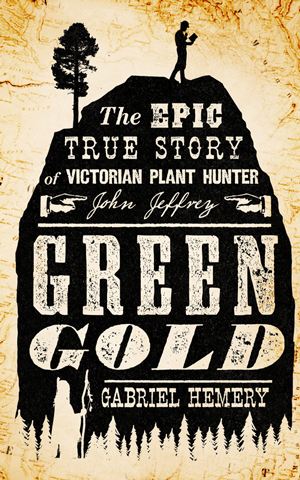
Green Gold by Gabriel Hemery is published by Unbound. It is the story of a brave Scottish botanist who fell of the edge of the world without a trace.
Intro: In 1850 young Scottish plant hunter John Jeffrey is despatched by an elite group of Victorian subscribers to seek highly-prized exotic tree and plant species in North America. An early letter home tells of a 1,200-mile transcontinental journey on foot.
IN Victorian times, plant-hunters were the astronauts of their age. They captured the popular imagination as they set off on exotic expeditions to discover new flora and fauna.
Like space travel today, these excursions were fraught with danger.
When 23-year-old John Jeffrey left his native Scotland for the Pacific coast of North America in 1850, he would have been familiar with the fate of his compatriot David Douglas 16 years earlier. The man, after whom the Douglas fir was named, perished when he fell – or likely was pushed – into a bull-pit in Hawaii.
At least we know what happened to him. For poor Jeffrey, however, who was last seen in San Francisco in 1854, disappeared without a trace. In this captivating book, forest scientist Gabriel Hemery offers the most informed speculation about his fate. Jeffrey kept diaries, now lost. So Hemery, who probably knows more about Jeffrey than anyone alive, has used his extensive research to fictionalise them.
They are interspersed with actual letters and other documents, which record that Jeffrey was despatched to North America thanks to a Victorian version of crowdfunding.
Shares in his expedition cost £5 each, and the list of 140 subscribers reads like a Who’s Who of high society, all looking to enhance their hothouses with the exotica he sent home. Their investment reaped some dividends. Visitors to the Royal Botanic Gardens in Edinburgh can now see the vibrant pink bloom Dodecatheon jeffreyi, also known as Jeffrey’s shooting star, which he found in California.
Jeffrey, a botanist hired by the keeper of that very garden, had never even been out of Scotland before, but soon found himself embarking on the Hudson’s Bay Company ship, the Prince of Wales.
He was tasked with getting across Canada to Vancouver Island, and then down through Washington state, Oregon and California and as far down as Mexico.
His instructions were clear: ‘You will collect seeds of all such trees, shrubs and plants as are not already introduced into this country.’ They wanted him to send back beetles, too. His remuneration was fixed at £80 per annum.
He arrived in Canada in August 1850. He made the long trek west by dogsled and canoe, then crossed the Rocky Mountains on foot. It took him another 12 months to reach the Pacific coast.
In November 1851, a box sent by Jeffrey was excitedly opened in Edinburgh, by members of the Oregon Botanical Association. It contained a few varieties of pine cone, several dead birds, and a small bottle containing beetles. They were underwhelmed.
Jeffrey’s reputation back home seems to have gone steadily downhill after that. He kept sending boxes, but they didn’t contain enough seeds for the Association’s liking. And Jeffrey’s letters and correspondence got fewer and briefer. One tersely explained that, while camping, most of his seeds had been eaten overnight by a rat.
At that time, the California Gold Rush was in full swing. It could well have been that Jeffrey, disillusioned with the comments from Edinburgh, decided that the earth held far more alluring treasures than plants. Hemery’s research has uncovered other possibilities: Jeffrey simply fell in love and absconded, maybe with a Native American woman, and settled down. Or that he was robbed and murdered.
What we know for sure is that Jeffrey’s letters dried up altogether and there were no more sightings of him, to the fury of his paymasters. In March 1854, they decided to relieve him of his duties, even though he had effectively beaten them to it.
The Association’s minutes record little appreciation of what Jeffrey had sent home, yet that amounted to at least 400 plant specimens and the seeds of 199 species.
No attempts were made to find him. But this fascinating book now helps to ensure that he is remembered for his achievements, and not simply for going missing.
– Green Gold by Gabriel Hemery is published by Unbound for £10.99, 280pp
 Arts, reviews & current affairs