
Arts, Books, China

Book Review: The Colour Of The Sky After Rain

MEMOIR

WHEN King George III’s ambassador was trying to negotiate a trade deal in China in 1793, he decided to curry favour with the Emperor by presenting him with a carriage which, thanks to the advancement of British engineering, was splendour in comfort and elegance.

Sadly, this grand gesture was a disaster. The carriage was designed so the driver sat higher up than the passenger – and the idea that Emperor Qianlong should be placed below someone else was gravely insulting to the Chinese.

As the ambassador said ruefully: ‘Nothing could be more fallacious than to judge of China by any European standard.’ More than two centuries later, are we any nearer to understanding China and its customs?

Apart from pandas, pollution, terracotta warriors and the Great Wall, most of us have only the haziest notion of what this vast country, which makes up a fifth of the globe’s population and is the world’s largest economy after the U.S. is really like.

One person who knows China well is Tessa Keswick, who is besotted with the country and has travelled widely there for the past 40 years. The daughter of the Scottish war hero Lord Lovat, she worked in business before becoming Kenneth Clarke’s political adviser, and then Director of the Centre for Policy Studies.

She is married to Henry Keswick, until recently the taipan (boss) of Jardine Matheson, the vast Hong Kong-based conglomerate. He was born in Shanghai: ‘I sometimes think he has Chinese blood in his veins . . . he is often more at home with Chinese than with Europeans,’ she muses.

The Colour Of The Sky After Rain is classified as a memoir but it is also an enticing travel guide.

Keswick has visited places that most foreigners (or guilou) never see and has witnessed first-hand the astounding changes this ‘impossibly difficult and completely fascinating country’ has recently gone through. From superhighways to vast airports, the transformation of the country since the death of Chairman Mao has happened at a dizzying pace – not least because the authorities have the last word in everything and there’s no room for dissent. In China, HS2 would have been built in a flash.

On her trips to the country in the early 1980s, the towns Keswick visited were pitifully dilapidated. She stayed in a hotel where rodents were so veracious that one of her travelling companions found all of the snacks in his suitcase had been eaten during the night, along with his toothpaste and chewing gum.

When she and Henry went on a ‘luxury cruise’ down the Yangtze River, they spotted a body floating past them, ‘a man in a peasant’s red suit, swollen up like a Michelin man . . . behind him comes a pink pig, also inflated with water and air, the four stiff trotters sticking up.’

She couldn’t have foreseen that within a few years, China would have undergone a startling revolutionary change.

The capital, Beijing, has gone from being in a state of ‘morbid depression’ to ‘a glorious modern megalopolis . . . one of my favourite cities in the world.’

While she admires the way millions of Chinese have been lifted out of poverty, Keswick also mourns what has been lost. Ancient towns and buildings have been ruthlessly swept away in the rush for progress, sometimes all too literally.

When the Three Gorges Dam was built on the Yangtze, it flooded thousands of towns and villages and displaced 1.4 million people.

Keswick is an engaging, lively guide and she is at her best when writing about the Chinese landscape.

In Yunnan, said to have some of the most fertile soil in the world, she marvels at thickets of forsythia and forests of camellias – a reminder that about half of the plants growing in British gardens originated in China.

There are useful nuggets throughout the book on how to behave when doing business with the Chinese. Even the smallest attempts at speaking Mandarin are met with delight.

British self-deprecation, on the other hand, goes down like a lead balloon. Commenting that China’s spanking new roads are so much better than British ones is seen as demeaning. ‘The Chinese are attracted by success and by self-confidence, and these generate respect,’ she counsels.

Above all, be punctual. Being late is unacceptably impolite, as the Queen found out on a state visit to China when, most uncharacteristically, she arrived three minutes late for an engagement.

The following day, the Chinese retaliated by being exactly three minutes late for her.

– The Colour Of The Sky After Rain by Tessa Keswick is published by Head of Zeus, 384pp
Standard
Arts, Films

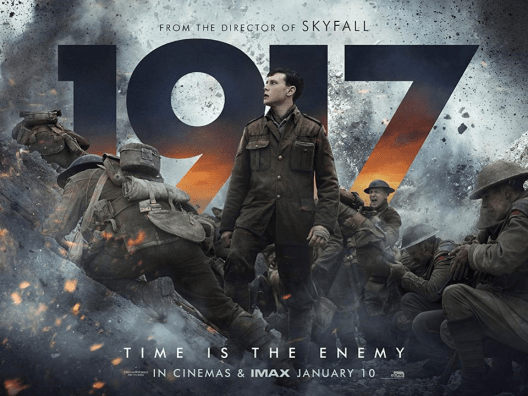
Film Review: 1917 (cert 15)

OSCARS 2020

1917

IT was twenty years ago when Sam Mendes won a coveted Golden Globes double – best drama film and best director – for his debut feature, American Beauty.

Then, Mendes was a 34-year-old movie novice when he won in 2000, precociously brilliant but already well established as a theatre director.

On the eve of this year’s Oscars Mendes looks as if he’s done it again. 1917 is a master stroke. He has fed two decades of film-making experience into this wonderfully powerful picture.

. Film Trailer –

During the centenary years of World War I, some terrific films were made about the conflict. The pick of them was a remarkable 2018 documentary, They Shall Not Grow Old, a treasure trove of original but newly colourised footage which showed that no big-screen dramatisation of trench warfare would ever be quite right, for one striking, if prosaic, reason: in real life, soldiers’ teeth, almost without exception, were terribly rotten.

In every other respect, however, Mendes propels his audience back to the Western Front with the same extraordinary, visceral power.

That’s due to both his skill as a film-maker and the bold simplicity of his story. Bold, because he resists the temptation to introduce layers of plot or characterisation.

He even resists the urge to tell us anew what, thanks to all those familiar animal metaphors, we already know – that our brave soldiers were lions led by donkeys, going like lambs to the slaughter.

Instead, this is an account of a perilous but straightforward mission by a pair of lance corporals, who are handed the challenge of delivering a message intended to save the lives of 1,600 men. To do so, they must cross battle-ravaged no-man’s land and the abandoned German front line at immense personal risk.

It is a partly fictionalised tale, but is inspired by the director’s late grandfather, Alfred Mendes, to whom the film is dedicated.

There are conflicting accounts of that inspiration, with some saying that Alfred Mendes himself delivered such a message. Other accounts suggest that he told his grandchildren stories about others who did so.


EITHER way, this is an intensely personal project. Mendes would undoubtedly be the first to concede his debts both to his Glaswegian co-writer Krysty Wilson-Cairns and, above all, to veteran British cinematographer Roger Deakins, who won an Academy Award for depicting the future in Blade Runner 2049 and is surely a strong contender for another – for evoking the past.

He takes us with these men on their harrowing journey by filming what appears to be (but isn’t quite) a single continuous take. The effect is thrillingly – at time knuckle-chewingly – immersive, and actually the roots of it are in Mendes’s 2015 Bond film Spectre, which began with an eight-minute take.

The director’s theatrical background is also conspicuously influential (like many of his plays), but this unfolds in real time. Mendes has packed cinematic titans Colin Firth and Benedict Cumberbatch to play the top brass.

Mark Strong and Andrew Scott play officers, too.

But, astutely, he has cast as his two lance corporals a pair of actors you may recognise but struggle to name: George MacKay and Dean-Charles Chapman (who was the sulky, mulleted best friend of the Bruce Springsteen nut in last year’s Blinded By The Light). They are the stars of this film, handily reinforcing the message that most war heroes come anonymously from the rank and file.

Chapman plays Blake, chosen because he is adept at map-reading and has a beloved older brother with the endangered division.

A General (Firth) explains tersely that the Germans have retreated, and the Field Commander (Cumberbatch) is about to order an advance, not knowing what aerial reconnaissance has shown, that the enemy has retreated only in order to lure the British into a heavily fortified trap. With phone wires cut, only messengers can stop the otherwise inevitable carnage. So Blake picks his friend Schofield (MacKay) to join him, and their grim-faced Captain (Scott) sends them off with a “cheerio” that is anything but cheerful.

After that, they are on their own; except, of course, that we are with them every step of the way – past the putrefying corpses of men and horses and even cows (shot by the Germans to remove a source of food), through booby-trapped, rat-infested trenches and on into other equally unforgettable visions of hell.

Mendes’s last two films were Skyfall and Spectre, featuring oodles of British derring-do, James Bond style. But 1917 depicts an altogether different kind of courage, forced on two ordinary young men by not only a fierce sense of duty, but an even fiercer instinct to survive.

1917 is a stunning film. Mendes deserves another top gong to be placed among his already overcrowded mantlepiece of film awards and accolades.

Verdict: A masterstroke from Mendes. An award-winning stunner

★★★★★

Standard