
LITERARY REVIEW
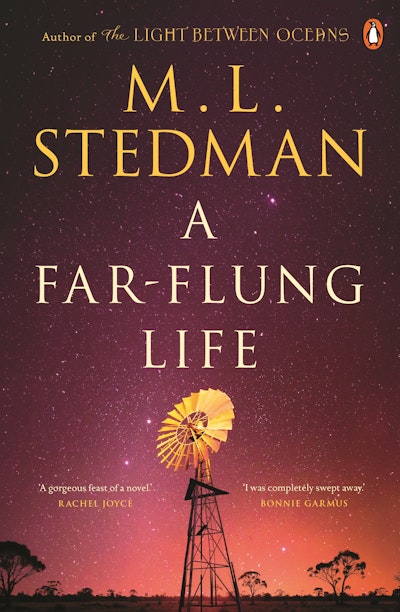
In ML Stedman’s immensely popular 2012 debut, The Light Between Oceans, moral ambiguity was the eddying undercurrent, in a story about a couple who discover a baby on the shores of their remote island home off the coast of Western Australia. That novel spurred an international bidding war and sparked a lacklustre film adaptation. In her second publication, A Far-flung Life, Stedman remains just as preoccupied by what governs our understanding of right and wrong, as well as how we define our sense of family and identity.
Also set in Western Australia, A Far-flung Life begins in 1958 and follows several generations of the MacBride family on their million-acre sheep ranch, Meredith Downs. Here, small decisions have vast consequences: when the patriarch, Phil, swerves to avoid a kangaroo while driving home from the market, he and his eldest son, Warren, are killed. Matt, the youngest son, only just survives. Lorna, suddenly a widow, takes over the reins of the ranch, now the sole parent not only of Matt, whose amnesia from his head injury forces him to redefine who he is and the life he had once hoped for, but also of her “fiery, mercurial” daughter, Rosie.
As the years pass, other figures drift in and out of the MacBride orbit: there’s the taciturn Pete Peachey, a former prisoner of war in Japan who culls the kangaroos on the family homestead; and Miles Beaumont, a dapper Englishman of noble blood who’s learning the ropes on the station. Everyone has their secrets, the albatross they carry. Rosie’s causes her to flee to the outback, though she returns not long after, with a newborn in tow. She, too, will make a decision that reverberates for the MacBrides over the decades – particularly for Matt, who must learn what it means to live a life indelibly marked by unfathomable events.
A recurring theme through this attentive novel is a “forgetment”, a Stedman coinage and idea not for a memory but for a “thing you forget”. The struggle of writing our own narrative when it is violently altered and the way we are shaped as much by conscious knowing as by unknowing (what we hope time will dissolve) – these richly human notions are handled with skilled care. Just as the unflinching land can “rearrange itself without warning or permission”, so can our lives, our sense of self. As Pete Peachey reflects, “’Us’ is an ever-changing thing.” Throughout A Far-flung Life, the at-times herculean labour of weathering that change is shown as not an interruption of life but a part of it.
Time and its fickle passing are insightfully examined. The nature of loss and its temporal warping – where “one minute didn’t have the same length as another” – stands in counterpoint to the indifferent, relentless passage of time on the land. Hours, days, weeks: these human-made creations, the contours of which seem to blur, are only one way we mark our passage. There’s also “the gradual curl of a ram’s horns”, “the stretching and the shrinking of the light”. Stedman elicits, too, how when dazed by grief, one can experience time as stasis: for Matt, forever tied to a cataclysmic single moment, “maybe the roo was always going to bound in front of the truck; was still bounding in some eternal present”.
As the MacBrides learn how to endure the challenges besetting them, it’s a testament to Stedman’s deftness and skill that A Far-flung Life, racked with calamity, only occasionally approaches the mawkish. Every loss feels earned, and what may have otherwise been a syrupy saga is instead a palpable examination of loss, memory, and identity. Her breadth of research is also fully alive in the novel’s expansive detail: the landscape is rendered with intimate familiarity, as is the quotidian minutiae of life on the station. Stedman’s masterful control of perspective, shifting between multiple characters as well as expanses of time and place, culminates in a remarkable, poignant tale.
The moral ambiguity animating the novel lies in things which are best left buried; which parts of a life are allowed to become “forgetments”. This isn’t a question of feigned ignorance but rather of what role forgetting plays in forgiveness – not only of others but of oneself. The author holds the inquiry up like a glimmering piece of quartz, illuminating its shadowed recesses and fractures. The answers, she suggests, aren’t important as the life lived in pursuit of them.
– A Far-flung Life by ML Stedman is published by Penguin, 448pp
 Arts, reviews & current affairs