
Art, Arts, Exhibitions, France

Art: Seurat and the Sea

COURTAULD GALLERY

Intro: A first-of-its-kind Courtauld exhibition brings together the French artist’s haunting seaside paintings
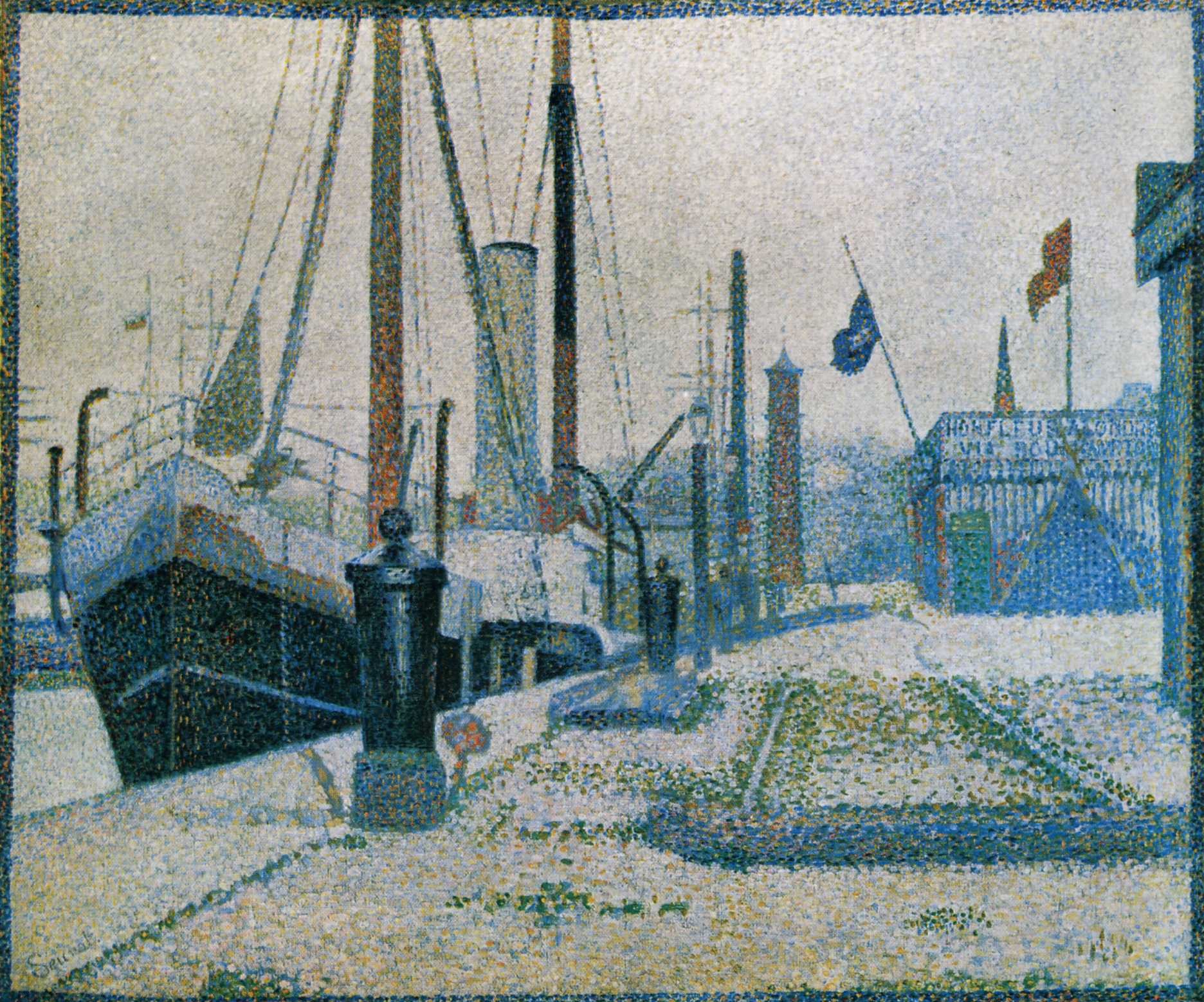
– Join the dots: Georges Seurat’s La Maria at Honfleur (1886)

Never before has there been an exhibition of seascapes by Georges Seurat, which is odd, given that the short-lived French artist’s “marines” make up the bulk of his output. So, the Courtauld in London – which excels at jewel-like exhibitions based on enterprising scholarship – deserves praise for mounting one. Let’s be clear, though. Seurat’s chilly Channel views are magnificently weird. But if that puts you off attending and buying a ticket at the exhibition, you should at least give the show and gallery a chance.

Seurat is remembered above all as the painter of interminable dots. By the time of his death in 1891, at the age of 31, he had produced only a handful of major canvases, mostly speckled with tiny spots and flecks of pigment, applied according to a rigorous and quasi-scientific method. (A Sunday on La Grande Jatte – 1884 (1884-86), in the Art Institute of Chicago, is undoubtedly the most famous.) As he result, he came across as an automaton. Compared with other modern artists, he’s uptight and hard to love.

Some will not be sure whether the Courtauld’s show of 26 works – including attractive oil sketches and preparatory drawings in Conté crayon, alongside 17 canvases – will convince sceptics that Seurat had a heart. His dotty views of ports and the open sea, produced on the northern coast of France over five summers between 1885 and 1890, contain anthropomorphic elements: masts, semaphores, bollards, buoys. But, with one or two matchstick-like exceptions, these seascapes are devoid of people.

The effect is rather uncanny, as if his subject were a model village. By representing glittering sunshine, fluttering pennants, and sailboats bobbing about on enticing, turquoise water, these pictures suggest summer holidays. But where are the holidaymakers? Seurat’s contemporaries sensed a “penetrating melancholy” in his seascapes, which, for all their luminosity, appear to anticipate the eerie landscapes of Giorgio de Chirico.

Nonetheless, Seurat was clever and original. Earlier artists, tackling marine themes, depicted seething waves; Seurat’s seas are calm as a millpond. His canvases are expertly composed and executed. They seem to contain the seeds of geometric abstraction and Op Art, even Minimalism.

Conceived during his final summer, and set at dusk, The Channel of Gravelines: An Evening (1890) is a meticulous mini-symphony in shades of purple, rose, and pink. In it, are established curious and yearning dynamics between inanimate objects – including, in the foreground, a lamppost and two prominent anchors that seem to move in concert, like synchronised swimmers. Seurat rejected the idea that his works contained “poetry”, arguing: “I apply my method and that is it.” Yet, others will say that if this wistful and mysterious painting isn’t what poetry looks like, then what does? 

Standard
Art, Artificial Intelligence, Arts, Culture, Society, Technology

AI-generic-slop is theft from real artists

CREATIVE ART

Intro: Art generated by online tools is painfully bland and is leading us down the path to cultural stagnation

Pablo Picasso, one of the most influential artists of the 20th century, admitted that “Great artists steal.” The Spanish genius assimilated African mask imagery into modern art, and many other greats throughout history have done something similar. Essentially, this is how creativity works. But behind their masterpieces are struggle, friction, and unique vision. Enter another entirely different beast, the theft by proliferating AI engines. These are killing creativity, harming real artists, and fuelling an epidemic of unoriginality.

By serving prompts to generators such as Midjourney or DALL-E, people can generate images on screen, in just a few seconds. Anyone can conjure up a Vincent van Gogh-styled still life or Leonardo da Vinci-inspired selfie and at once exhibit it online. Social media platforms such as X are filled with fans of this technology who declare: “AI art is art.” But this doesn’t make it true.

In fact, AI “art” doesn’t even exist – it is an illusion. AI models work on pattern recognition, not artistic decision making. While an “AI artist” may serve prompts to this technology, they cannot be considered the author of its output. It has simply been remixed from ready-made imagery without thinking, feeling, intent, or ingenuity. Absent from AI “art” is creative process, which should take more than a few seconds. This is apparent in the low-quality, generic slop that’s produced. Lacking a distinctiveness of style and voice, it can only offer a dynamic of smooth homogeneity.

It bypasses craft, which is what great artists develop – with brushes and paint, pencils and paper – over months, years, and even decades. AI artists celebrate the power of technology to make creativity accessible, and this forms their central argument and tenet as to why it’s so great. True craft, however, takes dedication, consistent practice, and experimentation.

John Constable not only worked tirelessly inside his studio but made countless studies en plein air – as revealed in Tate Britain’s current exhibition, Turner & Constable. Celebrating two of Britain’s greatest painters, it shows what being an artist really takes. On display are watercolours, oils and sketches, as well as paint-covered palettes, paintboxes, and even a sketching chair.

Among Constable’s masterpieces is his 1836 work Hampstead Heath with a Rainbow, where prismatic hues glide through menacing clouds. His technique looks effortless but was suffused with genius-level skill. And behind it, unseen by the average enthusiast, are more than 100 cloud studies he created in an attempt to capture their transient energy.

Where AI generates pictures in an instant, Constable was committed to an ongoing process; the experience gained through observation and documentation was ultimately of immense benefit to him.

Similarly, JMW Turner made around 37,000 sketches of landscapes he’d seen with his own eyes. Determined to evoke the raw power of nature – from blazing sunsets to howling storms – he pushed realism towards abstraction with an excitement that’s visible in his energetic brushstrokes.

In contrast to Constable and Turner’s radical compositions, AI’s aesthetic is flat, twee, and often old fashioned. Defined by a saccharine palette of candy colours and hazy tones, automatically generated landscapes are hollow, sanitised, and no match for Britain’s great painters and artists. Working some 200 years ago, they painted emotive, not idealised, places of both personal and historic significance.

What is more, both Constable and Turner began their paintings by looking, and really observing the world. This fundamental act is absent from the process of AI’s so-called artists who are more like a client giving instructions to a graphic designer than an artist painting at their easel. AI engines are also doing real harm to contemporary artists and their hard work.  

Among those who have already experienced its damaging effects is Australian painter Kim Leutwyler. She says her distinct style has been copied by app-generated portraits. “My issue isn’t with AI itself, but with the unethical way it has been trained without artists’ consent,” she said. “The right to opt in or out of having your data scraped for AI training should be fundamental, not optional.” This view is widely held across all of the creative industries.

AI, then, is pilfering from artists, the very people it relies on. It harms us all with its blandness. Rather than moving art forward, like Turner and Constable did in their day, it contributes to what has been termed “cultural stagnation”.

Anyone infuriated by Hollywood’s endless remakes of viewer favourites has a similar impact. It threatens both originality and individual thinking. And because future AI will only draw from more of this generated material, it will continue to create typical rather than unique visions.

AI art isn’t art, it’s a mirage, and it won’t be looked at for longer than a doom-scrolling second. In our world of efficiency and productivity, creative pursuits are one of very few remaining places where human endeavour is vital. Behind the brushstrokes of Turner and Constable are years of looking, thinking, making and struggle, and that’s what creative art is.

Standard
Afghanistan, Art, Arts, Britain

Afghanistan cartoon & sketch

– Credit image and artwork: Paul Thomas

Afghanistan sketch

NOW that the Taliban have retaken Afghanistan without encountering any serious resistance, they’ve embarked on a public relations offensive. We are being asked to believe in Taliban 2.0, a new caring, sharing, cuddly version. Out go stonings and beheadings, in come women’s rights. Having once banned singing and dancing, the mullahs are now embracing fun. Photos have emerged of Taliban fighters driving dodgems, with their rifles on the passenger seat, and frolicking on a merry-go-round.

Ride a painted pony . . .

There was another snap of a Taliban warrior working out in a gym – with a rocket launcher over his shoulder. Feel the burn! So despite reports that they’ve already started murdering Afghans who collaborated with the Americans and British, and dragged girls as young as 12 from their homes to be forcibly ‘married’, the Taliban want the world to think they’ve reformed. The soft-headed Hard Left, particularly in Britain, are willing to give them the benefit of the doubt.

If you swallow that moonshine, you’re a better man than I am.

Standard