
China, Defence, Government, Politics, Society, United States

China’s hypersonic missiles and its threat to the West

HYPERSONIC MISSILES

UNTIL very recently, few people outside of the military, intelligence and security services and the defence industry, had heard of hypersonic missiles or had an inkling as to what they were or their significance.

The revelation that China has tested such a missile – and that it was nuclear-capable – has sent shock waves around the world. The fact that it missed its presumed target by up to 24 miles brings scant comfort.

While the US is continuing to develop its own hypersonic missile, Russia has already tested them and even North Korea has claimed to have test-fired one. China is not alone but it has shown it is far more advanced than the West suspected.

Washington and other world capitals are now waking up to the implications of Beijing possessing a missile that can circle the globe at five times the speed of sound – and can sneak under the radar of US anti-missile defences.

The missile, carried on a “hypersonic glide vehicle”, was launched into space by rocket boosters (like those that launch spacecraft) in August. When they run out of fuel – typically within minutes – the boosters detach and fall away, and the glide vehicle continues to orbit the Earth at nearly 4,000mph, under its own momentum.

Although slower than ballistic missiles, hypersonic missiles fly at much lower trajectories – more like cruise missiles – so are easier to manoeuvre and harder to track. Such a weapon could help negate American defence systems. They are designed to destroy incoming ballistic missiles which soar high into space before descending on their target.

Certainly, China’s achievement is a game-changer in East-West relations. For a generation, the West has been used to China manufacturing more and more of what we buy as consumers. More than a quarter of manufactured goods, for example, bought in America are made in China. But when it came to high tech items, not least in the defence sector, the assumption was that the US still held a distinct edge over China.

In the space of just a few weeks that complacency has been rocked to its core. Even before the disclosure of the Chinese hypersonic test, the Pentagon had warned that Beijing was heading for global dominance because of its advances in artificial intelligence (AI), machine learning and cyber capabilities – and that gap was growing.

ANTI-BALLISTIC MISSILE SYSTEMS

THERE has been anger within the higher echelons of the Pentagon at the slow pace of technological transformation in the US military.

What the advent of hypersonic weapons does is shatter faith in anti-ballistic missile (ABM) systems because these are our guarantee against a surprise attack by a nuclear-armed rival. China’s new hypersonic missile launch puts the West on notice that its technological advantage is an illusion.

ABM defence systems, such as the American Patriot, point up at missiles incoming in a supersonic arc through outer space from launch pad to target. Targeting a low-flying hypersonic missile which harnesses AI to dodge defences is a vastly harder prospect.

Since the 1980s, America has invested billions in anti-missile defence. It was started by President Ronald Reagan who believed effective defence against ballistic missiles would reduce the risk of nuclear war – making disarmament and peace possible.

Sadly – as so often in history – scientists have found ways around apparently invulnerable defence systems. German tanks bypassed the incredibly sophisticated French fortifications that made up the Maginot Line in 1940 by diverting through Belgium. Now hypersonic missiles effectively undercut America’s anti-ballistic Maginot Line mentality.

CHINA’S UPSWING AND STRENGTH

BACK in the 1980s, the architect of China’s extraordinary economic upswing, leader Deng Xiaoping, advised future Chinese leaders to ensure their country rose “unobserved”. Deng recognised that China must bide its time until it reached full spectrum domination, from the military to the economic spheres. That meant avoiding antagonising rivals and neighbours.

Today’s leader, President Xi Jinping, is more inclined to exploit China’s new heavyweight standing. From border disputes with India to bullying breakaway Taiwan, Xi has been flexing his muscles. Indeed, Taiwan is the most likely flash point between the superpowers. President Xi is bent on reunifying the Chinese-speaking island democracy, while, after his humiliating retreat from Afghanistan, President Biden is determined not to look weak over Taiwan.

What if Beijing thinks American public resolve is just bluff and makes a land grab for the island? Miscalculation leads to world wars. In the 20th century, the democracies led by Britain and the US came out on top in two world wars. The Americans guided the West to a peaceful defeat of Soviet Communism in the Cold War.

But past glories do not guarantee future victories. Nor do decades of mutual nuclear deterrence between Washington and Moscow mean that the growing number of other nuclear-armed states will show the self-restraint of the Cold War era.

Any war between nuclear-armed states is too horrible to contemplate – or should be. But the development of hypersonic missiles and new AI weaponry raises the terrible spectre of Chinese Dr Strangeloves calculating the chances of emerging from their bunkers into a post-atomic desert as the world’s only superpower.

When Mao said that the Chinese would outnumber all the other survivors of any nuclear war 60 years ago, the then Soviet leaders thought he had gone mad and promptly cut nuclear cooperation with his regime.

Maybe today’s vastly more powerful and technologically sophisticated Communist China has escaped from Maoist thinking. But if it hasn’t, it is fast acquiring the futuristic weaponry to put its founder’s chilling words into practice.

Worst case scenarios are never certain. But planning for the best case is never wise. China’s military modernisation is going at hypersonic pace. The West will be worried. It must catch up – and fast.
Standard
Afghanistan, China, Middle East, Politics, Society

China preparing to capitalise in Afghanistan

ESSAY

Intro: Just days after the U.S. and its Coalition partners prepare to leave Afghanistan, China is preparing to gain a direct route to the riches of the Middle East. With billions in the Chinese war chest, just where will China’s ambitions end?

THERE is a reason why Afghanistan is known as “the graveyard of empires”. Every few decades this beleaguered nation emerges from obscurity to remind an apparently invincible invader that his army is not the first to bite the bitter dust there. Afghanistan is littered with examples of invading armies sent into retreat and heavy defeat. 

In 1842, the first of Britain’s four Afghan wars ended in catastrophe. Only one man survived from a force of about 4,500, plus 10,000 or so camp followers, linguistic interpreters, and local allies – and he was set free only so he could recount the scale of the defeat and the dire end of his comrades.

After ten years of brutality trying to convert Muslim Afghans into ‘modern’ communists, the once mighty Red Army found itself in humiliating defeat from Afghanistan in 1989. It would mark the beginning of the rapid fall of the Kremlin’s dominoes from Eastern Europe to Moscow itself.

Today, we see the U.S. and its coalition partners leaving Afghanistan in defeat after almost 20 years; the superpower discovering that Afghanistan’s fragmented tribal culture masks an unbreakable resilience. President Joe Biden, a recent convert to the cause of ending what he has described as a “forever war”, has set a deadline of September 11 for the last American troops to leave.

It is, of course, a highly symbolic act that marks 20 years since the 9/11 attacks by Al-Qaeda – which had its training camps in Afghanistan – that destroyed the World Trade Centre in New York.

Within two months of the invasion in October 2001 by the U.S.-led Coalition forces, Al-Qaeda’s leader, Osama bin Laden, had fled to Pakistan and the fundamentalist Taliban routed. But the mission soon lost its way, at a cost of thousands of military and civilian lives.

Now the U.S. cannot get out fast enough, abandoning its huge airbase at Bagram overnight on 2 July. Today, the situation around the capital Kabul is chaotic, its population in panic, and the Taliban is sweeping back into territory it had been forced to flee by Coalition forces.

Afghan soldiers loyal to the fragile Western-backed Kabul government are being routed. After clashes with newly strengthened Taliban units, an estimated 1,600 have fled and dispersed across the border into neighbouring Tajikistan.

Others have abandoned their weapons and uniforms to return to their homes or switched to fight with the Taliban, which is also taking territory it did not hold prior to the Coalition’s arrival.

Despite more than $2.3 trillion spent waging a war against a badly armed and underfed ragtag of rebels, the Americans leave their enemy in better shape than ever before.

But this will not deter the world’s newest superpower – China – which is waiting patiently in the wings. The Dragon of China will soon enter the fray.

In a development that should strike fear through Western capitals, Beijing scents an unrivalled opportunity to extend its influence in the region and gain strategic territorial and economic advantage that could rewrite the geopolitical map in its favour.

For President Xi Jinping’s Marxist government, Afghanistan is a prize beyond measure. It offers a portal through which Chinese military might could access the Arabian Sea, via Iran or Pakistan.

And the war-torn country could provide two other things China desperately wants: overland access to Iran and the Middle East, and a route to the Indian Ocean and on to Africa.

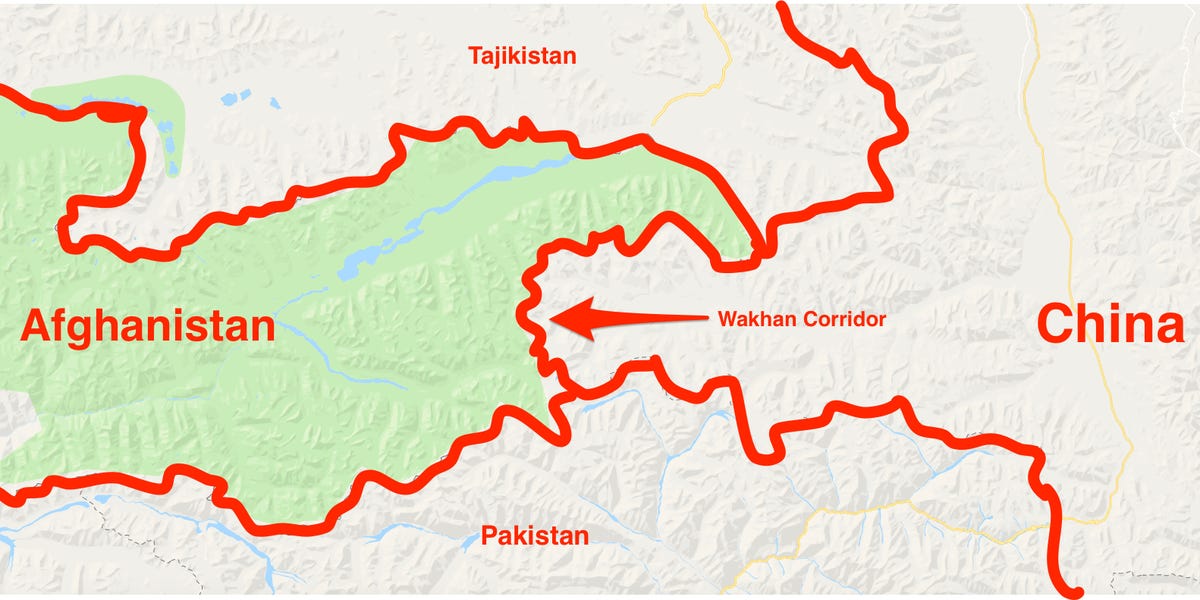
To reach these markets currently, Chinese goods must go the long way round, via container ships through the disputed South China Sea. But the short border Afghanistan shares with north-western China offers potential for a mega-highway, a high-speed rail link and fuel pipelines.

Beijing is confident that it can succeed where Whitehall, the Kremlin and the White House have failed over the centuries, for the simple reason that it is not interested in transforming Afghan society.

It has learned from the mistakes of the Russian communists. Chinese communists have no desire to remake Afghanistan (or anywhere else) in their own image.

Threat

Nor will its goals be achieved by brute force; President Xi has a far smarter plan. When the Kremlin occupied Afghanistan in 1979, it saw it as a steppingstone to dominating the oil-rich Middle East, but Soviet communism had little to offer compared with the wealth of modern China.

Xi prefers to use financial muscle as much as the threat of military power and, if reports that Beijing is prepared to invest $62 billion in Afghanistan are true, it is following a blueprint perfected in many countries from Malaysia to Montenegro.

Under a policy known as the Belt and Road Initiative (BRI), vast loans are offered to cash-strapped countries for infrastructure projects. In return, China gains access to new trade routes and ports, as well as banking hefty interest payments on its investment.

If the repayments are late, the Chinese could step in to reclaim land, mineral rights, or other collateral as compensation. It is a business plan more common in the underworld of gangsters and organised crime groups: victims are lured into a “debt trap” and forced to repay, one way or the other.

In return for its largesse, China will also expect the Taliban to ignore the “genocidal” oppression of their fellow Muslims, the 12 million Uighurs in China’s Xinjiang province, which sits close to the Afghan and Pakistani borders.

The last thing Beijing wants is an anarchic scenario in which a rise in Islamic fundamentalism on its border threatens domestic security in China.

But it has seen how indifferent strict Islamic regimes in the Middle East are to Uighur rights. The oil-rich Arab monarchies will much prefer doing lucrative deals with Beijing than bothering about its treatment of fellow Muslims.

Pakistan’s Prime Minister, the former international cricketer Imran Khan, who cynics argue has reinvented himself as a born-again Muslim to cement his political power base, has spoken up about the Uighurs – but only to defend China’s handling of them.

And even before Khan came to power, Pakistan’s generals saw the Taliban as a natural ally against their number one adversary, India. China, too, is at daggers drawn with India, so it will view an anti-India Taliban regime in Kabul as a possible ally.

Uncertain days lie ahead and as the remaining American troops gather to stockade the U.S. Embassy in Kabul and protect the dwindling band of Westerners there, there are many observers who recall evacuation of the U.S. embassy in Saigon in 1975. 

Similar humiliating scenes are likely in the coming weeks. Up to 1,000 U.S. troops are expected to be stationed at Kabul Airport to protect departing Western civilians.

Bleak

That will be little comfort to all those Afghans who have worked bravely with Coalition forces over more than two decades trying to improve life for their own people. Betrayed, their future is now bleak.

And, as for our pledges to women and girls – with the likely return to power in Kabul of the Taliban – they will lose those rights and freedoms that Allied intervention had brought.

China sees Afghanistan – even with the Taliban back in control – as one of the most crucial squares on the chessboard of world politics. And like a chess grandmaster, President Xi Jinping is not planning for a quick checkmate.

Historians will no doubt look back at what is happening now and see that China did indeed learn the lessons of history. Where Britain, Russia and America have failed, it may yet triumph, gaining the influence it seeks without having shed the same terrible price in blood and human sacrifice.

Appendage

– Afghanistan and China share a short 46-mile border. Afghanistan has huge strategic importance for China.
Standard
Arts, Books, China

Book Review: The Colour Of The Sky After Rain

MEMOIR

WHEN King George III’s ambassador was trying to negotiate a trade deal in China in 1793, he decided to curry favour with the Emperor by presenting him with a carriage which, thanks to the advancement of British engineering, was splendour in comfort and elegance.

Sadly, this grand gesture was a disaster. The carriage was designed so the driver sat higher up than the passenger – and the idea that Emperor Qianlong should be placed below someone else was gravely insulting to the Chinese.

As the ambassador said ruefully: ‘Nothing could be more fallacious than to judge of China by any European standard.’ More than two centuries later, are we any nearer to understanding China and its customs?

Apart from pandas, pollution, terracotta warriors and the Great Wall, most of us have only the haziest notion of what this vast country, which makes up a fifth of the globe’s population and is the world’s largest economy after the U.S. is really like.

One person who knows China well is Tessa Keswick, who is besotted with the country and has travelled widely there for the past 40 years. The daughter of the Scottish war hero Lord Lovat, she worked in business before becoming Kenneth Clarke’s political adviser, and then Director of the Centre for Policy Studies.

She is married to Henry Keswick, until recently the taipan (boss) of Jardine Matheson, the vast Hong Kong-based conglomerate. He was born in Shanghai: ‘I sometimes think he has Chinese blood in his veins . . . he is often more at home with Chinese than with Europeans,’ she muses.

The Colour Of The Sky After Rain is classified as a memoir but it is also an enticing travel guide.

Keswick has visited places that most foreigners (or guilou) never see and has witnessed first-hand the astounding changes this ‘impossibly difficult and completely fascinating country’ has recently gone through. From superhighways to vast airports, the transformation of the country since the death of Chairman Mao has happened at a dizzying pace – not least because the authorities have the last word in everything and there’s no room for dissent. In China, HS2 would have been built in a flash.

On her trips to the country in the early 1980s, the towns Keswick visited were pitifully dilapidated. She stayed in a hotel where rodents were so veracious that one of her travelling companions found all of the snacks in his suitcase had been eaten during the night, along with his toothpaste and chewing gum.

When she and Henry went on a ‘luxury cruise’ down the Yangtze River, they spotted a body floating past them, ‘a man in a peasant’s red suit, swollen up like a Michelin man . . . behind him comes a pink pig, also inflated with water and air, the four stiff trotters sticking up.’

She couldn’t have foreseen that within a few years, China would have undergone a startling revolutionary change.

The capital, Beijing, has gone from being in a state of ‘morbid depression’ to ‘a glorious modern megalopolis . . . one of my favourite cities in the world.’

While she admires the way millions of Chinese have been lifted out of poverty, Keswick also mourns what has been lost. Ancient towns and buildings have been ruthlessly swept away in the rush for progress, sometimes all too literally.

When the Three Gorges Dam was built on the Yangtze, it flooded thousands of towns and villages and displaced 1.4 million people.

Keswick is an engaging, lively guide and she is at her best when writing about the Chinese landscape.

In Yunnan, said to have some of the most fertile soil in the world, she marvels at thickets of forsythia and forests of camellias – a reminder that about half of the plants growing in British gardens originated in China.

There are useful nuggets throughout the book on how to behave when doing business with the Chinese. Even the smallest attempts at speaking Mandarin are met with delight.

British self-deprecation, on the other hand, goes down like a lead balloon. Commenting that China’s spanking new roads are so much better than British ones is seen as demeaning. ‘The Chinese are attracted by success and by self-confidence, and these generate respect,’ she counsels.

Above all, be punctual. Being late is unacceptably impolite, as the Queen found out on a state visit to China when, most uncharacteristically, she arrived three minutes late for an engagement.

The following day, the Chinese retaliated by being exactly three minutes late for her.

– The Colour Of The Sky After Rain by Tessa Keswick is published by Head of Zeus, 384pp

Standard