
Britain, Economic, Energy, Europe, Government, Politics, Russia, Society

Energy crisis: We’re at the mercy of Putin. It’s all our fault

ENERGY

THE Berlin Wall may have been brought down more than three decades ago, but the grim politics of the Cold War are in danger of returning to Europe.

With characteristic ruthlessness, Russian president Vladimir Putin is exploiting the energy crisis to bully his neighbours, strengthen his autocracy and intimidate the West.

His chosen weapon in this renewed campaign of hostility is Russia’s control of gas supplies: the vast gas-fields and the export pipelines that bring them directly to market.

This infrastructure, often legacy assets from the Soviet empire, give the Russian president enormous political and economic leverage in his quest for ever-greater domination of the region.

Russia’s capacity to manipulate the British and European energy markets for geopolitical ends has been dramatically illustrated during the turmoil of recent days and weeks. As the price of gas contracts soared by 40 per cent in just 24 hours last week, Gazprom, Russia’s state-backed monopoly exporter of pipeline gas, was accused of flexing its muscles by both restricting supplies to Europe and keeping its European underground storage facilities at deliberately low levels.

The sense of Russian control was further reinforced when it took just a few words from Putin himself to bring an immediate fall in gas prices.

Revelling in his position as the ultimate ringmaster and wire-puller, he said with a hint of blackmail that supplies could be increased. “This speculative craze doesn’t do us any good,” he said, adding that Europe’s leaders should “settle with Gazprom and talk it over”.

RELIANCE

PUTIN might be behaving like a mafia boss in charge of a protection racket, but British and European governments have for years disastrously played into his hands with misguided, short-term policy decisions.

To be fair, the EU has taken some steps to break the Russian stranglehold, by building new international pipelines, breaking the Kremlin’s east-west transit monopoly, and by introducing drastic reforms of the energy market that have unravelled the corrupt, exploitative business model.

Europe has also pioneered the import of liquified natural gas (LNG) from destinations such as Qatar.

Yet Europe has been increasing its reliance on supplies from outside the continent by running down its own domestic energy industries. So far, renewables have not made up the gap, especially in recent months when the wind has not been blowing.

In Britain, the problem is particularly acute because we are one of Europe’s largest gas users, while we have massively reduced gas production from the rich fields of the North Sea and Irish Sea over the past 20 years.

Nor have we made use of the vast reserves of shale gas that exist across the country, even though such resources have recently made America “energy independent” once more.

Instead, Britain has exacerbated its energy vulnerability by depending on just-in-time imports from pipelines and seaborne cargoes.

In a particular act of folly, the Tory Government in 2017 decided to close the huge storage facility on the Yorkshire coast connected to the Rough gas field, believing both that supplies of LNG would always be plentiful and also because the energy companies believed that limiting storage would boost prices and thereby profits.

Some four years later, the step has backfired catastrophically, leaving us at the mercy of Putin.

Indeed, our entire energy strategy has been marked by stinginess, wishful thinking and downright complacency.

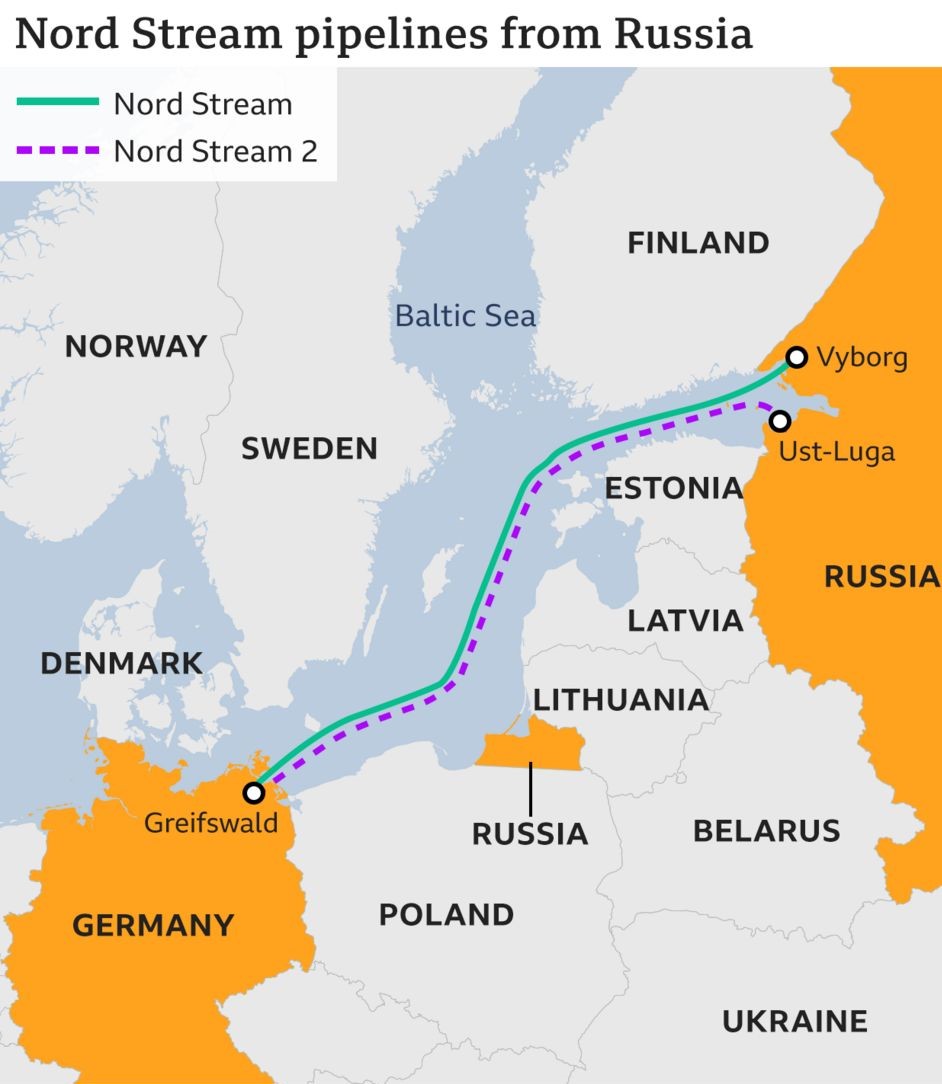
By manipulating energy markets, Putin’s immediate objective could not be clearer: he wants to pressurise Europe into approving immediately the operation of Gazprom’s controversial £8.1 billion Nord Stream 2 pipeline.

Now completed, this runs into Germany along the seabed of the Baltic Sea and bypasses Ukraine, in whose eastern regions Russia has been fighting a proxy war since 2014.

Critics say Nord Stream 2 will give too much influence to Russia over regional supplies and their prices.

But crucially, the project is backed by Germany, which puts cheap reliable supplies of Russian gas ahead of the security interests of its east European neighbours. US President Joe Biden’s administration, desperate to repair the damage done to relations with Europe under Donald Trump, has dropped American objections to the scheme.

The result is that Russia can now hold Ukraine and other Eastern European states to ransom. The Kremlin could shut down their gas without having to cut off the rest of Europe. In effect, one group of nations will be played off against the other in a fearful system of divide and rule, with Russia in command.

As Yuriy Vitrenko, the chief executive of Ukrainian energy giant Naftogaz, put it last week: “Moscow is withholding gas supplies in order to coerce Europe into accepting Nord Stream 2. Russia’s actions are the epitome of gas weaponisation. Anyone who refuses to acknowledge what Moscow is doing, especially when it does this so blatantly, is sending a dangerous message to the Russians that they can use gas to blackmail Europe and get away with it.”

TRAGEDY

GIVEN all this, it is almost inevitable that Ukraine will soon be plunged into another security crisis, perhaps even greater than the one that led to the annexation of Crimea in 2014. The fallout would be disastrous, especially in view of the fragility of Europe’s post-Covid economies.

The implications of Russia’s energy strength are brutal, leaving us relentlessly on the defensive. If, for example, Russia invaded Estonia, would NATO respond if Putin threatened to cut off Europe’s gas? The only way to break free from the shackles of energy dependency is to develop our own resources and means of storage.

In the 1970s, Western reliance on Middle Eastern oil created an era of regional conflict and economic crisis.

If today, the same were to happen because of our reliance on Russian gas, that too would be a tragedy.

. Appendage
Standard
Britain, Europe, France, Government, History, Military, Society, United States

75th Normandy Commemoration

NORMANDY

SEVENTY-FIVE years ago, Britain had embarked on its most momentous military mission. Upon the outcome of D-Day, June 6 – the largest seaborne invasion the world has ever seen – hinged the very freedom of all Europe. Events this week in Normandy have been an impassioned reminder of the huge sacrifice and human cost of liberating Europe from the tyranny of Hitler and the Nazis.

Codenamed Operation Overlord, it was an endeavour of mind-blowing scale and complexity. Some 156,000 British, American and Canadian troops landed on French soil in a heroic push to prise Hitler’s choking grip from the Continent.

Few were highly experienced, meticulously trained military men. Most were plucked from loving families and ordinary jobs: Insurance clerks, shopkeepers, postmen.

Displaying unimaginable courage, they stormed the chaotic Normandy beaches. It was, undoubtedly, hell on Earth – wading ashore into a hail of bullets, with shells exploding, the sea red with human blood, and the piercing screams of the dying.

Quite easily, the enterprise could have foundered – leaving Europe caught in the death roll of Nazi dictatorship. But thanks to the tenacity and sacrifice of the selfless men who fought that tumultuous day in 1944, the attack succeeded – altering the course of the Second World War.

Yes, the human price paid was huge. On D-Day alone, around 4,400 Allied troops paid the ultimate sacrifice. But tyranny was conquered, and the Continent liberated.

This week, a dwindling band of military veterans were joined by royalty and world leaders in Portsmouth – an embarkation point for the battle – to commemorate the anniversary. To witness the intrepid warriors – all aged over 90 – wiping away tears for fallen comrades was moving and humbling.

Her Majesty the Queen commended the resilience of the “wartime generation”. The bravery of those who fought – and died – would never be forgotten, she said. They deserved the thanks of the whole free world.

Truly, the debt our heroes are owed cannot be repaid.


YET, what would these exemplary men, who stoically stared death in the face when barely out of short trousers, make of today’s intemperance and bigotry?

In attendance was Jeremy Corbyn, who aspires to be prime minister, but who invariably fraternises with our enemies. His contempt at President Trump being an honoured guest at the anniversary was visceral – even though American GIs died to preserve our liberty. The US, via NATO, has ensured peace in Europe ever since.

Earlier, he whipped his Marxist acolytes into such a frenzy of hate an NHS worker ignorantly shrieked “Nazi scum” in the face of a Trump supporter.

Welcome, then, to the new intolerance of the hard-Left. Anyone failing to share their bigoted and hateful views is branded racist or fascist – even at events celebrating freedom.

Since these buffoons have clearly never read a history book, here’s a lesson: The Nazis murdered six million Jewish people, and stamped the evil of fascism across Europe. Someone who merely proffers a different opinion is not a Nazi.

Each time these screeching fanatics resort to such disgusting slanders, they cheapen the very ideals the veterans fought for.

250 giants of D-Day, now frail but burning with the valour that carried them to victory, returned to Normandy in an act of pilgrimage. They witnessed the inauguration of the first British monument on the coast of France to honour the 22,442 members of our Armed Forces killed there.

Seventy-five years ago, Britain had far more to worry about than the present political turmoil of Brexit. The future of the world was in the balance.

But even after we have untangled ourselves from the EU, Europe will remain our historical and geographical kin. In times of danger, Britain will resolutely defend the freedoms given to us by the band of brothers on D-Day.

Standard
Britain, Europe, NATO, Nuclear Weapons, Russia, United States

The nuclear détente withdrawal makes the world far more dangerous

ARMS CONTROL TREATY

TENSIONS between the world’s two nuclear superpowers have reached a level not seen since the early 1980s.

During an election rally in Nevada, President Trump said that Russia was cheating on the 1987 arms control treaty. The treaty banned land-based cruise missiles in Europe.

An agreement had been made back in 1987 between Ronald Reagan and Mikhail Gorbachev – leaders who trusted each other enough to take a decisive step in ending the arms race which had been a key feature of the Cold War for the previous four decades.

Now Trump, in response to Putin’s cheating, is saying he will pull out of the treaty altogether. And the world is back to the hair-trigger situation faced before détente introduced arms control between East and West.

The fact is that the new highly-mobile missiles which Russia have developed undoubtedly make the world a far more dangerous place. And Donald Trump’s aggressive chest-beating response risks making an already fraught situation worse.

To understand why, we must look at how Putin has broken his treaty obligations.

The Intermediate Nuclear Forces (INF) treaty banned Russia from having any land-based intermediate nuclear missiles with a range of more than 300 miles. Sea-launched missiles were allowed, however – the theory being that they were more difficult for Russia to hide because the submarines and warships from which they were launched could be tracked and monitored by the West.

As a result, instead of the lumbering land-based SS20 missiles which worried the West so much in the 1980s, Russia has concentrated over the decades on developing much smaller missiles that can be launched from the sea. Such missiles, albeit without nuclear warheads, were used to devastating effect against rebels in Aleppo in Syria.

What Putin’s technicians have now done is to adapt these Kalibr sea-launched systems to make land-based cruise missiles capable of being transported by small trucks. They can be moved across country at 50mph and it would be impossible to track every one of them – making a surprise attack technically possible.

And the missiles, which fly under the radar, have been fitted with supersonic boosters which makes them practically impossible to intercept. This puts a vast swathe of NATO countries, including Britain, theoretically in the firing line.


WHY this is so disturbing is that it fits into Putin’s tactical strategy. Today’s Kremlin chief is ruthless, but worse he runs a Russia much less moribund than the wheezing Communist colossus of the 1980s. Putin’s armed forces are much leaner and meaner than in those days.

War in the 21st century has been practised already from Syria to Ukraine and in cyberspace. Putin knows he doesn’t need two million badly trained soldiers to be sacrificed in the trenches.

If it comes to war, he’ll need the best cyber-sabotage, the most effective special forces and, crucially, unstoppable medium-range nuclear missiles. Which he now seems to have acquired, despite the treaty.

This is why Trump has reacted so vigorously. Playing the tough guy also plays well to his core supporters, and he faces mid-term elections in two weeks’ times.

The trouble is that by dropping the Intermediate Nuclear Forces (INF) treaty now might suit Russia better in the coming years than the US. While for America the INF treaty has been a useful bulwark against nuclear escalation and proliferation, Putin’s strategists have chafed at the restrictions INF imposed on them.

By ripping it up, Trump will be criticised by European leaders – Germany was the first US ally to do so, with foreign minister Heiko Maas urging Washington to consider the consequences both for Europe and for future disarmament efforts.

All of this will delight Putin because it plays into his divide-and-rule approach to Europe.

More worryingly, if Trump does dump the INF agreement, there will be nothing to stop Putin’s generals from building and refining as many of these new faster-than-sound land-based nuclear missiles as possible.

Other nuclear powers, especially China and probably India and Pakistan, will want to buy them if they can’t build their own.

This technology is so easy to hide, swift to deploy and difficult to stop that it steeply increases the chances of a successful surprise nuclear attack. Worse still, without the trust between the US and Russian leaders that existed in Reagan and Gorbachev’s day, diplomacy is on a hair trigger – as in the worst days of the Cold War.

President Trump has declared he wants to make America safer, but we should fear he has made the world an even more dangerous and tense place. According to Mikhail Gorbachev, pulling out of the historic US-Russia arms treaty now “endangers life on Earth”.

Standard