
Government, Iran, Israel, Middle East, Politics

The west must engage with Iran’s new president

MIDDLE EAST

IRAN has a new hard-line president. With an inexperienced government in Israel threatening military action against Tehran, a lethal shadow war is escalating in the Middle East. Iran’s ally and proxy, Hezbollah, is firing missiles into Israel from a dysfunctional and chaotic Lebanon. Hostage-taking has led to a bitter exchange of words from London. And US fears are growing that the Vienna nuclear talks have failed. With or without a deal, it is suggested that Iran may soon be able to build an atomic weapon.

The position in the Gulf is perilous, and a particularly portentous moment for the multifaceted conflict between Iran and the west. Ebrahim Raisi, who was sworn in as president last Thursday after a rigged election, offered very little for optimism. “Tyrannical sanctions” imposed by the Trump administration, which have ravaged the country since 2018, must be lifted, he said. But he offered no plan to achieve it and nothing in the way of concessions.

Raisi’s ascent to power marks a definitive triumph for the fiercely conservative, anti-western factions associated with Iran’s supreme leader, Ayatollah Ali Khamenei. Raisi’s predecessors – Hassan Rouhani and Mohammad Khatami – fought a long, losing internal battle for rapprochement with the US and Europe. Now, hardliners control all the Islamic republic’s main institutions: the military, judiciary and parliament.

Such a clean sweep poses ominous implications. Backed by the powerful and influential Islamic Revolutionary Guard Corps, Raisi, ironically, now has the political clout to cut a deal in Vienna that Rouhani lacked. He may well do so. Iran’s economy is in dire straights with inflation and shortages wreaking havoc. Official figures show the poverty rate doubled over two years, to 30% in 2019. That statistic could have deteriorated even more by now. A limited agreement on sanctions relief could ease the public’s pain.

Raisi and the ageing, hawkish Khamenei, however, remain ardent nationalists who believe strongly in the virtues of self-reliance, both on ideological and religious grounds. They passionately argue that, in the future, Iran’s centrally directed economy, increasingly dominated by IRGC interests, should not depend on private sector trade with a US-dominated west. They aim to eliminate forever the political leverage that sanctions have afforded Washington. They don’t want to be friends with America.

Raisi’s insistence on increased self-reliance also presages an expansion of Iran’s regional sway, not least by reinforcing the “axis of resistance” with allies in Syria, Iraq, Yemen and Lebanon. Similarly, closer strategic alliances with China and Russia are in prospect. Tehran recently signed a 25-year trade and military partnership with Beijing. Vladimir Putin has been quick in heartily congratulating Raisi on his election victory.

The Gulf drone attack on the Israel-linked tanker MV Mercer Street, which killed a Briton and Romanian last week, augers ill for the Raisi era. As always, Iran denies responsibility. Britain and the US say they can categorically prove otherwise. Tehran’s suspension of talks on an international prisoner swap is another blow, as is the shocking and unjust 10-year jail sentence given to a British-Iranian, Mehran Raoof. Richard Ratcliffe, husband of harshly imprisoned Nazanin Zaghari-Ratcliffe, is right to raise the alarm in urging the Foreign Secretary, Dominic Raab to do much more.

Alarming, too, is the sudden outbreak of hostilities across the Israel-Lebanon border and now with Hamas in Gaza. In an unusual statement, Hezbollah has admitted launching missiles against Israeli targets. Such an open declaration looks like a message for Naftali Bennett, Israel’s untested prime minister, sent with Iran’s approval. After the tanker attack, an incensed Tehran threatened direct military action. Such a contest between new leaders Raisi and Bennett is something the Middle East cannot afford.

Concerns are growing in Washington that smouldering tensions involving Tehran and other regional actors, fanned by the changes of leadership in Iran and Israel, could ignite. Earlier this year, there was talk of easing the tensions between Iran and its arch-rival, Saudi Arabia. Officials from either side met in Baghdad, but all that hope has now vanquished. The Saudis snubbed an invitation to Raisi’s inauguration. Back to square one.

The Biden administration also has worries of its own. It had hoped tensions with Iran could have been defused with the reviving of the 2015 nuclear pact that was petulantly abandoned by Trump. It’s chastening to reflect that his foolish decision did as much as anything to assure the ascent of Raisi and the hardliners. Even if there is a compromise and the pact is reinstated, many in the US now argue it’s already too late. Iran, it is suspected, has gained so much bomb-making know-how, it simply will not be interested in any revival of the agreement with the west.

Understandably, this thought alone is deeply troubling for Israel’s leaders. It should also worry the region and their not-so-distant European neighbours. But further sabre-rattling and proxy-war fighting is not the way to respond. The EU sent a representative to Raisi’s inauguration, which was the right thing to do. At this perilous juncture, the US and Britain, too, must urgently strive to keep the door open and advance dialogue with Tehran. For his part, Raisi should stop posturing and show some statesmanship by immediately releasing all western hostages.
Standard
Afghanistan, China, Middle East, Politics, Society

China preparing to capitalise in Afghanistan

ESSAY

Intro: Just days after the U.S. and its Coalition partners prepare to leave Afghanistan, China is preparing to gain a direct route to the riches of the Middle East. With billions in the Chinese war chest, just where will China’s ambitions end?

THERE is a reason why Afghanistan is known as “the graveyard of empires”. Every few decades this beleaguered nation emerges from obscurity to remind an apparently invincible invader that his army is not the first to bite the bitter dust there. Afghanistan is littered with examples of invading armies sent into retreat and heavy defeat. 

In 1842, the first of Britain’s four Afghan wars ended in catastrophe. Only one man survived from a force of about 4,500, plus 10,000 or so camp followers, linguistic interpreters, and local allies – and he was set free only so he could recount the scale of the defeat and the dire end of his comrades.

After ten years of brutality trying to convert Muslim Afghans into ‘modern’ communists, the once mighty Red Army found itself in humiliating defeat from Afghanistan in 1989. It would mark the beginning of the rapid fall of the Kremlin’s dominoes from Eastern Europe to Moscow itself.

Today, we see the U.S. and its coalition partners leaving Afghanistan in defeat after almost 20 years; the superpower discovering that Afghanistan’s fragmented tribal culture masks an unbreakable resilience. President Joe Biden, a recent convert to the cause of ending what he has described as a “forever war”, has set a deadline of September 11 for the last American troops to leave.

It is, of course, a highly symbolic act that marks 20 years since the 9/11 attacks by Al-Qaeda – which had its training camps in Afghanistan – that destroyed the World Trade Centre in New York.

Within two months of the invasion in October 2001 by the U.S.-led Coalition forces, Al-Qaeda’s leader, Osama bin Laden, had fled to Pakistan and the fundamentalist Taliban routed. But the mission soon lost its way, at a cost of thousands of military and civilian lives.

Now the U.S. cannot get out fast enough, abandoning its huge airbase at Bagram overnight on 2 July. Today, the situation around the capital Kabul is chaotic, its population in panic, and the Taliban is sweeping back into territory it had been forced to flee by Coalition forces.

Afghan soldiers loyal to the fragile Western-backed Kabul government are being routed. After clashes with newly strengthened Taliban units, an estimated 1,600 have fled and dispersed across the border into neighbouring Tajikistan.

Others have abandoned their weapons and uniforms to return to their homes or switched to fight with the Taliban, which is also taking territory it did not hold prior to the Coalition’s arrival.

Despite more than $2.3 trillion spent waging a war against a badly armed and underfed ragtag of rebels, the Americans leave their enemy in better shape than ever before.

But this will not deter the world’s newest superpower – China – which is waiting patiently in the wings. The Dragon of China will soon enter the fray.

In a development that should strike fear through Western capitals, Beijing scents an unrivalled opportunity to extend its influence in the region and gain strategic territorial and economic advantage that could rewrite the geopolitical map in its favour.

For President Xi Jinping’s Marxist government, Afghanistan is a prize beyond measure. It offers a portal through which Chinese military might could access the Arabian Sea, via Iran or Pakistan.

And the war-torn country could provide two other things China desperately wants: overland access to Iran and the Middle East, and a route to the Indian Ocean and on to Africa.

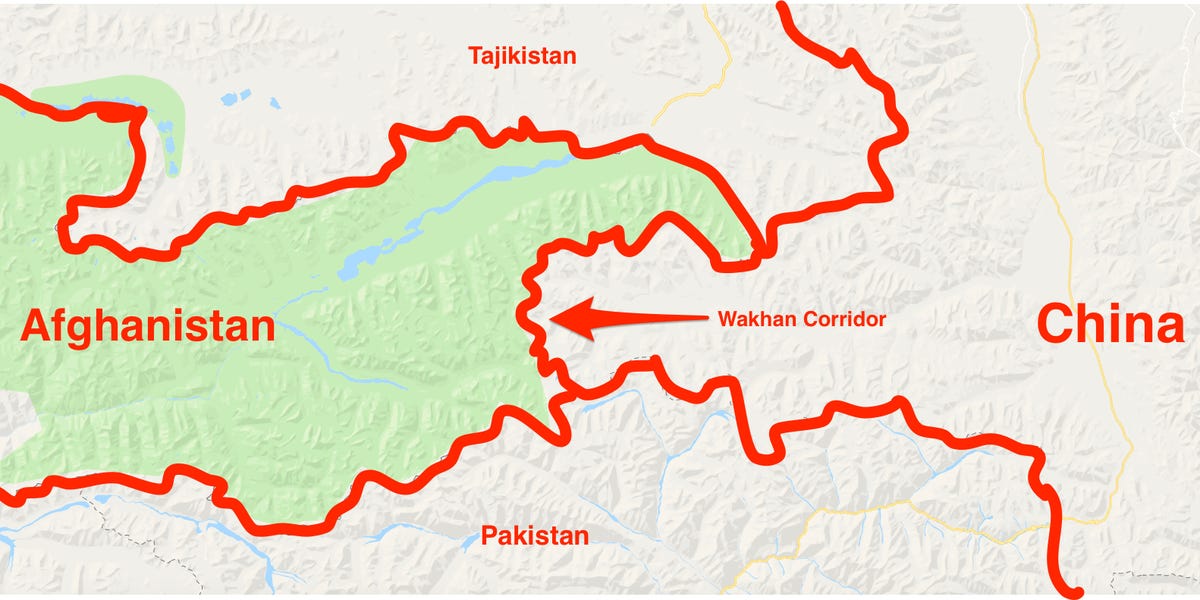
To reach these markets currently, Chinese goods must go the long way round, via container ships through the disputed South China Sea. But the short border Afghanistan shares with north-western China offers potential for a mega-highway, a high-speed rail link and fuel pipelines.

Beijing is confident that it can succeed where Whitehall, the Kremlin and the White House have failed over the centuries, for the simple reason that it is not interested in transforming Afghan society.

It has learned from the mistakes of the Russian communists. Chinese communists have no desire to remake Afghanistan (or anywhere else) in their own image.

Threat

Nor will its goals be achieved by brute force; President Xi has a far smarter plan. When the Kremlin occupied Afghanistan in 1979, it saw it as a steppingstone to dominating the oil-rich Middle East, but Soviet communism had little to offer compared with the wealth of modern China.

Xi prefers to use financial muscle as much as the threat of military power and, if reports that Beijing is prepared to invest $62 billion in Afghanistan are true, it is following a blueprint perfected in many countries from Malaysia to Montenegro.

Under a policy known as the Belt and Road Initiative (BRI), vast loans are offered to cash-strapped countries for infrastructure projects. In return, China gains access to new trade routes and ports, as well as banking hefty interest payments on its investment.

If the repayments are late, the Chinese could step in to reclaim land, mineral rights, or other collateral as compensation. It is a business plan more common in the underworld of gangsters and organised crime groups: victims are lured into a “debt trap” and forced to repay, one way or the other.

In return for its largesse, China will also expect the Taliban to ignore the “genocidal” oppression of their fellow Muslims, the 12 million Uighurs in China’s Xinjiang province, which sits close to the Afghan and Pakistani borders.

The last thing Beijing wants is an anarchic scenario in which a rise in Islamic fundamentalism on its border threatens domestic security in China.

But it has seen how indifferent strict Islamic regimes in the Middle East are to Uighur rights. The oil-rich Arab monarchies will much prefer doing lucrative deals with Beijing than bothering about its treatment of fellow Muslims.

Pakistan’s Prime Minister, the former international cricketer Imran Khan, who cynics argue has reinvented himself as a born-again Muslim to cement his political power base, has spoken up about the Uighurs – but only to defend China’s handling of them.

And even before Khan came to power, Pakistan’s generals saw the Taliban as a natural ally against their number one adversary, India. China, too, is at daggers drawn with India, so it will view an anti-India Taliban regime in Kabul as a possible ally.

Uncertain days lie ahead and as the remaining American troops gather to stockade the U.S. Embassy in Kabul and protect the dwindling band of Westerners there, there are many observers who recall evacuation of the U.S. embassy in Saigon in 1975. 

Similar humiliating scenes are likely in the coming weeks. Up to 1,000 U.S. troops are expected to be stationed at Kabul Airport to protect departing Western civilians.

Bleak

That will be little comfort to all those Afghans who have worked bravely with Coalition forces over more than two decades trying to improve life for their own people. Betrayed, their future is now bleak.

And, as for our pledges to women and girls – with the likely return to power in Kabul of the Taliban – they will lose those rights and freedoms that Allied intervention had brought.

China sees Afghanistan – even with the Taliban back in control – as one of the most crucial squares on the chessboard of world politics. And like a chess grandmaster, President Xi Jinping is not planning for a quick checkmate.

Historians will no doubt look back at what is happening now and see that China did indeed learn the lessons of history. Where Britain, Russia and America have failed, it may yet triumph, gaining the influence it seeks without having shed the same terrible price in blood and human sacrifice.

Appendage

– Afghanistan and China share a short 46-mile border. Afghanistan has huge strategic importance for China.
Standard
History, Israel, Middle East, Palestine, United States

Palestine: Another body blow for peace

GAZA BORDER

Gaza

THE shocking images of slaughter at the Gaza border earlier this week are a public relations disaster for Israel. At this very moment in time when the Jewish state is marking the 70th anniversary of its foundation, its government finds itself the target of global anger and outrage.

An occasion which may perhaps been one for national pride is now badly tarnished by media coverage of its soldiers shooting teenagers and civilian protestors.

History, of course, has always offered fuel for such controversy in this combustible region. It is filled with the legacies of territorial disputes and religious clashes. Israel’s “birthday” was always likely to provoke some sort of turmoil.

For the creation of the state of Israel is a source of profound grievance to many Palestinians, who believe that their people were driven off their own land and displaced into Lebanon, the West Bank and the Gaza strip.

In this narrative of despair, they feel they were robbed of their livelihoods and their nationhood through the event known as the “Nakba” or the “Catastrophe” whose anniversary fell on May 15, 2018.

Tensions were always bound to be high at this period, particularly as Palestinian demonstrators – some of them crudely armed – gathered on the border with Israel to demand the right of return to the home of their forebears.

But what has really ignited the powder keg was the decision by the White House to move the US embassy from Tel Aviv to the divided city of Jerusalem, which the state of Israel regards as its capital.

It is a step that has inflamed discord with the Palestinians, who lay claim to the eastern part of the city and whose Muslim faith has several sacred sites within its walls, as of course do Jews.

It was the fear of inflaming tensions that prevented a succession of US presidents, including Bill Clinton and Barack Obama, from implementing a pledge to shift the American embassy to Jerusalem.

But Donald Trump, never a man to follow political precedent, has ignored such doubts.

He adopted his stance partly because he has always been a big admirer of Israel and is deeply suspicious of Muslim fundamentalism in the region, as he demonstrated in his decision to pull out of the Iran nuclear deal – a policy that was eagerly welcomed by the Israeli government of Benjamin Netanyahu.

Mr Trump also has close personal ties to Israel, for his daughter Ivanka is married to Jared Kushner, whose family has donated money to Israeli settlements in the West Bank.

For the Palestinians, all of this is highly provocative, making a mockery of US talk about the need for a peaceful solution to the long-standing conflict. This mood of anger is also sedulously cultivated by Hamas, the ruthless terrorist organisation which runs Gaza and relies on the culture of victimhood to maintain its iron grip on power.

That is why it has always been more interested in fomenting bitterness and hatred towards Israel than in improving living standards in the Gaza strip. And why the fact that so many martyrs have died – or been sacrificed – suits its cause.

Endlessly exploiting the climate of indignation, Hamas continually preaches the apocalyptic gospel of the armed struggle and martyrdom.

The interests of Hamas are served by turning a youthful, seething, radicalised population’s anger towards Israel.

That is the opposite of what Israel wants on its border with Gaza. Many British people, viewing the heart-rending reports of bloodshed, will understandably feel that the Israeli authorities grossly over-reacted to the demonstrations.

However, there are two crucial considerations to bear in mind about the Israeli response. First, one of the central themes of the radical Palestinian movement is to reclaim former homelands that are now Israeli territory. It is a drive called “The Great March of Return”.


YET, by its very nature, this would threaten the very existence of the state of Israel. The security forces must therefore feel that, however savage the consequences, they cannot allow thousands of protesters in a human wave to cross the border and squat in Israel.

Second, although most of the demonstrators were unarmed, some definitely were. Hamas’s cynical eagerness to exploit the discontent means that there were bound to have been hardened insurgents in the crowd, carrying knives, guns, petrol bombs or even rocket launchers.

The entire experience of Israeli history over the last 70 years is filled with attacks from its enemies. Almost every flashpoint becomes another challenge to the state’s right to exist. That is why the Israeli forces must be so vigilant.

It could be that the hard-line tactics actually work in deterring further border demonstrations. But the tough response could have the opposite effect, emboldening Hamas and fuelling radical fury as well as sympathy for the Palestinians from abroad.

Certainly, there is little doubt that the region will descend into further strife. In the face of the casualties caused by Israeli guns, the more moderate Palestinians, headed by Mahmoud Abbas, president of the Palestinian Authority in the West Bank and a traditional Arab secular nationalist, have been pushed to make radical protests too, to keep pace with popular anger.

Hamas will continue to say that figures such as Abbas have achieved nothing with their impulse to compromise, with the result that force now must be used.

Similarly, the rapprochement between Israel and Arab states such as Saudi Arabia and Jordan – inspired by their shared fear of a dominant Shia Iran – could now break down.

The three nations formed a close alliance in opposition to president Bashar al-Assad’s regime in Syria.

But what is certain is that it will now be far more difficult for any predominately Muslim state to work with Israel. For those who may have hoped that Palestinian people-power protests would help bring harmony, this is another bitter disappointment in a region scarred by decades of lost opportunities for peace.

. Reference and appendage:

Six Day War

Standard