
Education, Information, Science, Society, Technology

Information Society: Probability and Statistics

INFORMATION AGE

WE live in an information age in which modern technology makes it easy to gather large amounts of information on almost every aspect of our lives. However, on its own this information is of only limited value – it needs to be organised and analysed to be of practical use.


INFORMATION about population numbers have been collected since ancient times (see Appendage), but the science of analysing and making sense of data – statistics – is relatively recent. Although now not usually considered to be a branch of mathematics, statistics relies on mathematical analysis to interpret information and is closely linked to the area of mathematics known as probability theory.

Chance and probability

The beginnings of probability theory came from the fascination that two 17th-century French mathematicians had with games of chance. Blaise Pascal and Pierre de Fermat discussed, in a series of letters, a method of calculating the chances of success in gambling games, and they were the first to give the subject of probability a scientific treatment.

What they discussed was a mathematical way of determining the probability of a particular outcome occurring in a random event, such as tossing a coin or throwing a dice. When a coin is tossed there are two possibilities: heads or tails. Each is equally likely: there is one chance in two that the coin will come up heads (or tails), or in other words the probability is 1/2. The six faces of a dice give one chance in six of throwing any particular number, a probability of 1/6. In games using more than one dice, or a deck of cards, or a roulette wheel, the calculation becomes more complex but is essentially built from basic principles and is the same. From this discussion of gambling games, a theory of probability evolved.

The idea was further developed by the next generation of mathematicians. French mathematician Abraham de Moivre discovered a pattern to the probability of outcomes, now known as normal distribution and represented graphically as the bell curve.
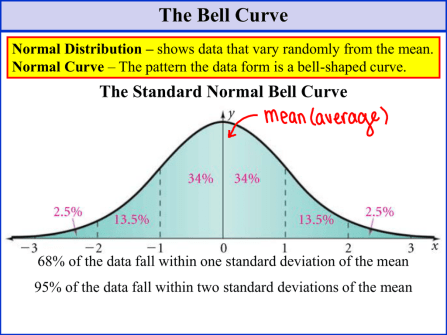
Bell Curve

[Bell Curve: Normal distribution] – When certain values (such as height) are plotted against the number of occurrences of that value (how many people are of a specific height), the result is often a bell-shaped curve – the normal distribution. The most common value, at the peak, is the mean (average).

British mathematician and clergyman Thomas Bayes took de Moivre’s ideas further with his theorem of conditional probabilities, which makes it possible to calculate the probability of a particular event occurring when that event is conditional on other factors and the probabilities of those factors are known. Bayes’ work was further developed by Pierre-Simon Laplace, a French mathematician and astronomer whose application of Bayes’ theorem to real cases led to a new field of study: statistics.

Detecting patterns

The pioneering work in statistics was done by de Moivre, who used data about death rates and rates of interest to devise a theory of annuities, which enabled insurance companies to compile tables of risk for life assurance based on scientific principles. This application of mathematics to data in records was at first known as “political arithmetic”, and, as patterns emerged in collections of data, research began into their underlying statistical laws. To begin with, statistics was concerned with social issues, and advances in sociology and criminology were made by the Belgian mathematician Adolphe Quetelet, who introduced the concept of the “average man”. He also believed mathematics lay at the heart of every science, and statistical analysis could be applied to data of all kinds. Perhaps the area where this had greatest effect was medicine, where an important new study, epidemiology (occurrence of disease in populations), developed from medical statistics.

As more practical use was made of probability theory and statistics, the mathematics behind them was developed by various mathematicians, including the Frenchman Adrien-Marie Legendre, the German Carl Friedrich Gauss, and the Russian Andrey Nikolaevich Kolmogorov, whose systematic approach to the subject forms the basis for much of modern probability theory.

Modern statistics

Statistics plays a key role in much of modern life. Governments collect and analyse a wide range of personal data to detect patterns that can help shape policies. Businesses use market research to gather information about potential customers and apply statistical methods to analyse the data. In science, statistics and probability are central to subjects such as quantum theory and are also essential to many other subjects, from psychology and economics to information science.

Data Samples

In practice, the data used for statistical analysis must be sound for it to produce useful results. The data must be collected using a valid method that measures what is intended, and the data must be accurate. It is also essential that the set of data is large enough and constitutes a representative sample. For example, in general public opinion polls the right questions must be asked in an unambiguous, neutral way; sufficient numbers of people must be polled; and, as a whole, the respondents must be representative of the population (for instance, in age and gender).

Applications
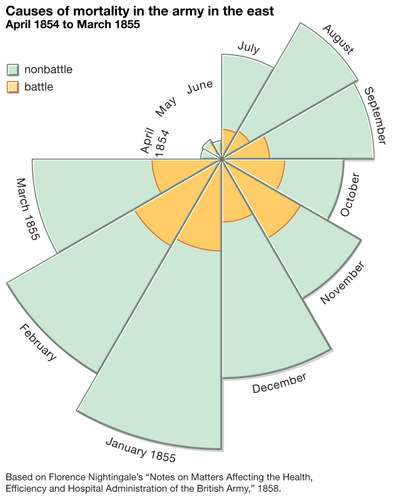
Coxcomb2

Florence Nightingale’s “coxcomb” graph – This graph devised by Florence Nightingale shows the relative causes of death among soldiers in one 12-month period during the Crimean War (1854-56).

. Coxcomb graphs – Working as a nurse for British troops during the Crimean War, Florence Nightingale kept records of troop deaths and later used the information to create what are now called “coxcomb” graphs. These highlighted the number of deaths that were not directly caused by combat but by factors such as wound infection and disease.

. Computerised Modelling – The development of probability and statistics gave scientists new ways to analyse and conceptualise the physical world.

Many natural systems are influenced by numerous factors and exhibit chaotic behaviour. For example, influences on the weather include air, land, and sea temperatures, winds, sea currents, humidity, and the amount of sunlight. Minute changes in any one of these factors can have a profound effect on the weather. Because of this, weather forecasting relies on numerical models in which statistical methods are used to arrive at predictions that have various degrees of probability of being correct.

. Quantum Theory – The currently accepted theory of the nature and behaviour of matter at the subatomic level, quantum theory uses probability as one of its fundamental tenets. For example, according to quantum theory it is impossible to know precisely the location and momentum of subatomic particles such as electrons “orbiting” the nucleus of an atom; it is only possible to specify regions – known as clouds – where particles may be located with the highest probability.

Appendage

Early Censuses

The earliest known census dates from ancient Babylonian times, about 3800 BCE, and recorded the human population and agricultural data.

Many of the other ancient civilisations also regularly recorded population numbers, often for the purposes of taxation. In the Middle Ages, probably the best-known census is the Domesday Book, which was instigated by William I of England in 1086 to tax the recently conquered population. These early censuses were simply records of numbers because mathematical techniques for analysing data had not yet been developed.
Standard
Britain, Economic, Government, Internet, Technology

5G and why we need it

TELECOMMUNICATIONS

5G

5G is the “fifth generation” upgrade to mobile telecommunications. It does not consist of a single new operating system but a “systems of systems” that will dramatically increase data speeds to such an extent you’ll be able to download a movie in just three seconds. It will also increase internet capacity a thousand-fold when it’s fully operational.

There is a big difference between 4G and 5G capabilities. 4G, like all the ‘G’s before it, is principally designed for smartphone browsing. 5G, however, is far more ambitious, linking together all kinds of devices, from household appliances such as fridges and washing machines to cars and electricity meters.

It is supposed to create what has been termed the “internet of things”, where everything we use in our day-to-day lives can be controlled remotely. For example, you could use the 5G network to control your washing machine from the other side of the world. It could also speed up the development of driverless cars by allowing vehicles to interact with each other.

5G will become increasingly relevant with a pressing need for it. In its strategy document for 5G rollout, published in 2017, the UK Government predicted that global data traffic would grow from 3.7 exabytes (3.7 billion-billion bytes of information, where one byte is equivalent to a short email) in 2015 to 30.6 exabytes in 2020. That’s the same as if the number of passengers on London’s Tube network grew by 53 per cent every year. Without an upgrade, existing systems face being overloaded.

There are also government policies which are dependent on 5G. If we are to reach net zero carbon emissions by 2050 – the ambitious target which was unveiled by former Prime Minister Theresa May last summer – then we will need to make much smarter use of the electricity grid. The 5G network would allow household appliances like fridges and electric car charges to switch in and out of the grid when needed.

There are risks with 5G. An “internet of things”, where every appliance is interconnected, provides new opportunities for hackers to interfere with electronic systems. They could potentially seize control of vehicles and cause them to crash, or by hacking smart door locks to gain entry to households.

Hostile nations could exploit 5G to try to disrupt our utility supplies, nuclear plants or airports. There are also serious privacy issues as 5G will make it easier for governments and corporations to track our lives one click at a time. But there are also considerable advantages – 5G networks involve far more secure data encryption. So, while there will be more appliances for hackers to target, doing so won’t be easy.


WHOEVER builds the 5G grid, or supplies equipment for it, could potentially plant bugs to allow interference with the network or enable mass surveillance by accessing data.

Huawei has repeatedly denied that it is an arm of the Chinese state, but as a Chinese company it is vulnerable to the control of a dictatorship with an appalling human rights record.

We wouldn’t allow a Chinese company to supply fighter jets for the RAF, goes the argument, and therefore we shouldn’t allow one to supply vital communications infrastructure.

Former national security adviser Lord Ricketts has dismissed the fears, however, saying: “I personally think we can find a solution which does allow them to have some role.”

Another serious concern is what it would mean for Britain’s role within the “Five Eyes” network of security partners – the US, Australia, Canada, New Zealand and Britain – who frequently exchange intelligence. Canada has yet to make a decision, while New Zealand initially stopped Huawei providing 5G equipment but has since said it has not imposed a complete ban.

The United States is worried. Donald Trump doesn’t trust Huawei to build even the smallest part of our 5G network and the US has warned that it might be reluctant to share intelligence with the UK if we utilise the services of the Chinese company – although MI5 chief Andrew Parker recently claimed that this is an unlikely consequence. Some analysts have argued that the US is only saying this as a protectionist ruse in its ongoing trade war with China.

Yet, that doesn’t explain why Australia, too, has banned Huawei from building its own 5G network. The chair of Australia’s intelligence and security committee, Andrew Hastie, claims it is a question of “digital sovereignty”, while his colleague James Paterson points out: “Successive Australian governments banned Huawei from our broadband and 5G networks with very little controversy.”

In any case, no US company currently makes 5G network equipment. Instead, the US is considering subsidising Swedish firm Ericsson and Finnish company Nokia in order to help develop its own 5G network. In the US, T-Mobile has already switched on a slower version of its 5G network, claiming it covers 200 million people.

Some of our other allies are also refusing to denounce the Chinese firm. German Chancellor Angela Merkel is reluctant to ban Huawei, fearing retaliation against German companies exporting to China. France, too, has said it will allow Huawei to build parts of its 5G network.

Under Theresa May’s premiership, the government announced that Huawei would be allowed to provide equipment for the periphery of the 5G network, such as masts, but not the control systems at the core of the network. The security services – MI5, MI6 and GCHQ – claim that the risk to 5G from using a Chinese supplier is manageable.

But one complication that will need to be resolved is that our existing 3G and 4G telecoms networks already contain equipment manufactured by Huawei. In 2005, for example, BT signed a contract with Huawei that allowed it to connect customer lines to the main part of the network.

The UK Government announced this week that it is to stick to its existing policy, which is to allow Huawei to build communication towers and other peripheral equipment for the 5G network but ban it from the core parts of the network (such as military intelligence). Measures were also announced to reduce future reliance on China’s involvement by imposing a 35 per cent cap on Huawei’s share of the market.

Our Government claims that Huawei has such a technological head-start in creating 5G equipment that shunning it would delay the introduction and considerably increase costs. Alternative, though significantly more expensive, suppliers are ZTE, which is owned by the Chinese government, Ericsson, Nokia, Samsung (South Korean) and Viettel (owned by the Vietnamese military). The actual cost to the Government of Huawei’s input into 5G is unknown, as is the time frame. Restricting Huawei’s involvement would have delayed the launch of 5G by up to two years and cost the economy between £4.5billion and £6.6billion, according to a 2019 report by the telecoms industry body, Mobile UK.

We could have decided to upgrade the existing 4G network which would have given extra capacity for now. But, in the long run, that would have led to Britain lagging behind in telecommunications.

The pros and cons of using Huawei

Advantages –

. Banning the Chinese would reduce the number of companies supplying 5G, decreasing competition and leading to a rise in costs for consumers.

. Whitehall officials have also said it would cost the UK economy tens of billions of pounds in the coming years, from the lost opportunity of the productive gains of using 5G.

. There would also be a cost to companies who have started to roll it out across the country.

. Officials have warned that by barring Chinese involvement could slow down the rollout of 5G by up to three years.

. Huawei’s exclusion would likely damage relations with China, where Britain is also seeking to strike a post-Brexit trade deal.

The Risks –

. The U.S. says Huawei could be used as a back door for spying by the Chinese state.

. Critics have also warned China could use its access to Britain’s data network to shut down critical national infrastructure.

. There are fears the UK could lose its intelligence sharing relationship with countries such as the US and Australia, who have warned against allowing Huawei anywhere near their networks.

. Members of the US Congress have also threatened to block a future post-Brexit trade deal if the UK pushed ahead with using Huawei.

Standard
Britain, Government, Internet, Legal, Society, Technology

New enforceable code for web giants

INFORMATION COMMISSIONER

FACEBOOK, Google and other social media platforms will be forced to introduce strict age checks on their websites or assume all their users are children.

Web firms that hoover up people’s personal information will have to guarantee they know the age of their users before allowing them to set up an account.

Companies that refuse will face fines of up to 4 per cent of their global turnover – £1.67billion in the case of Facebook.

The age checks are part of a tough new code being drawn up by the Information Commissioner’s Office (ICO), which is backed by existing laws and will come into force as early as the autumn.

. See also Internet safety: The era of tech self-regulation is ending

Experts claim it will have a “transformative” effect on social media sites, which have been accused of exposing young people to dangerous and illicit material, bullying and predators. It includes rules to help protect children from paedophiles online.

The code also aims to stop web firms bombarding children with harmful content, a problem highlighted by the case of Molly Russell, 14, who killed herself after Instagram allowed her to view self-harm images. Under the new code:

. Tech firms will be banned from building up a “profile” of children based on their search history, and then using it to send them suggestions for material such as pornography, hate speech and self-harm.

. Children’s privacy settings must automatically be set to the highest level.

. Geolocation services must be switched off by default, making it harder for trolls and paedophiles to target children based on their whereabouts.

. Tech firms will not be allowed to include features on children’s accounts designed to fuel addictive behaviour, including online videos that automatically start one after the other, notifications that arrive through the night, and prompts nudging children to lower their privacy settings.

Once the new rules are implemented, children should be asked to prove their age by uploading their passports or birth certificate to an independent verification firm. This would then give them a digital “fingerprint” which they could use to demonstrate their age on other websites.

Alternatively, the tech firms could ask children to get their parents’ consent, and have the parents prove their identity with a credit card.

If the web giants cannot guarantee the age of their users, they will have to assume they are all children – and dramatically limit the amount of information they collect on them, as set out in the code.

At present, a third of British children aged 11 and nearly half of those aged 12 have an account on Facebook, Twitter or another social network, OFCOM figures show.

Many youngsters are exposed to material or conversations they are too young to cope with as a result.

The Deputy Commissioner at the ICO, said: “We are going to be making it quite clear that there is a reasonable expectation that companies stick to their own published terms and policies, including what they say about age restrictions.”

A House of Lords amendment tabled by Baroness Beeban Kidron that ensures the new code will be drawn up and put into law, said: “I expect the code to say: ‘You may not, as a company, help children find things that are detrimental to their health and well-being.’ That is transformative. This is so radical because it goes into the engine room, into the mechanics of how businesses work and says you cannot exploit children.”

The rules will come into force by the end of the year, and will be policed by the ICO, which has the powers to hand out huge fines.

It will also use its powers to crack down on any web firm that does not have controls in place to enforce its own terms and conditions. Companies that say they ban pornography and hate speech online will have to show the watchdog they have reporting mechanisms in place, and that they quickly remove problem material.

Firms that demand children are aged 13 or above – as most web giants do – will also have to demonstrate that they strictly enforce this policy.

At the moment, web giants such as Facebook, simply ask children to confirm their age by entering their date of birth without demanding proof.


FOR far too long, social media giants have arrogantly refused to take responsibility for the filth swilling across their sites.

Many of these firms, cloistered in Silicon Valley ivory towers, are owned by tax-avoiding billionaires who are indifferent to the trauma inflicted on children using websites such as Facebook and Instagram.

At the click of a mouse, young children are at risk of exposure to paedophiles, self-harm images, online pornography and extremist propaganda.

Finally, however, these behemoths are being brought to heel by the Information Commissioner (ICO). They must ensure strict age checks and stop bombarding children with damaging content – or face multi-million-pound fines.

Such enforced regulation is very welcome and well overdue.

Standard