
Afghanistan, Britain, Government, Politics, Society, United States

The failure in Afghanistan has been a military and political disaster

AFGHANISTAN

LET’S be in no doubt. The UK’s latest Afghan war – the fourth since 1839 – has ended in abject failure. The shameful retreat was down to a bungled withdrawal of US forces by Joe Biden, who’s lacklustre approach leaves his leadership open to criticism of weakness and inadequacy. What extraordinary and pitiful scenes the world has witnessed in recent days: bodies falling from the sky, the Taliban cheering in Kabul and the mighty America humbled. The Taliban on the ground is operating akin to the Nazis as they go door-to-door in neighbourhoods seeking retribution against those that supported the West. There is a growing sense of unease, and rightly too, as the West awaits what might come next.

Britain scuttled out at the same time, the prime minister telling MPs on the day of Mr Biden’s announcement that there can be no military victory in Afghanistan. What a shameful assessment given all that has been sacrificed in terms of blood and treasure plundered. The world is witnessing the extent of the military and political catastrophe after twenty years of miscalculation and misadventure.  

The UK is currently driven by a desire to stay close to the US. But America is a superpower, able to shrug off defeats and move on. The blow of losing Kabul is felt more deeply in Britain shorn itself of substantial global influence. And, yet, this has led the UK to take Washington’s lead in military affairs. In Afghanistan, the US judgment that a combination of special forces, local proxies and air power would wipe out domestic resistance to a military occupation was flawed. The Afghan security forces that NATO trained were exposed as a shell and collapsed at a time when it was most needed. In 20 years of relentless fighting, more than 170,000 Afghans have lost their lives. The death toll continues to rise as the barbarism of the Taliban metes out savage reprisals against local Afghans and interpreters who helped western intelligence services and the British Army in a quest for democracy and more moderate living. In June, almost 1,000 Afghans were killed in the simmering civil war. A few weeks later half the country was under Taliban control.

Western politicians prefer to tell a story of progress in Afghanistan. But that could all be unravelled now the Taliban are in control. Since 2001, the US has spent nearly $145bn (£106bn) trying to rebuild Afghanistan. By 2019, the average Afghan student received four years of schooling (twenty years ago it was just two). As prosperity was building, Afghans were known to have lived healthier and longer lives and the country is certainly wealthier than it was in 2001. But as many will soon realise the state can only function with international aid. Aid funds three-quarters of total public expenditure.

Elections were held in Afghanistan but the institutions that support democracy were not allowed to take root. One elected president, Hamid Karzai, fell out with the Americans so badly he threatened to join the Taliban himself. The other, Ashraf Ghani, fled as the Taliban advanced. Almost every other Afghan ruler in the 20th century was assassinated, lynched or deposed. A western-made “liberal democracy” has fallen into the hands of religious fanatics with close links to al-Qaeda. It must be clear by now that nations cannot be hustled at the barrel of an American gun into the postmodern age, especially when they have not been allowed to come to terms with modernity.

In Afghanistan, the battle for hearts and minds was lost long ago. Without hearts and minds, one cannot obtain intelligence, and without intelligence, the insurgents will remain undefeated.

The Royal United Services Institute, a security thinktank, describes the outcome in Afghanistan as “strategically worse than the situation prior to the 9/11 attacks – a Taliban state, with terror groups already baked into it, with nowhere else to turn for major support other than Beijing”.

The collapse of the Taliban in 2001 encouraged the US to adopt a similar strategy in Iraq and Libya. After 20 years of disastrous results, British ministers should reach for a new approach. After all, relations between London and Washington have historically never been entirely unconditional. Yet, whilst the government speaks of creating new special forces regiments and naval “littoral strike groups” for international interventions, Britain needs to learn its own history. It used to station military forces around the world to maintain its empire. It should think again before doing so for someone else.
Standard
Afghanistan, Britain, Government, Politics, Society, United States

The tragedy in Afghanistan shames the world

AFGHANISTAN

COMEBACKS have rarely been as brutally quick as the Taliban’s dramatic surge across Afghanistan since the start of July.

Eleven regional capitals have fallen to the insurgents in six days and hundreds of thousands of Afghans have fled their homes, fearing life under Islamic fundamentalism.

Funded by an annual budget believed to be in the region of $1.5bn, cash comes direct from drug-running, extortion, and the imposition of local taxes in areas and regions the Taliban control. Their forces include up to 85,000 fighters and their weaponry include AK-47 assault rifles, rocket-propelled grenades, mortars, other small rockets, anti-aircraft and anti-tank weapons, suicide bombers, Improvised Explosive Devices (IEDs), plus weapons captured from the Afghan army.

It is time to ask how a group reviled as savage religious extremists and sponsors of international terrorism could recover from utter defeat two decades ago to become Afghanistan’s rulers-in-waiting.

Does the Taliban’s apparent impending victory mean that the country is destined to hurtle back to the brutal medieval regime that ruled there in 2001?

Day by day, the plight of Afghanistan and its people grows ever more desperate.

Emboldened by the withdrawal of Western troops, the resurgent Taliban is sweeping through the country with alarming speed.

Nearly a third of the 35 provinces are under their control, with insurgents in striking distance of Kabul. The fact that 600 British troops – mostly from the Parachute Regiment – are being sent to oversee the immediate evacuation of all our nationals suggests the fall of the capital is just days away.

There are already reports of atrocities – summary executions, torture and mutilation. If the Taliban take the whole country, this wicked and hideous persecution will again become the norm.

This is not a problem the West can brush aside. American invaded after 9/11 to oust the Taliban and stop Afghanistan being a sanctuary for terror groups. Following their withdrawal, how long before the jihadis are plotting mayhem in the West?

Meanwhile, with up to 100,000 refugees fleeing each month, many will soon begin arriving in Europe seeking asylum. This is the world’s problem. Who will help Afghanistan’s fragile Government fight off the barbarians at their gate?

President Biden’s woefully nonchalant remarks that Afghans “need to fight for themselves” suggests America has shamefully washed its hands of its responsibilities.

To his credit, UK Defence Secretary Ben Wallace, a former soldier, tried to put together a British-led coalition. But without US engagement, it was never likely to happen. The lily-livered UN stands impotently by. The Islamic world is troublingly muted.

Afghanistan’s plight will be distressing to British soldiers who lost 455 colleagues trying to keep the Taliban out. Not for the first time, brave men and women who gave so much for our safety are left to rue the cost of politicians’ foreign misadventures. A tragedy that shames the world.

Standard
Afghanistan, China, Middle East, Politics, Society

China preparing to capitalise in Afghanistan

ESSAY

Intro: Just days after the U.S. and its Coalition partners prepare to leave Afghanistan, China is preparing to gain a direct route to the riches of the Middle East. With billions in the Chinese war chest, just where will China’s ambitions end?

THERE is a reason why Afghanistan is known as “the graveyard of empires”. Every few decades this beleaguered nation emerges from obscurity to remind an apparently invincible invader that his army is not the first to bite the bitter dust there. Afghanistan is littered with examples of invading armies sent into retreat and heavy defeat. 

In 1842, the first of Britain’s four Afghan wars ended in catastrophe. Only one man survived from a force of about 4,500, plus 10,000 or so camp followers, linguistic interpreters, and local allies – and he was set free only so he could recount the scale of the defeat and the dire end of his comrades.

After ten years of brutality trying to convert Muslim Afghans into ‘modern’ communists, the once mighty Red Army found itself in humiliating defeat from Afghanistan in 1989. It would mark the beginning of the rapid fall of the Kremlin’s dominoes from Eastern Europe to Moscow itself.

Today, we see the U.S. and its coalition partners leaving Afghanistan in defeat after almost 20 years; the superpower discovering that Afghanistan’s fragmented tribal culture masks an unbreakable resilience. President Joe Biden, a recent convert to the cause of ending what he has described as a “forever war”, has set a deadline of September 11 for the last American troops to leave.

It is, of course, a highly symbolic act that marks 20 years since the 9/11 attacks by Al-Qaeda – which had its training camps in Afghanistan – that destroyed the World Trade Centre in New York.

Within two months of the invasion in October 2001 by the U.S.-led Coalition forces, Al-Qaeda’s leader, Osama bin Laden, had fled to Pakistan and the fundamentalist Taliban routed. But the mission soon lost its way, at a cost of thousands of military and civilian lives.

Now the U.S. cannot get out fast enough, abandoning its huge airbase at Bagram overnight on 2 July. Today, the situation around the capital Kabul is chaotic, its population in panic, and the Taliban is sweeping back into territory it had been forced to flee by Coalition forces.

Afghan soldiers loyal to the fragile Western-backed Kabul government are being routed. After clashes with newly strengthened Taliban units, an estimated 1,600 have fled and dispersed across the border into neighbouring Tajikistan.

Others have abandoned their weapons and uniforms to return to their homes or switched to fight with the Taliban, which is also taking territory it did not hold prior to the Coalition’s arrival.

Despite more than $2.3 trillion spent waging a war against a badly armed and underfed ragtag of rebels, the Americans leave their enemy in better shape than ever before.

But this will not deter the world’s newest superpower – China – which is waiting patiently in the wings. The Dragon of China will soon enter the fray.

In a development that should strike fear through Western capitals, Beijing scents an unrivalled opportunity to extend its influence in the region and gain strategic territorial and economic advantage that could rewrite the geopolitical map in its favour.

For President Xi Jinping’s Marxist government, Afghanistan is a prize beyond measure. It offers a portal through which Chinese military might could access the Arabian Sea, via Iran or Pakistan.

And the war-torn country could provide two other things China desperately wants: overland access to Iran and the Middle East, and a route to the Indian Ocean and on to Africa.

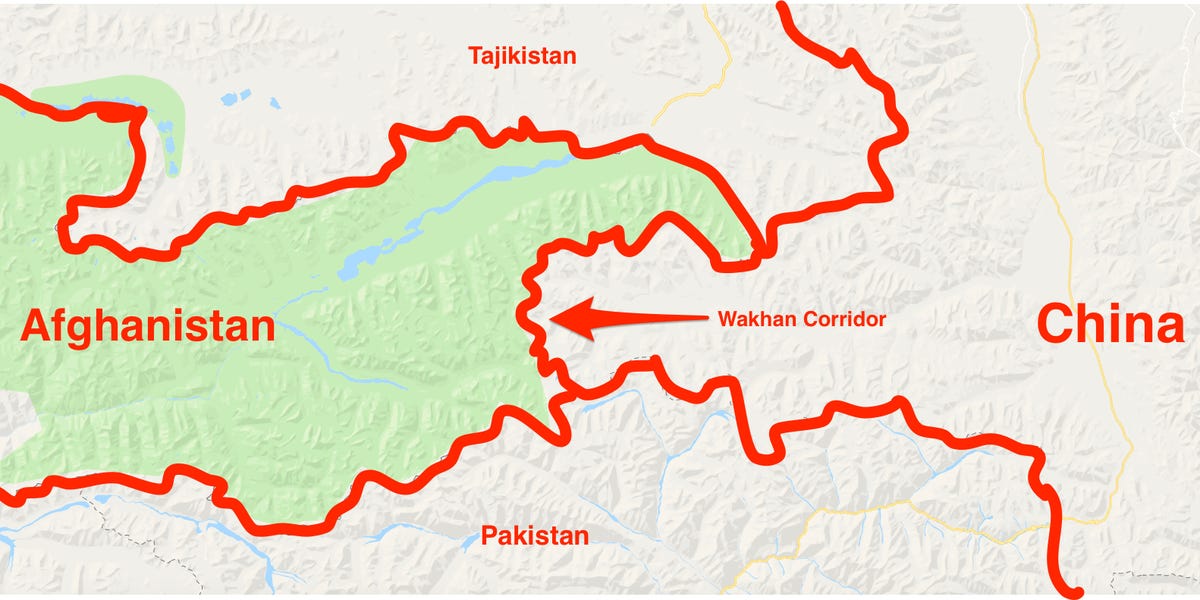
To reach these markets currently, Chinese goods must go the long way round, via container ships through the disputed South China Sea. But the short border Afghanistan shares with north-western China offers potential for a mega-highway, a high-speed rail link and fuel pipelines.

Beijing is confident that it can succeed where Whitehall, the Kremlin and the White House have failed over the centuries, for the simple reason that it is not interested in transforming Afghan society.

It has learned from the mistakes of the Russian communists. Chinese communists have no desire to remake Afghanistan (or anywhere else) in their own image.

Threat

Nor will its goals be achieved by brute force; President Xi has a far smarter plan. When the Kremlin occupied Afghanistan in 1979, it saw it as a steppingstone to dominating the oil-rich Middle East, but Soviet communism had little to offer compared with the wealth of modern China.

Xi prefers to use financial muscle as much as the threat of military power and, if reports that Beijing is prepared to invest $62 billion in Afghanistan are true, it is following a blueprint perfected in many countries from Malaysia to Montenegro.

Under a policy known as the Belt and Road Initiative (BRI), vast loans are offered to cash-strapped countries for infrastructure projects. In return, China gains access to new trade routes and ports, as well as banking hefty interest payments on its investment.

If the repayments are late, the Chinese could step in to reclaim land, mineral rights, or other collateral as compensation. It is a business plan more common in the underworld of gangsters and organised crime groups: victims are lured into a “debt trap” and forced to repay, one way or the other.

In return for its largesse, China will also expect the Taliban to ignore the “genocidal” oppression of their fellow Muslims, the 12 million Uighurs in China’s Xinjiang province, which sits close to the Afghan and Pakistani borders.

The last thing Beijing wants is an anarchic scenario in which a rise in Islamic fundamentalism on its border threatens domestic security in China.

But it has seen how indifferent strict Islamic regimes in the Middle East are to Uighur rights. The oil-rich Arab monarchies will much prefer doing lucrative deals with Beijing than bothering about its treatment of fellow Muslims.

Pakistan’s Prime Minister, the former international cricketer Imran Khan, who cynics argue has reinvented himself as a born-again Muslim to cement his political power base, has spoken up about the Uighurs – but only to defend China’s handling of them.

And even before Khan came to power, Pakistan’s generals saw the Taliban as a natural ally against their number one adversary, India. China, too, is at daggers drawn with India, so it will view an anti-India Taliban regime in Kabul as a possible ally.

Uncertain days lie ahead and as the remaining American troops gather to stockade the U.S. Embassy in Kabul and protect the dwindling band of Westerners there, there are many observers who recall evacuation of the U.S. embassy in Saigon in 1975. 

Similar humiliating scenes are likely in the coming weeks. Up to 1,000 U.S. troops are expected to be stationed at Kabul Airport to protect departing Western civilians.

Bleak

That will be little comfort to all those Afghans who have worked bravely with Coalition forces over more than two decades trying to improve life for their own people. Betrayed, their future is now bleak.

And, as for our pledges to women and girls – with the likely return to power in Kabul of the Taliban – they will lose those rights and freedoms that Allied intervention had brought.

China sees Afghanistan – even with the Taliban back in control – as one of the most crucial squares on the chessboard of world politics. And like a chess grandmaster, President Xi Jinping is not planning for a quick checkmate.

Historians will no doubt look back at what is happening now and see that China did indeed learn the lessons of history. Where Britain, Russia and America have failed, it may yet triumph, gaining the influence it seeks without having shed the same terrible price in blood and human sacrifice.

Appendage

– Afghanistan and China share a short 46-mile border. Afghanistan has huge strategic importance for China.
Standard