
LITERARY REVIEW
Intro: If you feel like your life is just a game, this book explains why. As philosopher C Thi Nguyen explains, have we let metrics twist our values? The author argues that when we use simple, clear metrics to measure success, we often “capture” our complex values and shrink them down to fit those metrics
In the Domesday Book of 1086, a manuscript record of the Great Survey conducted at the behest of William the Conqueror, philosopher C Thi Nguyen tells us, English surveyors measured land by the “hide”: the area an average family needed to sustain themselves. No doubt that was a useful measure, but you need local knowledge to use it. Some places are more productive than others, so how much land, exactly, would the average family need? It could be 40 acres, or 60, or 120.
If decisions are taken locally, there’s little issue. But as soon as authority and powers begin to centralise, units such as the “hide” disappear, replaced by standardised measures that are easier to record and act upon. Local knowledge is forgotten. The more centralisation advances – and in our modern age it has only advanced – the greater the problem grows.
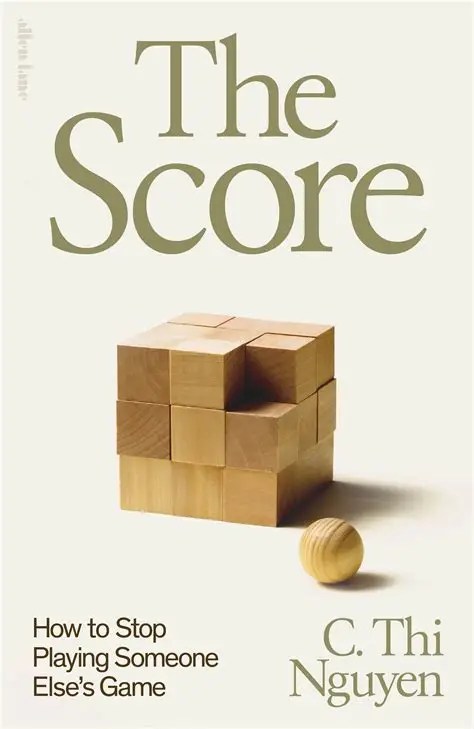
The Score is part polemic and part philosophical inquiry. At its heart, Nguyen’s argument is that in an effort to be objective and unprejudiced, our governments have turned metrics into targets and built rules around them. The result is that our civic life has become a superficially efficient but fundamentally amoral – not to mention inescapable – game. As well as being a philosopher, Nguyen is a lover of board games, video games, technical climbing, and even yo-yoing; or, in other words, he understands the utility of rules. Yet, he writes, that, in the desire to make life ever more frictionless and reasonable, we’ve let metrics twist our values.
Early on, for instance, he mentions a pastor who, instructed to meet a baptism quota, finds himself ignoring the pastoral needs of the rest of his flock. At least the pastor works in a setting where the problem can be aired. For most of us, fixated on annual targets in various settings, the number of likes on social media, and the steps recorded on our fitness apps, external metrics work beneath our notice, replacing our original values. ‘I have 1,000 friends and took 10,000 steps today’: supposedly makes the claimant healthy and popular.
Academia, to no one’s great surprise, is far from immune either. Nguyen argues that the US News & World Report university rankings “no longer celebrate academic distinctiveness”, because prospective students now outsource their reasoning to the US News algorithm. Do you want to fight for social justice or make a killing on Wall Street? Either way, you’ll apply to the same law school – the one at the top of the list.
More ominous examples follow. There is, for example, a US department of state metric called Tip (Trafficking in Persons), which measures the effectiveness of policies to reduce modern slavery, and sex trafficking in particular. It is well established that slavery flourishes in areas of extreme poverty. But if a country reduces its ambient poverty and, as a result, reduces sex trafficking, the Tip report’s metrics indicate failure – because conviction numbers drop off. As Nguyen explains, the metric “incentivises countries to keep sex trafficking around so that there will be plenty of traffickers to convict.”
The author’s most profound insight lies in plain sight: to quote Wordsworth, “our meddling intellect misshapes the beauteous forms of things”. Games do exactly that, and offer a refreshing refuge – for a few minutes or a few hours – from the ambiguities of the real world. The gamification of real life, on the other hand, traps us all, with no prospect of an ending.
So how do we escape a gamified world? Read more books? Take up the violin? Stick it to The Man wherever we can? Such things don’t sound like a call to revolution, and I’m not sure Nguyen’s heart is in the fight. Individuals may recover their agency – and this book will help them do so – but it’s hard to see why businesses, governments, and bureaucracies of all kinds would abandon their self-empowering rhetoric of “objective” metrics.
In the early part of the narrative, Nguyen says: “I had an entire theory about games, in which clear and simple scoring systems were the magic ingredient that opened the door to a whole world of delightful play. And I had an entire theory about metrics, in which clear and simple scoring systems killed what really mattered.” This is well put.
In an otherwise trenchant and entertaining book, critics may well point to the fact that Nguyen follows the rules of his genre very closely. Like every “popular thinker” on the shelf, he can’t resist sharing his personal journey to enlightenment. If you’ve ever read The Very Hungry Caterpillar to children, you’ll know how much young readers delight in repetition. Nguyen, to many readers, is the Eric Carle of philosophy. For those up to speed with his topic, his steady circumspection may prove exasperating.
But don’t discard him. A book, too, is a kind of game, in which “we adopt a goal in order to get the struggle that we really want.” It’s about going the long way, a particular way, using a particular method. If we truly want to understand our civic plight – and not just merely tick off some talking points – then The Score should be read. You’ll find that Nguyen has planned this particular long way round with adeptness.
– The Score: How to Stop Playing Someone Else’s Game is published by Allen Lane, 368pp
 Arts, reviews & current affairs