
Britain, Military, Russia, Ukraine, United States

A daring strike. Reason why we must keep sending arms

UKRAINE-RUSSIA

THE surprise factor has always been critical in war. And once again, Ukraine has displayed it with audaciousness – just as the country did when fighting back so valiantly against the world’s second biggest military power 30 months ago after Vladimir Putin tried to crush their country with his invasion.

Kyiv’s troops have made a lightning-fast thrust into the Kursk region of Russia with tank and mechanised units that no one anticipated – especially not the Kremlin.

It was clearly well prepared and planned, with cyber attacks stifling Russian communications and drones, aided by substantial artillery firepower. These are regular Ukrainian military forces – not the militia involved in previous incursions.

Russian convoys hastily transferring troops to the region after the initial raid seem to have been hit hard by Ukraine. Minefields were laid to protect the attack force. Social media suggests more Ukrainian tanks and troops are going in, plus significant captures of enemy soldiers.

It is difficult to determine precise numbers of the troops involved, let alone the aims of this daring strike that has taken them possibly 20 miles over the border. Whatever the case, it all shows an impressive level of operational planning and diligence.

It also bears similarities in style to the rapid advance by Ukraine two years ago that recaptured big chunks of the Kharkiv region. That was led by General Oleksandr Syrskyi, who has since been promoted to overall commander of Ukraine’s armed forces.

To take the fight into Russia with the first invasion of its terrain since 1941 is a bold and risky move. And it seems Western allies were left as surprised as the Kremlin when it was launched from Ukraine’s Sumy region.

Putin, the architect of so many bloodstained atrocities in this hideous war, has been silent so far. His aides are appealing to the United Nations for support, and bleat pathetically about “large-scale provocation”, and seemingly are threatening a “tough response”.

Only time will tell if this was a brave and foolhardy move by Ukraine – or a smart move that will force Moscow to shift forces from other parts of the frontline, thereby aiding Kyiv’s defence of its terrain while raising much needed morale among citizens and Western allies.

The attack certainly demolishes any suggestions that the war was settling into a stalemate, with Russia’s remorseless military steamroller making grinding gains in eastern Ukraine despite massive causalities.

Kyiv has demonstrated its military capabilities again when sufficiently equipped with modern weapons – just as it has in its remarkable defeat of Russia’s Black Sea fleet, where it used drones and missiles to sink or damage at least one third of the ships, forcing the rest to retreat from Crimea. This has frustrated Moscow’s ability to bomb Ukraine from warships.

In this latest operation, Ukraine has hit two airbases used to launch the glide bombs that are causing horrific carnage among Ukrainian civilians and soldiers with massive blasts.

The sluggish Russian response shows (again) the failings of a top-down, Soviet-style command structure under a power-crazed dictator. Moscow’s propaganda has been reduced to showing footage of “successful” strikes repelling Ukraine in Kursk – footage that was in reality filmed elsewhere.

We do not know if Ukraine intends to press on or try to hold this captured terrain for trading in future negotiations for its own stolen lands – or to retreat having shaken the enemy, rattled the Russian regime, and forced it to place more security and troops all along the border regions.

Military strategists are, however, right to point out that Moscow has held a big advantage in this war until now because it has not needed to commit military resources to defend its border – that’s an amazing thing during any war.

This advantage was down to the West’s ridiculous determination from the start to restrain Ukrainian efforts to fight back inside Russia. Washington even complained to Kyiv about attacks on fuel dumps supplying the Kremlin’s military machine.

The West’s pathetic fear of escalation, stoked ceaselessly by Russian threats of nuclear war, has been a powerful weapon for Putin because it has limited military aid for Kyiv and severely shackled Ukraine’s ability to defend itself.

Now, though, Kyiv has dramatically challenged this stance and shown the absurdities of such timidity in this epochal confrontation between dictatorship and democracy. It feeds into the dictum expressed by Prussian strategist Carl von Clausewitz, who said: “Enemy blows must be returned in war”.


. 14 August 2024

A sign negotiated peace is edging closer

IN the last few weeks, Kyiv had been signalling it was open to peace talks with Moscow. This was not an attempt to surrender, but to arrange a settlement that preserves Ukraine’s independence and by recovering as much ground as possible.

Ukraine’s foreign minister, Dmytro Kuleba, had even gone to see Vladimir Putin’s allies in Beijing to sound out whether China would act as an intermediary.

If Putin took Zelensky’s willingness to talk as a sign that his resolve to fight was weakening, he surely suffered the greatest shock of his presidency in the early hours of August 6.

A week ago, an elite Ukrainian unit stormed the border and its forces have since seized some 400 square miles of Russian territory in the Kursk region.

It appears that the Ukrainians have adopted the great Soviet art of “maskirovka” – deception in warfare – and taught the Russian tyrant a lesson in over-confidence.

The claim that Kyiv’s allies were caught by surprise is disquieting. The presence of NATO advisers and technicians helping the Ukrainians deploy Western weaponry – including F16 fighters, French and British cruise missiles, and German armoured vehicles – must have been seen along with the preparations being made for the sudden offensive. The West is treading carefully, mindful of the cost the war is extracting from its taxpayers. Its leaders are more than happy to see Putin embarrassed by Ukraine’s surprise attack, but they’ve kept the triumphalist rhetoric to a minimum (for fear of burning bridges with the Kremlin were it to open talks on a ceasefire).

Through its successful invasion into Russian territory, Ukraine has dramatically gained more leverage for any impending talks. Zelensky now has the basis for bargaining Russian land not only for peace but also for the return of areas of the Donbas overrun by the enemy.

Seen in that light, this act of aggression is not an escalation of the war but a signal that a negotiated settlement might be edging closer. It will be tempting for Zelensky to push further. With new American F16s at his disposal, Russian targets in the Black Sea will be vulnerable.

Potential propaganda coups like destroying the bridge linking Russia to Crimea, or by targeting Putin’s palace near Sochi on the coast, could be strategic options. Such gains, however, could also be counter-productive, for they would enrage and infuriate Putin so much that any prospect of a peace deal would be dead in the water.

The important point is that being good at war is not just about fighting well.

As the Prussian general and military theorist Carl von Clausewitz argued after fighting with the Russian army against Napoleon in 1812, the ultimate purpose of war is to achieve a political objective.

Political and military leaders have to keep their eyes on the great prize of attaining that ultimate goal – whether they call it victory or peace – rather than just tactical victories on the battlefield.

The choice of invading Kursk was hugely symbolic given the emotional resonance the region holds over Russians.

On the very same terrain in 1943, the heroic Red Army routed the retreating Nazis in the biggest tank battle ever seen. That involved some 6,000 tanks and almost two million troops. The Battle of Kursk became a decisive turning point in the defeat of Hitler in the east.

The ill-fated submarine that was named in its honour has also imprinted itself on the Russian psyche. In August 2000, just eight months after Putin won his inaugural presidency, the nuclear-powered K-141 Kursk sank in the Barents Sea, taking with it all 118 souls on board.

Therefore the invasion of Kursk in particular, the first foreign incursion into Russia since the Second World War, will have hurt Putin.

That war ended in total victory; this one will end with a messy compromise.

Diplomacy is an unseemly business best kept secret from squeamish publics. A lot can go wrong, even with diplomacy behind the scenes. Trust is in short supply to put it mildly. Yet, there is now a glimmer of hope that Ukraine can get to hold its essential territory and rebuild its society and economy.
Standard
Britain, Economic, Energy, Europe, Government, Politics, Russia, Society

Energy crisis: We’re at the mercy of Putin. It’s all our fault

ENERGY

THE Berlin Wall may have been brought down more than three decades ago, but the grim politics of the Cold War are in danger of returning to Europe.

With characteristic ruthlessness, Russian president Vladimir Putin is exploiting the energy crisis to bully his neighbours, strengthen his autocracy and intimidate the West.

His chosen weapon in this renewed campaign of hostility is Russia’s control of gas supplies: the vast gas-fields and the export pipelines that bring them directly to market.

This infrastructure, often legacy assets from the Soviet empire, give the Russian president enormous political and economic leverage in his quest for ever-greater domination of the region.

Russia’s capacity to manipulate the British and European energy markets for geopolitical ends has been dramatically illustrated during the turmoil of recent days and weeks. As the price of gas contracts soared by 40 per cent in just 24 hours last week, Gazprom, Russia’s state-backed monopoly exporter of pipeline gas, was accused of flexing its muscles by both restricting supplies to Europe and keeping its European underground storage facilities at deliberately low levels.

The sense of Russian control was further reinforced when it took just a few words from Putin himself to bring an immediate fall in gas prices.

Revelling in his position as the ultimate ringmaster and wire-puller, he said with a hint of blackmail that supplies could be increased. “This speculative craze doesn’t do us any good,” he said, adding that Europe’s leaders should “settle with Gazprom and talk it over”.

RELIANCE

PUTIN might be behaving like a mafia boss in charge of a protection racket, but British and European governments have for years disastrously played into his hands with misguided, short-term policy decisions.

To be fair, the EU has taken some steps to break the Russian stranglehold, by building new international pipelines, breaking the Kremlin’s east-west transit monopoly, and by introducing drastic reforms of the energy market that have unravelled the corrupt, exploitative business model.

Europe has also pioneered the import of liquified natural gas (LNG) from destinations such as Qatar.

Yet Europe has been increasing its reliance on supplies from outside the continent by running down its own domestic energy industries. So far, renewables have not made up the gap, especially in recent months when the wind has not been blowing.

In Britain, the problem is particularly acute because we are one of Europe’s largest gas users, while we have massively reduced gas production from the rich fields of the North Sea and Irish Sea over the past 20 years.

Nor have we made use of the vast reserves of shale gas that exist across the country, even though such resources have recently made America “energy independent” once more.

Instead, Britain has exacerbated its energy vulnerability by depending on just-in-time imports from pipelines and seaborne cargoes.

In a particular act of folly, the Tory Government in 2017 decided to close the huge storage facility on the Yorkshire coast connected to the Rough gas field, believing both that supplies of LNG would always be plentiful and also because the energy companies believed that limiting storage would boost prices and thereby profits.

Some four years later, the step has backfired catastrophically, leaving us at the mercy of Putin.

Indeed, our entire energy strategy has been marked by stinginess, wishful thinking and downright complacency.

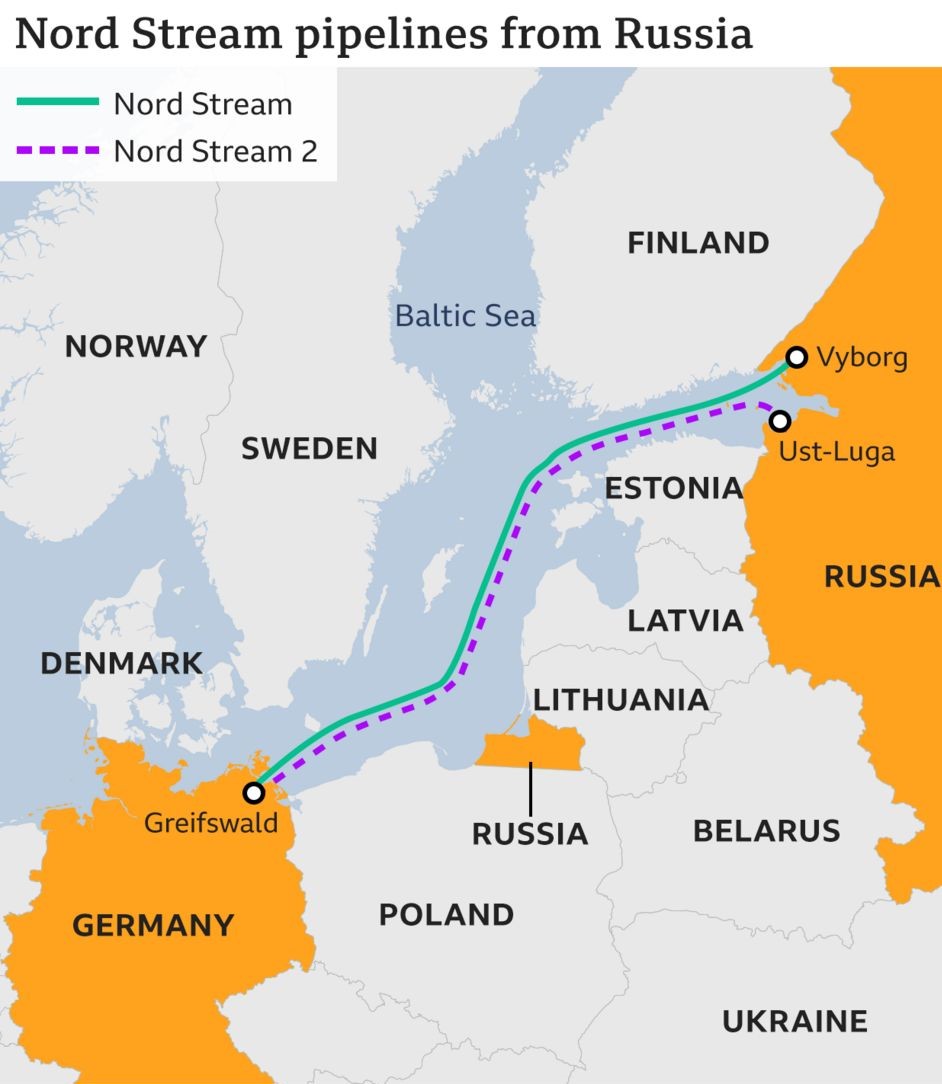
By manipulating energy markets, Putin’s immediate objective could not be clearer: he wants to pressurise Europe into approving immediately the operation of Gazprom’s controversial £8.1 billion Nord Stream 2 pipeline.

Now completed, this runs into Germany along the seabed of the Baltic Sea and bypasses Ukraine, in whose eastern regions Russia has been fighting a proxy war since 2014.

Critics say Nord Stream 2 will give too much influence to Russia over regional supplies and their prices.

But crucially, the project is backed by Germany, which puts cheap reliable supplies of Russian gas ahead of the security interests of its east European neighbours. US President Joe Biden’s administration, desperate to repair the damage done to relations with Europe under Donald Trump, has dropped American objections to the scheme.

The result is that Russia can now hold Ukraine and other Eastern European states to ransom. The Kremlin could shut down their gas without having to cut off the rest of Europe. In effect, one group of nations will be played off against the other in a fearful system of divide and rule, with Russia in command.

As Yuriy Vitrenko, the chief executive of Ukrainian energy giant Naftogaz, put it last week: “Moscow is withholding gas supplies in order to coerce Europe into accepting Nord Stream 2. Russia’s actions are the epitome of gas weaponisation. Anyone who refuses to acknowledge what Moscow is doing, especially when it does this so blatantly, is sending a dangerous message to the Russians that they can use gas to blackmail Europe and get away with it.”

TRAGEDY

GIVEN all this, it is almost inevitable that Ukraine will soon be plunged into another security crisis, perhaps even greater than the one that led to the annexation of Crimea in 2014. The fallout would be disastrous, especially in view of the fragility of Europe’s post-Covid economies.

The implications of Russia’s energy strength are brutal, leaving us relentlessly on the defensive. If, for example, Russia invaded Estonia, would NATO respond if Putin threatened to cut off Europe’s gas? The only way to break free from the shackles of energy dependency is to develop our own resources and means of storage.

In the 1970s, Western reliance on Middle Eastern oil created an era of regional conflict and economic crisis.

If today, the same were to happen because of our reliance on Russian gas, that too would be a tragedy.

. Appendage

Standard
Britain, Government, National Security, Russia, Society, United States

The Kremlin’s power to paralyse

WESTERN SECURITY

RUSSIA’S tentacles of sinister cyber operations are snaking out across the globe and pose the gravest of threats to Western security and democracy.

Recent revelations expose the sheer scale, breadth and audacity of the Kremlin-backed plots – and our vulnerability to this new brand of warfare.

Among those who were targeted were a British television network, the Democratic Party in America, public transport hubs in Ukraine, the US engineering giant Westinghouse, and the World Anti-Doping Agency based in Montreal – apparently hacked in a brazen act of revenge for showing Russia’s systematic abuse of the testing regime at the Sochi Winter Olympics in 2014.

Perhaps the most disturbing of all, however, was the unsuccessful attacks on our own soil – at the Foreign Office and Porton Down – and the foiled attempts by four Russian agents to hack the Organisation for the Prohibition of Chemical Weapons (OPCW) in the Hague.

The OPCW is continuing to conduct investigations into the Salisbury novichok poisonings and the use of banned weapons by the Russian-backed Assad regime in Syria.

About a dozen or so “cyber-actors” have been identified as responsible, but they are all fronts for the GRU – the Russian military intelligence unit also implicated in the attempted assassination of former Russian agent Sergei Skripal and his daughter.

Given are dependence on computers, its coordinated attacks have huge implications. Everything from cash machines to home heating systems, from electricity generators to mobile phones, and to the health service which is relying more on cyber technology. We have seen many times in recent years the enormous disruption caused by a temporary breakdown in service, as happened during the botched IT upgrade at the TSB bank.

Similarly, 18 months ago the NHS was hit by a major cyber problem, prompting the mass cancellations of appointments and operations. Then the North Korean government of Kim Jong-Un was cynical enough to take the blame and the fear inspired by that. But it is clear, from the wealth of mounting evidence, that the Russians certainly have the capability and determination to launch similar attacks.

If patients’ lives were put at risk by such a cyber-attack, it would create a real global panic – the cyber equivalent of the Cuban Missile Crisis.

That is why we should be worried. What is happening now in cyberspace is even more dangerous and certainly more unpredictable than the darkest days of the Cold War.

For all the anxieties back then about a nuclear stand-off, at least the hostility between the West and the Soviet Bloc was governed by respected boundaries. The rules – such as a prohibition on assassinations – were generally upheld. Both sides communicated with each other, partly from the need to avoid a nuclear apocalypse through a catastrophic misunderstanding.

That culture has disappeared. We live in a much more fluid world where restrictions on movement – especially in Europe – hardly exist at all. At any given moment there are probably more than 100,000 Russians in Britain, most of them wholly innocent and here to work, study or by enjoying a break. Yet that transient mass also provides cover for hostile intelligence agents.

Moreover, technology makes it much easier for someone to cause mayhem. During the Cold War, if the Soviets wanted to hit a water pumping station or sabotage an aircraft, they had to send in armed agents. Today, that could be accomplished from an office in Moscow or Kiev – just as computer programs can churn out millions of emails to damage businesses, influence elections and propagate fake news and untruths.

Then there are the armies of hackers in “troll” factories who spread and disseminate destabilising information, such as Hillary Clinton’s emails or the intricate medical details of Olympic cyclist Bradley Wiggins’ asthma prescriptions. The aim is to undermine public respect for Western politicians and heroes alike.

The fall of the Berlin Wall almost three decades ago was a remarkable triumph for freedom and capitalism over totalitarianism. But that ascendency lulled Western politicians into a false sense of security.

Russia, which has an economy no bigger than that of Britain or France, is showing almost by the day that if resources are focused on a certain area – in this case cyber warfare – then a nation can still have lethal power.

And we are only just coming to terms with it. Lord Ricketts, who served as Britain’s National Security Adviser until 2012, has warned that the recent plots are just the start, “pilot projects” to test defences in advance of a full-blooded cyber assault to bring anarchy to the West.

As President Putin’s invasion of Crimea and his support for the blood-soaked Assad regime in Syria has shown, he is not a man constrained by normal democratic values. Throughout his presidency he has been pushing at boundaries, seeing what he can get away with, what will provoke the West to act.

Now his dwindling popularity at home over his domestic agenda – particularly his attempt to raise the retirement age – makes it all the more imperative for him to wrap himself in the nationalist flag with high-profile attacks on the West.


AT least the complacency in Europe and America is beginning to lift and we are starting to fight back – such as when the Dutch defence minister, Ank Bijeveld, and Peter Wilson, the British ambassador to the Netherlands, explained how the OPCW conspiracy was foiled.

In the context of cyber warfare, the West has unparalleled expertise. The staff of both the US National Security Agency and our own formidable base at GCHQ in Cheltenham have world-beating abilities in hacking computers and other electronic devices.

So far, the West has proved far more restrained than Russia in deploying that expertise. There is only one documented case of Western agents using a computer against an enemy state’s infrastructure. That occurred when the Israelis and the Americans worked together to release the Stuxnet virus into the computers that operated Iran’s nuclear programme. It proved what the West can do if necessary.

But any escalation in cyber warfare is fraught with risk. A miscalculation by any rogue agents, anxious to ingratiate themselves with the Kremlin, could have disastrous consequences.

The reality of the new world disorder is one in which Putin is not only promoting, but relishing. We would do well to remember that.

Standard