
LITERARY REVIEW
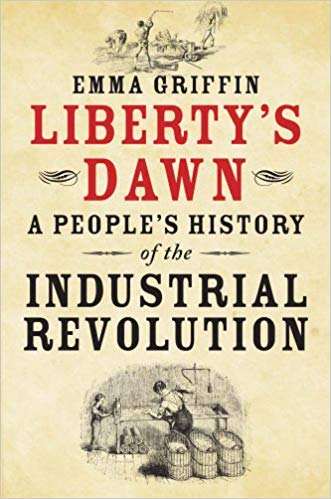
THIS recently released book by Emma Griffin, published by Yale University Press for £25, describes how life wasn’t all trouble at the mill prior to the Industrial Revolution. History books have led us to believe that the working classes had a thoroughly rotten time of it during the turbulent years of the Industrial Revolution. A picture is often painted of people being uprooted from their picturesque rural hovels, crammed together in filthy factories where they either wheezed themselves into early graves, or else became hideously entangled in a life that revolved entirely around the Spinning Wheel.
Emma Griffin, though, doesn’t see it like this. She perceives the Industrial Revolution as having been a tremendous boom to a lot of working class people: they earned far more than they had done before, escaped lives of crushing poverty and destitution and, for the first time, began to exert some measure of control over their lives.
Reviewers’ might be tempted to dismiss Griffin’s work as the ravings of a particularly cranky historian desperate to make a splash – except that Ms Griffin has lots of anecdotal evidence to back up her claims. This was the age, we should remember, in which large numbers of working men and women learned how to read and write.
Remarkably, their self-confessed testimonies, or ‘autobiographies’, as Griffin calls them, have been sitting largely untouched in county archives for the past 200 years.
It is apparent that Emma Griffin has stumbled on an enormous treasure trove. The writer suggests that our ancestors, faltering at first, but later with increasing confidence, describe their daily lives with vivid clarity.
Just a generation earlier they would have been illiterate. Now, with the world changing at a furious and fast pace all round them, they sought to set down their experiences for the benefit of their children and for future generations.
One man recalling the seven years he spent working in a Lancashire factory in the early 19th century wrote: ‘I was never as happy as I was then.’
 Arts, reviews & current affairs