
LITERARY REVIEW
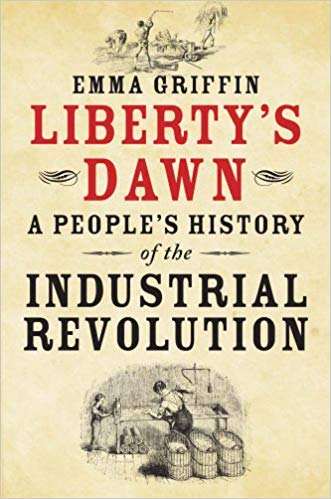
THIS recently released book by Emma Griffin, published by Yale University Press for £25, describes how life wasn’t all trouble at the mill prior to the Industrial Revolution. History books have led us to believe that the working classes had a thoroughly rotten time of it during the turbulent years of the Industrial Revolution. A picture is often painted of people being uprooted from their picturesque rural hovels, crammed together in filthy factories where they either wheezed themselves into early graves, or else became hideously entangled in a life that revolved entirely around the Spinning Wheel.
Emma Griffin, though, doesn’t see it like this. She perceives the Industrial Revolution as having been a tremendous boom to a lot of working class people: they earned far more than they had done before, escaped lives of crushing poverty and destitution and, for the first time, began to exert some measure of control over their lives.
Reviewers’ might be tempted to dismiss Griffin’s work as the ravings of a particularly cranky historian desperate to make a splash – except that Ms Griffin has lots of anecdotal evidence to back up her claims. This was the age, we should remember, in which large numbers of working men and women learned how to read and write.
Remarkably, their self-confessed testimonies, or ‘autobiographies’, as Griffin calls them, have been sitting largely untouched in county archives for the past 200 years.
It is apparent that Emma Griffin has stumbled on an enormous treasure trove. The writer suggests that our ancestors, faltering at first, but later with increasing confidence, describe their daily lives with vivid clarity.
Just a generation earlier they would have been illiterate. Now, with the world changing at a furious and fast pace all round them, they sought to set down their experiences for the benefit of their children and for future generations.
One man recalling the seven years he spent working in a Lancashire factory in the early 19th century wrote: ‘I was never as happy as I was then.’
Charles Campbell, a man faced with a choice between working in a medical practice in a small village in the Highlands, or being a spinner in a Glasgow cotton mill, plumped unhesitatingly for the latter and never regretted it.
Rather than working himself to the bone for next-to-nothing in the Highlands, he earned a rather lucrative and hefty 30 shillings a week in a mill. Another man crowed, ‘We seemed to be rolling in wealth,’ who worked weaving cotton shawls in Manchester.
Yet, as Griffin concedes, this is only part of the story. Even the brightest optimist would have a job persuading anyone that the Industrial Revolution brought joy to generations of working-class children.
In most cases, they simply exchanged one form of drudgery for another. One man recalled how, aged six, he’d been sent off to work at a local farm. ‘I sometimes lost my way in a fog, and wandered miles shouting and crying for my mother, half-blind and nearly heartbroken.’
Wherever children lived, most started work between the ages of six and ten, sent out by their parents to supplement the family income.
In textile mills, children usually started off as ‘piecers’, standing by the spinning machines repairing breaks in the thread. They often worked 12 to 13-hour days, 6 days a week. A former child piecer, Moses Heap recalled being so tired and exhausted that he was carried to and from work by his father.
And it wasn’t just working practices that changed during the Industrial Revolution. Everything did – including sexual behaviour. The stigma of illegitimacy, for example, remained as high as it had always done, hence the number of shotgun marriages. By the end of the 18th century it’s estimated that between 30 and 40 per cent of women walking down the aisle were pregnant.
But look a little closer and the picture changes. Women were now able to earn more working in factories than they had ever done before. As a result they became less dependent on men, and subsequently better equipped to look after any illegitimate children they might have. As time progressed, attitudes became less rigid. Two sisters called Shaw living in 19th century Preston both had illegitimate children without anyone in their family being too harangued, let alone turfing them out on the street.
Being crammed together in large urban cities also helped working-class people educate themselves. They began forming ‘improvement societies’, which in turn gave rise to Sunday Schools. By the 1830s, more children were being educated at Sunday schools than day schools. The way in which people worshipped also changed. In rural Anglican churches, the poor had pews set aside for them, although they were required to curtsy or bow to the minister’s wife before they sat down. The squire and other notables sat safely cordoned off behind a curtain.
Starting in the mid-18th century, various non-conformist denominations were founded – among them the Methodists – where the poor could go without having to dress up, or kowtow to anyone, and where they were encouraged to talk rather than bury their heads in their hands.
We might ask, then, why the Industrial Revolution has had such a bad reputation. Much of the blame must be laid at the door of Friedrich Engels, whose book, ‘The Condition Of The Working Class in England’, published in 1845, became the definitive work on the subject. But the revolutionary Engels had his own motives for saying how brutally savage it had all been – and, until now, no one seems to have bothered examining the first-hand testimonies for themselves.
There’s no doubt that Emma Griffin has unearthed something very significant in her work, and it does leave some pretty searching questions over the role of historians and how un-enamoured they have been over such an important aspect of our history. Almost all of our preconceptions about one of the most significant periods in British history should now be turned on its head.
For who said: ‘History gets thicker as it approaches recent times?’
 Arts, reviews & current affairs