
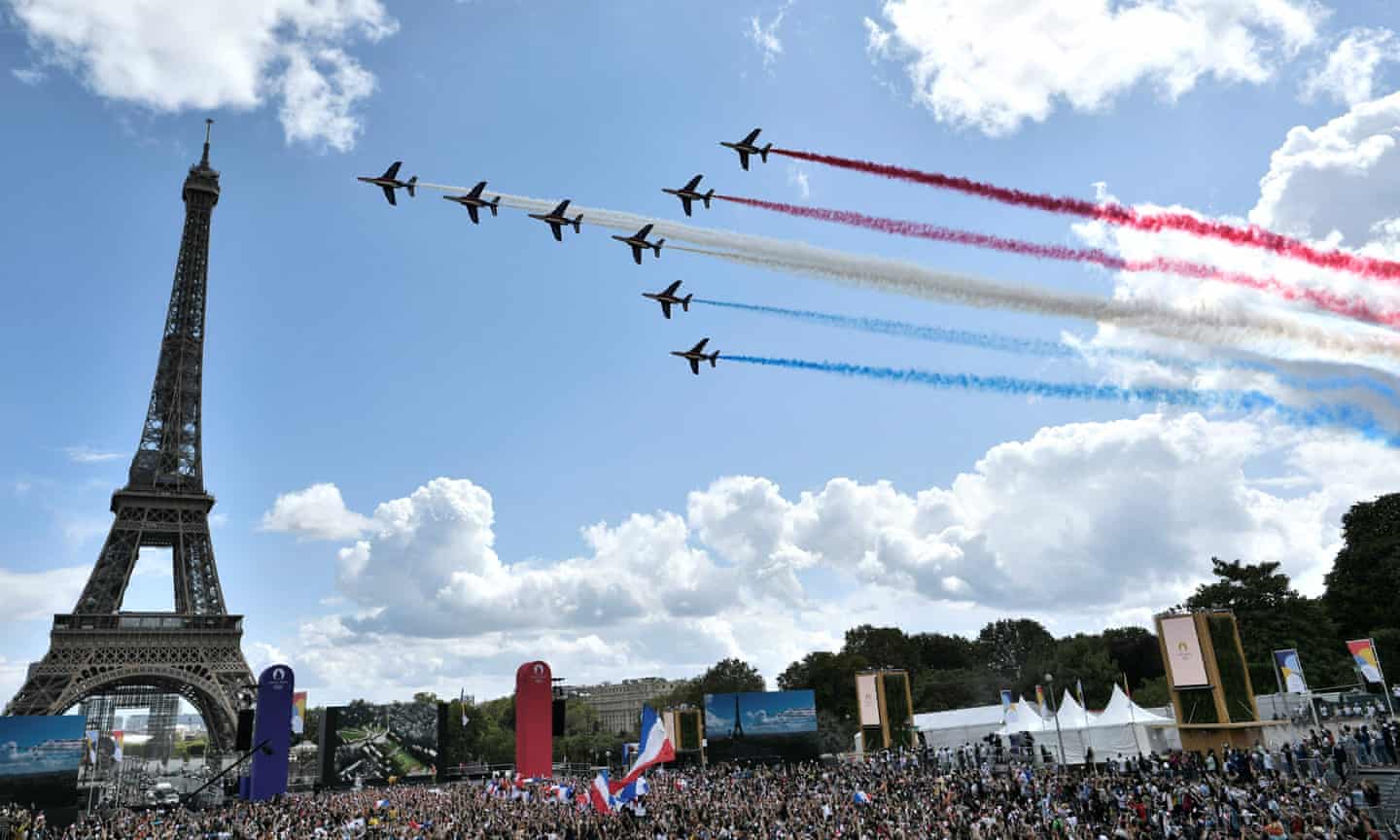
French flypast following handover of Olympic flag
MIDDLE EAST
IRAN has a new hard-line president. With an inexperienced government in Israel threatening military action against Tehran, a lethal shadow war is escalating in the Middle East. Iran’s ally and proxy, Hezbollah, is firing missiles into Israel from a dysfunctional and chaotic Lebanon. Hostage-taking has led to a bitter exchange of words from London. And US fears are growing that the Vienna nuclear talks have failed. With or without a deal, it is suggested that Iran may soon be able to build an atomic weapon.
The position in the Gulf is perilous, and a particularly portentous moment for the multifaceted conflict between Iran and the west. Ebrahim Raisi, who was sworn in as president last Thursday after a rigged election, offered very little for optimism. “Tyrannical sanctions” imposed by the Trump administration, which have ravaged the country since 2018, must be lifted, he said. But he offered no plan to achieve it and nothing in the way of concessions.
Raisi’s ascent to power marks a definitive triumph for the fiercely conservative, anti-western factions associated with Iran’s supreme leader, Ayatollah Ali Khamenei. Raisi’s predecessors – Hassan Rouhani and Mohammad Khatami – fought a long, losing internal battle for rapprochement with the US and Europe. Now, hardliners control all the Islamic republic’s main institutions: the military, judiciary and parliament.
Such a clean sweep poses ominous implications. Backed by the powerful and influential Islamic Revolutionary Guard Corps, Raisi, ironically, now has the political clout to cut a deal in Vienna that Rouhani lacked. He may well do so. Iran’s economy is in dire straights with inflation and shortages wreaking havoc. Official figures show the poverty rate doubled over two years, to 30% in 2019. That statistic could have deteriorated even more by now. A limited agreement on sanctions relief could ease the public’s pain.
Raisi and the ageing, hawkish Khamenei, however, remain ardent nationalists who believe strongly in the virtues of self-reliance, both on ideological and religious grounds. They passionately argue that, in the future, Iran’s centrally directed economy, increasingly dominated by IRGC interests, should not depend on private sector trade with a US-dominated west. They aim to eliminate forever the political leverage that sanctions have afforded Washington. They don’t want to be friends with America.
Raisi’s insistence on increased self-reliance also presages an expansion of Iran’s regional sway, not least by reinforcing the “axis of resistance” with allies in Syria, Iraq, Yemen and Lebanon. Similarly, closer strategic alliances with China and Russia are in prospect. Tehran recently signed a 25-year trade and military partnership with Beijing. Vladimir Putin has been quick in heartily congratulating Raisi on his election victory.
The Gulf drone attack on the Israel-linked tanker MV Mercer Street, which killed a Briton and Romanian last week, augers ill for the Raisi era. As always, Iran denies responsibility. Britain and the US say they can categorically prove otherwise. Tehran’s suspension of talks on an international prisoner swap is another blow, as is the shocking and unjust 10-year jail sentence given to a British-Iranian, Mehran Raoof. Richard Ratcliffe, husband of harshly imprisoned Nazanin Zaghari-Ratcliffe, is right to raise the alarm in urging the Foreign Secretary, Dominic Raab to do much more.
Alarming, too, is the sudden outbreak of hostilities across the Israel-Lebanon border and now with Hamas in Gaza. In an unusual statement, Hezbollah has admitted launching missiles against Israeli targets. Such an open declaration looks like a message for Naftali Bennett, Israel’s untested prime minister, sent with Iran’s approval. After the tanker attack, an incensed Tehran threatened direct military action. Such a contest between new leaders Raisi and Bennett is something the Middle East cannot afford.
Concerns are growing in Washington that smouldering tensions involving Tehran and other regional actors, fanned by the changes of leadership in Iran and Israel, could ignite. Earlier this year, there was talk of easing the tensions between Iran and its arch-rival, Saudi Arabia. Officials from either side met in Baghdad, but all that hope has now vanquished. The Saudis snubbed an invitation to Raisi’s inauguration. Back to square one.
The Biden administration also has worries of its own. It had hoped tensions with Iran could have been defused with the reviving of the 2015 nuclear pact that was petulantly abandoned by Trump. It’s chastening to reflect that his foolish decision did as much as anything to assure the ascent of Raisi and the hardliners. Even if there is a compromise and the pact is reinstated, many in the US now argue it’s already too late. Iran, it is suspected, has gained so much bomb-making know-how, it simply will not be interested in any revival of the agreement with the west.
Understandably, this thought alone is deeply troubling for Israel’s leaders. It should also worry the region and their not-so-distant European neighbours. But further sabre-rattling and proxy-war fighting is not the way to respond. The EU sent a representative to Raisi’s inauguration, which was the right thing to do. At this perilous juncture, the US and Britain, too, must urgently strive to keep the door open and advance dialogue with Tehran. For his part, Raisi should stop posturing and show some statesmanship by immediately releasing all western hostages.


(10) Sunday, August 8 (final day) –

Final Medal Table Standings

General Overview of Team GB
Considering that for much of the last 18 months, the country has been locked down and many of our athletes have been without competition, the results in Tokyo have been an incredible succession of firsts and new records having been set. Jason Kenny has become the most decorated British Olympian ever. Laura Kenny became the most successful female track cyclist in Olympic history. The Boxing team winning the most medals since Antwerp 1920. Adam Peaty becoming the first British swimmer to successfully defend an Olympic gold medal. Duncan Scott becoming the first Briton to win four medals at a single Games. Katie French and Joe Choong winning Golds in the women and men’s modern pentathlon – the first time both titles have been won by the same country. Sky Brown becoming the youngest Team GB medallist ever. The men’s and women’s 1500m – both incredibly difficult races on the international stage – claiming bronze for Scots Josh Kerr and silver for Laura Muir.
And the unforgettable images. The sheer joy and exuberance of Sky Brown on a skateboard. Charlotte Worthington’s 360 degree jump on a BMX. In the men’s keirin Jason Kenny shooting out on front at the start and staying there. The look of delight on Keely Hodgkinson’s face when she realises she has won silver in the Women’s 800 metres. And Tom Daley knitting.
When Daley Thompson won his second decathlon gold at the Los Angeles Olympics in 1984, Time magazine ran a feature about him titled ‘Call this Briton Great’. In 2021, of the 65 medal winners, Call these Britons Great. Truly inspiring.

