
LITERARY REVIEW
REVIEW
DURING World War II, captured German generals and other senior officers were taken to Trent Park, a mansion house in North London.
On arrival, they were greeted by a one-legged Scottish aristocrat named Lord Aberfeldy. He was, he told them, their welfare officer and a second cousin of the king, who was very concerned that they should be treated well.
But this was all an elaborate charade. Aberfeldy was no royal relative – he was an intelligence officer called Ian Munro, who also happened to be a very good actor. So enthusiastically did he throw himself into this role that, according to a colleague, “he became too grand to talk to any of us” and “expected orderlies to address him as Your Lordship”.
His job was to butter up the generals and keep them happy. While Aberfeldy flattered them and brought them treats, they were less likely to notice what was unusual about Trent Park, which was that everything that could be bugged was.
Hidden microphones were everywhere: in the light fittings, in the fireplaces, under the floorboards in the generals’ bedrooms. There were even some hung in the trees in the grounds. The whole place was wired for sound and, in rooms hidden from view, secret listeners tuned in to everything the Germans said.
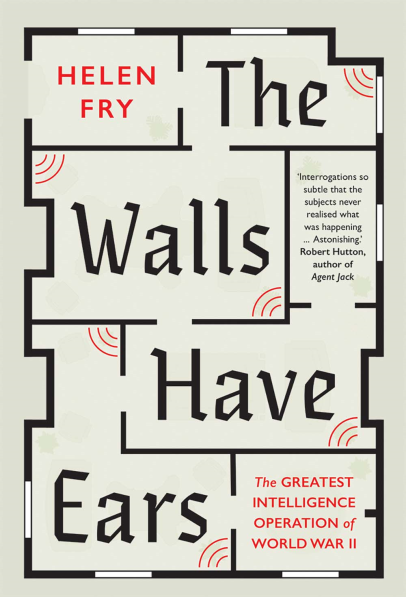
This was one of the most effective intelligence operations of the war, yet probably the least known. Its records have been declassified only over the past 20 years, and Helen Fry’s remarkable and insightful book throws new light on its workings.
It was run by Thomas Joseph Kendrick, a man with 30 years’ worth of experience in the secret services behind him.
WHILE working as a British passport officer in 1938, he became the “Oskar Schindler of Vienna”, arranging for hundreds of Jews to leave Austria after the Nazi takeover. He was arrested, interrogated by the Gestapo and expelled from the country for espionage.
Returning to London, he was the ideal commander for a new unit setting up a special bugging operation in the Tower of London. When war was declared, and the first German prisoners of war (PoWs) arrived – most Luftwaffe pilots and U-boat officers – Kendrick was ready.
Early results were promising, although, very occasionally, one of the shrewder prisoners became suspicious. Wilhelm Meyer, a pilot shot down over the Thames in November 1939, asked a cellmate: “Do you think listening apparatus are built in here?” But even Meyer finally decided he was being over-cautious.
Most were blithely unsuspecting as Kendrick’s team recorded every word they said.
As the war went on, and more and more PoWs arrived, Kendrick expanded his work. Three more sites, including Trent Park, were fitted with cutting-edge recording technology shipped over from the Radio Corporation of America in New York. With Allied victories in North Africa, more senior German officers were taken captive. (There was, of course, a huge influx of high-ranking Wehrmacht personnel after D-Day.)
As operations grew, Kendrick needed extra listeners. His interview techniques could be terrifying for candidates.
He once handed a would-be recruit a pistol across his desk. “If you ever betray anything about this work,” he said, “here is the gun with which I expect you to do the decent thing. If you don’t, I will.” His original listeners were British-born, but fluent in German. Soon, because of the variety of accents and dialects they were encountering, he needed native German-speaking emigres, most of them driven into exile by the Nazis.
They were the “King’s Most Loyal Enemy Aliens”, as one man sardonically described them.
Kendrick also used “stool pigeons” – fake fellow prisoners who joined real PoWs in their cells and subtly encouraged them to talk. One of these, a fluent German speaker, was the father of singer and actress Olivia Newton-John.
Another, whose name has never been revealed, was a former inmate of Belsen, imprisoned for his political views. After release, he had been conscripted into the German army and then captured by the British.
Unsurprisingly, his loyalty to the Nazi regime was non-existent. He was one of the first to reveal the horrors going on in the camps. But Kendrick’s greatest successes were with the generals at Trent Park. The more senior they were, the more they knew (and could unwittingly reveal) about the German war effort.
Most of them were eccentric, arrogant parodies of the Prussian officer class. One, Lieutenant-General Gotthard Frantz, wore a monocle at all times, even under sunglasses, and went to bed with all his medals on.
Another was heard to exclaim in utter bafflement, “We have the best generals and we are losing the war!”
As Fry wryly comments: “Clearly, talking too much within earshot of the hidden microphones may have had something to do with that (the loose talk).”
Others, however, more sensitive and intelligent, became severe critics of the Nazis – although toasts were still raised on Hitler’s birthday. “Pity it has to be English beer,” remarked one of the generals.
RIVALRIES developed at Trent Park between pro-Nazis and those utterly disillusioned with the progress of the war.
Kendrick’s methods of dealing with the generals was unusual, to say the least. As well as listening in on their every conversation, he took to wining and dining them. There were even lunch trips to Simpson’s on the Strand.
When Winston Churchill found out about this, he was furious and had them stopped – so Kendrick relocated the lunches to The Ritz.
Helen Fry likens the atmosphere at Trent Park to a traditional London gentlemen’s club.
Living a life of relative luxury, with their egos stroked and sense of self-importance encouraged, they relaxed – and played straight into Kendrick’s hands.
However unorthodox his operation, it worked. His listeners never set eyes on a single German PoW, but eavesdropped on more than 10,000.
They picked up enormously valuable intelligence on the secret weapons programme that produced the V1 and V2 rockets; on battle plans and troop positions; and on U-boat bases and new aircraft technology.
“You have done a Herculean task,” Kendrick was told towards the end of the war.
It was on a par with the better-known work at Bletchley Park and the cracking of the enigma code.
Helen Fry’s richly researched book, packed with surprising and fascinating detail, will bring the covert listeners of the time some of the attention they deserve.
– The Walls Have Ears: The Greatest Intelligence Operation of World War II is published by Yale, 320pp


