
Britain, Defence, Europe, Government, NATO, Society, Ukraine, United States

Britain could do much more in Ukraine

UKRAINIAN CONFLICT

THE UK has been at the forefront in providing military aid to Ukraine, coming second only to the US in the total support it has given.

In some areas, however, Germany is supplying more military hardware than Britain, even though it has been accused of reluctance in supporting Ukraine.

Britain is Europe’s biggest military donor to Kyiv, with some £2.3bn spent in 2022, and as much again is to come in 2023.

The Berlin government says it has so far issued licences for the export of military goods to Ukraine worth a total of nearly £2.1bn.

President Volodymyr Zelensky’s visit to Britain this week came with a shopping list and appealed for more assistance for his embattled troops.

Fighter jets were at the top of his list – and he made a pointed rebuttal to Rishi Sunak’s suggestion that it would take Ukrainian pilots three years to learn to fly the RAF’s Typhoons, saying he would send air crew who have “already trained for two and a half years”.

Here, it is assessed what Britain could do to enhance its military support for Ukraine:

Typhoon Fighter Jets

The UK has 137 Typhoons, of which around 100 are “on the flight line”, in other words operational. These are based at RAF Lossiemouth in Scotland and RAF Coningsby in Lincolnshire. Only a few days ago No 10 shot down Boris Johnson’s demands for the UK to provide fighter jets, insisting “it was not practical” – in part due to the training requirements for Typhoons and the F-35 and complications involving their integration with other aircraft and technological systems in the war zone.

But within hours of Mr Zelensky’s plea for British jets to protect Ukraine, the rhetoric from Downing Street had changed saying the UK was “actively looking at just that”.

Sunak’s change of stance also followed Mr Johnson reiterating there was “no conceivable reason” why the UK should not send aircraft.

But, frustratingly for Ukraine, Sunak stopped short of an unequivocal commitment.

The Prime Minister described the announcement that the RAF would train Ukrainian fighter pilots as a “first step” towards sending jets. He also insisted it takes three years to train a Typhoon pilot – hence why the UK is not sending any combat aircraft yet.

But Mr Zelensky dismissed the Prime Minister’s excuse for inaction, insisting Ukraine would be sending pilots to the UK with two and a half years’ experience.

Many military analysts claim the UK’s fast-jet fleet is not suited to the conflict, and Ukraine would gain more from the F-16s operated by NATO partners such as Denmark, the Netherlands and Poland. These are simpler to use than the UK’s jets.

The US would need to sign off any transfer to Ukraine, as it controls the export licences.

Recent indications from the White House suggest this would not be problematic – although President Biden does not want to send the US’s own F-16s into aerial battle against Russia.

F-16 donations could happen within weeks, and President Zelensky’s visits to Paris and Brussels should provide added impetus.

The Netherlands has 40 F-16s and is transitioning to the more advanced F-35, made by the same manufacturer, Lockheed Martin. So it has jets to spare that are easier to operate than UK aircraft.

That so many NATO allies operate F-16s also gives advantages for training and supply chains.

Even relatively primitive fighter jets are unlikely to be available in the short term, so will not play any part in the anticipated spring offensive being planned in Kyiv.

France also hasn’t ruled out sending fighter jets, albeit with strict non-escalation clauses, including a ban on any French jet attacking inside Russia’s internationally recognised border.

Germany has ruled out sending fighter jets to Ukraine.

Challenger Tanks

The UK has 227 Challenger 2 tanks, of which 14 have already been committed to Ukraine. As Mr Sunak has pledged, they will reach the battlefield next month.

The conventional wisdom is that Britain could do more to help Ukraine. A further 14 Challenger 2s are being brought to “high readiness”, and could be transferred to the war zone.

Mr Johnson highlighted the absurdity of British tanks patrolling rural Wiltshire when they could be sent to the Donbass.

Arguably, the UK’s provision of Challenger 2s was primarily a political gesture intended to convince Germany to release and deploy its Leopard 1 and 2 tanks – which were always Kyiv’s preferred options. Being lighter and more mobile these tanks are considered better suited to the conflict in eastern Ukraine.

Germany has agreed to supply 14 Leopard 2s – and said earlier this week it would join the Netherlands and Denmark to provide up to 178 older Leopard 1s. Leopards are used across NATO so it will be easier to resupply the German-made tanks than the Challenger 2s, which are used only by the UK.

The Challenger 2 is also due to be withdrawn from service. Of the 227, 148 will have their engines tuned, their turrets replaced and their main guns replaced. The same hulls will be used for what will be called Challenger 3.

These upgraded tanks will start entering service from 2027.

How many Challenger 3s are built is subject to a review by Defence Secretary Ben Wallace. The review will consider lessons learned from the conflict in Ukraine, which has changed the debate about the role of armour in modern warfare.

The Ministry of Defence says the Challenger 3 will reach 60mph and have more range. It will also be the UK’s fully digitised tank, able to share live data with other vehicles and attack helicopters.

Ukraine said it needed 300 Western tanks to make a significant difference on the battlefield. Ukraine has reached that target, mostly Leopard 1s and 2s, so it does not desperately need a tank with logistical issues such as Challenger 2 – and it does not have the time to wait for its successor Challenger 3.

Long-Range Artillery

Britain has committed to sending 30 AS-90 self-propelled howitzers to Ukraine when its combat troops have completed training on the weapon in the UK.

According to reports the British Army ordered 179 AS-90s from its manufacturer, BAE Systems – so there should be significant scope for further donations to Ukraine.

The weapon weighs around 44 tons, has a range of 15 miles and can fire three shots every ten seconds. It is operated by a five-man crew.

The UK has also given six Guided Multiple Launch Rocket Systems (GMLRS) firing M31A1 missiles up to 50 miles, letting Ukraine hit targets behind Russian lines.

Germany has provided five of an equivalent system, the Mars II rocket launcher, complete with ammunition. The UK is understood to have critical shortfalls of ammunition used by the AS-90 and GMLRS as a result of the conflict. Shortages of the anti-tank Stinger, Javelin and N-LAW weapons have also been reported.

The UK must increase production and procurement of munitions and guided-weapons systems, not only to support Ukraine but to ensure the UK can defend itself and meet NATO obligations.

A former senior military commander, Major General Jonathan Shaw, said: “Russia has mobilised its society and industry for war – we must respond. Wars are fought by nations, not armies. The West must mobilise its society and industries to win.”

But the UK is competing with NATO allies such as Poland and the US for many of the same requirements, such as additional GMLRS stocks.


DEFENCE analysts refute that RAF Typhoons should be offered to Ukraine. Their arguments should be considered before any deployment is made.

Our Typhoon fleet is routinely described as “overstretched” due to its operational commitments. Some missions are arguably by choice and not necessity.

Given the acute threat to British and regional security posed by a possible Russian victory in Ukraine, some might say that these responsibilities need be reconsidered so that Typhoons could be released to Kyiv.

The Typhoons flying over Iraq and Syria are based at RAF Akrotiri in Cyprus. Regional partners could be petitioned and encouraged to fly more sorties, freeing up the eight jets based at Akrotiri.

It is almost two months since any RAF assets hit an Islamic State target – when an unmanned Reaper drone fired a pair of Hellfire missiles to destroy a building. It is possible that drones could take the place of the Typhoons. That would be a strategic decision.

Four more Typhoons are in the Falklands and have flown “deterrence patrols” there since 2009.

The overall Typhoon force – 100 aircraft – is spread thinly and worn out. Numbers are compromised by spare part problems, engineer shortages and pilots lacking training hours. The first Typhoons, introduced in 2002, have flown longer than was originally planned and suffer from wear and tear.

To defeat Russian fighter jets in dogfights, Ukrainian-flown aircraft need advanced air-to-air missiles. The options are limited and the European Meteor missile – the weapon of choice for aerial engagement – is not compatible with early Typhoons.

To avoid Russian air defence systems, the Typhoons would need to fly at low altitude, and they were not designed for this.

However, the Typhoon has some advantages over rivals – it is faster than the MIG-29 and has a much bigger payload.

The claim that logistical support and maintenance is difficult is highly valid. The Typhoon is complex to maintain and significant numbers of UK contractors would be needed as well as arrays of support equipment. Defence Secretary Ben Wallace has likened the Typhoon to a Formula One racing car, with good reason. The Typhoon is a highly complex aircraft.

The RAF Typhoon jets are especially susceptible to engine damage from objects being sucked into its air intakes, meaning smooth and constantly maintained runways are a must. Such runways would become a Russian target.
Standard
Britain, Economic, Energy, Europe, Government, Politics, Russia, Society

Energy crisis: We’re at the mercy of Putin. It’s all our fault

ENERGY

THE Berlin Wall may have been brought down more than three decades ago, but the grim politics of the Cold War are in danger of returning to Europe.

With characteristic ruthlessness, Russian president Vladimir Putin is exploiting the energy crisis to bully his neighbours, strengthen his autocracy and intimidate the West.

His chosen weapon in this renewed campaign of hostility is Russia’s control of gas supplies: the vast gas-fields and the export pipelines that bring them directly to market.

This infrastructure, often legacy assets from the Soviet empire, give the Russian president enormous political and economic leverage in his quest for ever-greater domination of the region.

Russia’s capacity to manipulate the British and European energy markets for geopolitical ends has been dramatically illustrated during the turmoil of recent days and weeks. As the price of gas contracts soared by 40 per cent in just 24 hours last week, Gazprom, Russia’s state-backed monopoly exporter of pipeline gas, was accused of flexing its muscles by both restricting supplies to Europe and keeping its European underground storage facilities at deliberately low levels.

The sense of Russian control was further reinforced when it took just a few words from Putin himself to bring an immediate fall in gas prices.

Revelling in his position as the ultimate ringmaster and wire-puller, he said with a hint of blackmail that supplies could be increased. “This speculative craze doesn’t do us any good,” he said, adding that Europe’s leaders should “settle with Gazprom and talk it over”.

RELIANCE

PUTIN might be behaving like a mafia boss in charge of a protection racket, but British and European governments have for years disastrously played into his hands with misguided, short-term policy decisions.

To be fair, the EU has taken some steps to break the Russian stranglehold, by building new international pipelines, breaking the Kremlin’s east-west transit monopoly, and by introducing drastic reforms of the energy market that have unravelled the corrupt, exploitative business model.

Europe has also pioneered the import of liquified natural gas (LNG) from destinations such as Qatar.

Yet Europe has been increasing its reliance on supplies from outside the continent by running down its own domestic energy industries. So far, renewables have not made up the gap, especially in recent months when the wind has not been blowing.

In Britain, the problem is particularly acute because we are one of Europe’s largest gas users, while we have massively reduced gas production from the rich fields of the North Sea and Irish Sea over the past 20 years.

Nor have we made use of the vast reserves of shale gas that exist across the country, even though such resources have recently made America “energy independent” once more.

Instead, Britain has exacerbated its energy vulnerability by depending on just-in-time imports from pipelines and seaborne cargoes.

In a particular act of folly, the Tory Government in 2017 decided to close the huge storage facility on the Yorkshire coast connected to the Rough gas field, believing both that supplies of LNG would always be plentiful and also because the energy companies believed that limiting storage would boost prices and thereby profits.

Some four years later, the step has backfired catastrophically, leaving us at the mercy of Putin.

Indeed, our entire energy strategy has been marked by stinginess, wishful thinking and downright complacency.

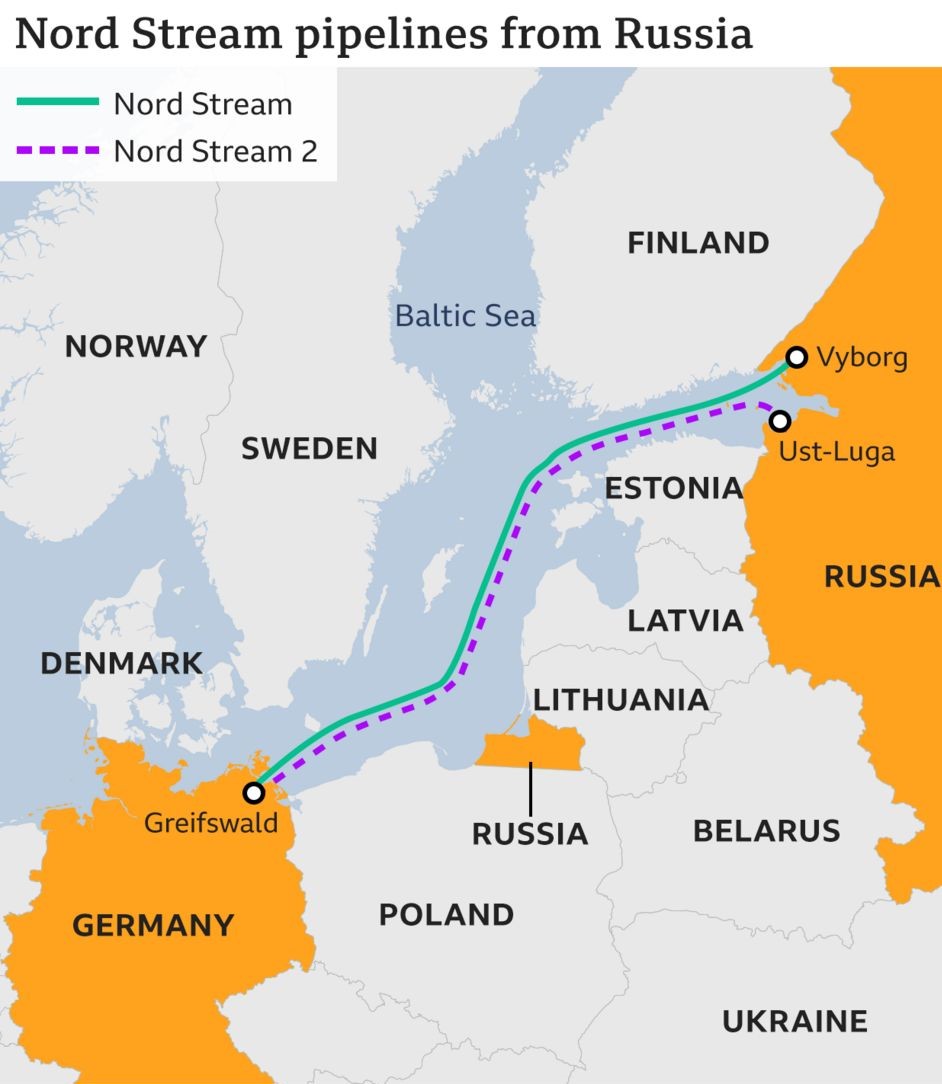
By manipulating energy markets, Putin’s immediate objective could not be clearer: he wants to pressurise Europe into approving immediately the operation of Gazprom’s controversial £8.1 billion Nord Stream 2 pipeline.

Now completed, this runs into Germany along the seabed of the Baltic Sea and bypasses Ukraine, in whose eastern regions Russia has been fighting a proxy war since 2014.

Critics say Nord Stream 2 will give too much influence to Russia over regional supplies and their prices.

But crucially, the project is backed by Germany, which puts cheap reliable supplies of Russian gas ahead of the security interests of its east European neighbours. US President Joe Biden’s administration, desperate to repair the damage done to relations with Europe under Donald Trump, has dropped American objections to the scheme.

The result is that Russia can now hold Ukraine and other Eastern European states to ransom. The Kremlin could shut down their gas without having to cut off the rest of Europe. In effect, one group of nations will be played off against the other in a fearful system of divide and rule, with Russia in command.

As Yuriy Vitrenko, the chief executive of Ukrainian energy giant Naftogaz, put it last week: “Moscow is withholding gas supplies in order to coerce Europe into accepting Nord Stream 2. Russia’s actions are the epitome of gas weaponisation. Anyone who refuses to acknowledge what Moscow is doing, especially when it does this so blatantly, is sending a dangerous message to the Russians that they can use gas to blackmail Europe and get away with it.”

TRAGEDY

GIVEN all this, it is almost inevitable that Ukraine will soon be plunged into another security crisis, perhaps even greater than the one that led to the annexation of Crimea in 2014. The fallout would be disastrous, especially in view of the fragility of Europe’s post-Covid economies.

The implications of Russia’s energy strength are brutal, leaving us relentlessly on the defensive. If, for example, Russia invaded Estonia, would NATO respond if Putin threatened to cut off Europe’s gas? The only way to break free from the shackles of energy dependency is to develop our own resources and means of storage.

In the 1970s, Western reliance on Middle Eastern oil created an era of regional conflict and economic crisis.

If today, the same were to happen because of our reliance on Russian gas, that too would be a tragedy.

. Appendage

Standard
Britain, Europe, France, Government, History, Military, Society, United States

75th Normandy Commemoration

NORMANDY

SEVENTY-FIVE years ago, Britain had embarked on its most momentous military mission. Upon the outcome of D-Day, June 6 – the largest seaborne invasion the world has ever seen – hinged the very freedom of all Europe. Events this week in Normandy have been an impassioned reminder of the huge sacrifice and human cost of liberating Europe from the tyranny of Hitler and the Nazis.

Codenamed Operation Overlord, it was an endeavour of mind-blowing scale and complexity. Some 156,000 British, American and Canadian troops landed on French soil in a heroic push to prise Hitler’s choking grip from the Continent.

Few were highly experienced, meticulously trained military men. Most were plucked from loving families and ordinary jobs: Insurance clerks, shopkeepers, postmen.

Displaying unimaginable courage, they stormed the chaotic Normandy beaches. It was, undoubtedly, hell on Earth – wading ashore into a hail of bullets, with shells exploding, the sea red with human blood, and the piercing screams of the dying.

Quite easily, the enterprise could have foundered – leaving Europe caught in the death roll of Nazi dictatorship. But thanks to the tenacity and sacrifice of the selfless men who fought that tumultuous day in 1944, the attack succeeded – altering the course of the Second World War.

Yes, the human price paid was huge. On D-Day alone, around 4,400 Allied troops paid the ultimate sacrifice. But tyranny was conquered, and the Continent liberated.

This week, a dwindling band of military veterans were joined by royalty and world leaders in Portsmouth – an embarkation point for the battle – to commemorate the anniversary. To witness the intrepid warriors – all aged over 90 – wiping away tears for fallen comrades was moving and humbling.

Her Majesty the Queen commended the resilience of the “wartime generation”. The bravery of those who fought – and died – would never be forgotten, she said. They deserved the thanks of the whole free world.

Truly, the debt our heroes are owed cannot be repaid.


YET, what would these exemplary men, who stoically stared death in the face when barely out of short trousers, make of today’s intemperance and bigotry?

In attendance was Jeremy Corbyn, who aspires to be prime minister, but who invariably fraternises with our enemies. His contempt at President Trump being an honoured guest at the anniversary was visceral – even though American GIs died to preserve our liberty. The US, via NATO, has ensured peace in Europe ever since.

Earlier, he whipped his Marxist acolytes into such a frenzy of hate an NHS worker ignorantly shrieked “Nazi scum” in the face of a Trump supporter.

Welcome, then, to the new intolerance of the hard-Left. Anyone failing to share their bigoted and hateful views is branded racist or fascist – even at events celebrating freedom.

Since these buffoons have clearly never read a history book, here’s a lesson: The Nazis murdered six million Jewish people, and stamped the evil of fascism across Europe. Someone who merely proffers a different opinion is not a Nazi.

Each time these screeching fanatics resort to such disgusting slanders, they cheapen the very ideals the veterans fought for.

250 giants of D-Day, now frail but burning with the valour that carried them to victory, returned to Normandy in an act of pilgrimage. They witnessed the inauguration of the first British monument on the coast of France to honour the 22,442 members of our Armed Forces killed there.

Seventy-five years ago, Britain had far more to worry about than the present political turmoil of Brexit. The future of the world was in the balance.

But even after we have untangled ourselves from the EU, Europe will remain our historical and geographical kin. In times of danger, Britain will resolutely defend the freedoms given to us by the band of brothers on D-Day.

Standard