
Government, Iran, Israel, Middle East, Politics

The west must engage with Iran’s new president

MIDDLE EAST

IRAN has a new hard-line president. With an inexperienced government in Israel threatening military action against Tehran, a lethal shadow war is escalating in the Middle East. Iran’s ally and proxy, Hezbollah, is firing missiles into Israel from a dysfunctional and chaotic Lebanon. Hostage-taking has led to a bitter exchange of words from London. And US fears are growing that the Vienna nuclear talks have failed. With or without a deal, it is suggested that Iran may soon be able to build an atomic weapon.

The position in the Gulf is perilous, and a particularly portentous moment for the multifaceted conflict between Iran and the west. Ebrahim Raisi, who was sworn in as president last Thursday after a rigged election, offered very little for optimism. “Tyrannical sanctions” imposed by the Trump administration, which have ravaged the country since 2018, must be lifted, he said. But he offered no plan to achieve it and nothing in the way of concessions.

Raisi’s ascent to power marks a definitive triumph for the fiercely conservative, anti-western factions associated with Iran’s supreme leader, Ayatollah Ali Khamenei. Raisi’s predecessors – Hassan Rouhani and Mohammad Khatami – fought a long, losing internal battle for rapprochement with the US and Europe. Now, hardliners control all the Islamic republic’s main institutions: the military, judiciary and parliament.

Such a clean sweep poses ominous implications. Backed by the powerful and influential Islamic Revolutionary Guard Corps, Raisi, ironically, now has the political clout to cut a deal in Vienna that Rouhani lacked. He may well do so. Iran’s economy is in dire straights with inflation and shortages wreaking havoc. Official figures show the poverty rate doubled over two years, to 30% in 2019. That statistic could have deteriorated even more by now. A limited agreement on sanctions relief could ease the public’s pain.

Raisi and the ageing, hawkish Khamenei, however, remain ardent nationalists who believe strongly in the virtues of self-reliance, both on ideological and religious grounds. They passionately argue that, in the future, Iran’s centrally directed economy, increasingly dominated by IRGC interests, should not depend on private sector trade with a US-dominated west. They aim to eliminate forever the political leverage that sanctions have afforded Washington. They don’t want to be friends with America.

Raisi’s insistence on increased self-reliance also presages an expansion of Iran’s regional sway, not least by reinforcing the “axis of resistance” with allies in Syria, Iraq, Yemen and Lebanon. Similarly, closer strategic alliances with China and Russia are in prospect. Tehran recently signed a 25-year trade and military partnership with Beijing. Vladimir Putin has been quick in heartily congratulating Raisi on his election victory.

The Gulf drone attack on the Israel-linked tanker MV Mercer Street, which killed a Briton and Romanian last week, augers ill for the Raisi era. As always, Iran denies responsibility. Britain and the US say they can categorically prove otherwise. Tehran’s suspension of talks on an international prisoner swap is another blow, as is the shocking and unjust 10-year jail sentence given to a British-Iranian, Mehran Raoof. Richard Ratcliffe, husband of harshly imprisoned Nazanin Zaghari-Ratcliffe, is right to raise the alarm in urging the Foreign Secretary, Dominic Raab to do much more.

Alarming, too, is the sudden outbreak of hostilities across the Israel-Lebanon border and now with Hamas in Gaza. In an unusual statement, Hezbollah has admitted launching missiles against Israeli targets. Such an open declaration looks like a message for Naftali Bennett, Israel’s untested prime minister, sent with Iran’s approval. After the tanker attack, an incensed Tehran threatened direct military action. Such a contest between new leaders Raisi and Bennett is something the Middle East cannot afford.

Concerns are growing in Washington that smouldering tensions involving Tehran and other regional actors, fanned by the changes of leadership in Iran and Israel, could ignite. Earlier this year, there was talk of easing the tensions between Iran and its arch-rival, Saudi Arabia. Officials from either side met in Baghdad, but all that hope has now vanquished. The Saudis snubbed an invitation to Raisi’s inauguration. Back to square one.

The Biden administration also has worries of its own. It had hoped tensions with Iran could have been defused with the reviving of the 2015 nuclear pact that was petulantly abandoned by Trump. It’s chastening to reflect that his foolish decision did as much as anything to assure the ascent of Raisi and the hardliners. Even if there is a compromise and the pact is reinstated, many in the US now argue it’s already too late. Iran, it is suspected, has gained so much bomb-making know-how, it simply will not be interested in any revival of the agreement with the west.

Understandably, this thought alone is deeply troubling for Israel’s leaders. It should also worry the region and their not-so-distant European neighbours. But further sabre-rattling and proxy-war fighting is not the way to respond. The EU sent a representative to Raisi’s inauguration, which was the right thing to do. At this perilous juncture, the US and Britain, too, must urgently strive to keep the door open and advance dialogue with Tehran. For his part, Raisi should stop posturing and show some statesmanship by immediately releasing all western hostages.
Standard
Culture, History, Iran, Society

The destruction of cultural heritage is a war crime

IRAN

THE United States has been warned not to attack Iranian culture sites as it would be a breach of international rules.

The US President has threatened to target Iranian state treasures if Tehran retaliates over the assassination of its top military commander in Iraq. The assassination of Major General Qassem Soleimani has sparked worldwide condemnation.

International laws and conventions prevent the destruction of culture heritage. The British Foreign Secretary, Dominic Raab, has said that he expects cultural sites to be “respected”.

Targeting cultural sites is a war crime under the 1954 Hague Convention. The UN Security Council also passed a resolution in 2017 condemning the destruction of heritage sites.

The US President raised the prospect of targeting sites, when he tweeted that the US had targeted 52 Iranian sites, some “important to Iranian culture”.

The threat has enraged Iran, with the country’s foreign minister saying such a move would be a “war crime”.

Donald Trump’s threat caught many in his administration off-guard. Many of his officials sought to clarify that the US military would not intentionally commit war crimes, but Mr Trump has doubled down on his remarks.

The US President said: “They’re allowed to kill our people. They’re allowed to torture and maim our people. They’re allowed to use roadside bombs and blow up our people. And we’re not allowed to touch their cultural sites? It doesn’t work that way.”

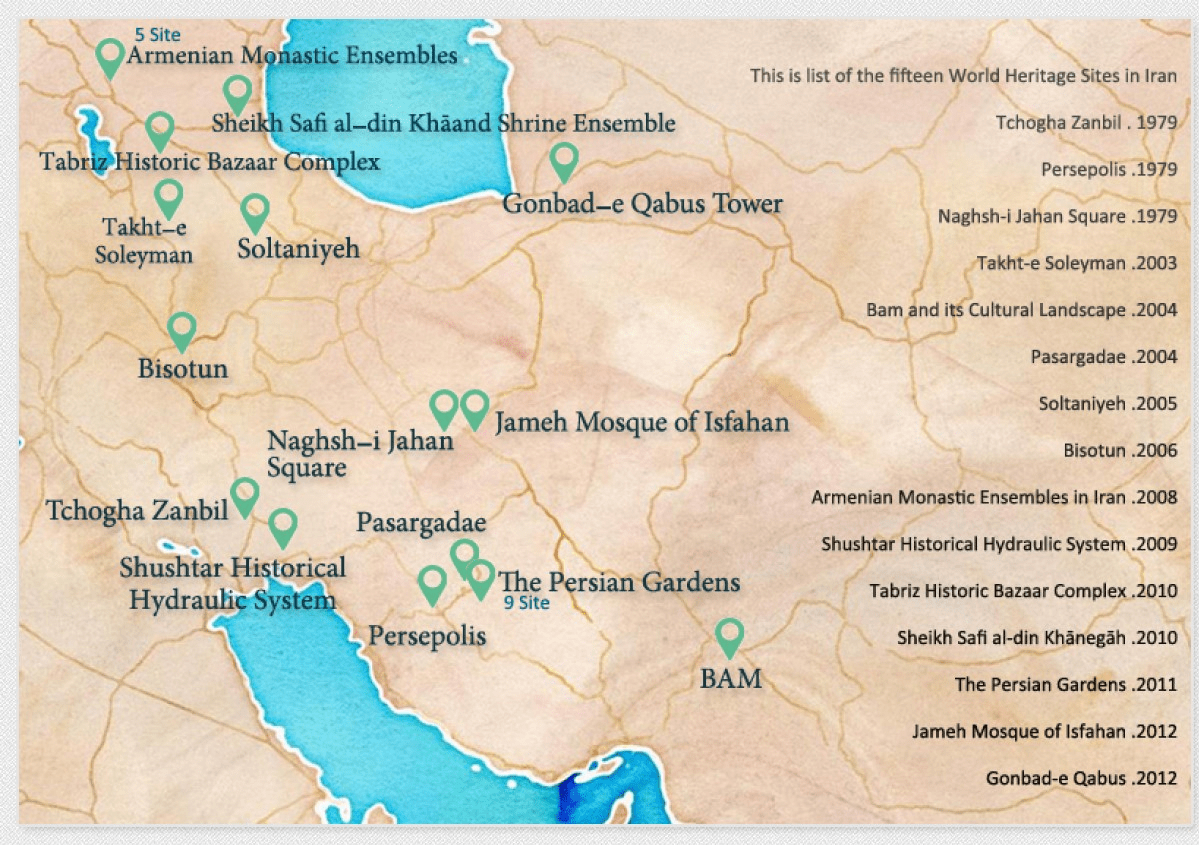
Iran is home to two dozen UNESCO world heritage sites, including Persepolis with its ancient ruins that date back to 518BC. Another heritage site is at Bisotun in the west, where hewn into a rock face is a huge bas-relief ordered by Darius the Great, when he rose to the throne of the Persian Empire in 521BC. Then there is Pasargadae, founded by Cyrus the Great in the 6th century BC.

In the province of Fars, the remains of its palaces, gardens and the tomb of Cyrus are “some of the earliest manifestations of Persian art and architecture”, says UNESCO.

Tehran itself is a treasure chest of mosques, fortresses and temples. Its Golestan Palace is famous for its stunning architecture.

A much more recent monument, the Azadi (Freedom) Tower, was commissioned by the last Shah of Iran, Mohammad Reza Pahlavi, to mark the 2,500th year of the foundation of the Imperial State of Iran. It was renamed after the 1979 Revolution.

All of these places and many more are steeped in their country’s long and often bloody history – the next chapter of which could see them blown to smithereens.

Appendage:

Cultural and Heritage sites in Iran

iran-culture-sites.png

Standard
Britain, Economic, Iran, Society, United States

Gulf of Oman: The stakes could not be higher

US-IRANIAN TENSIONS

THE attacks on the Japanese and Norwegian oil tankers in the Gulf of Oman have brought the simmering tensions between the United States and Iran to a new incendiary level.

Even before last week’s incident, President Trump demonstrated his hostile approach by imposing heavy sanctions on Iranian oil exports and withdrawing from the conciliatory nuclear deal negotiated by President Barack Obama in 2015.

Washington has directly blamed Tehran for the tanker explosions, backing up the claim with the release of video evidence which appears to show members of the Iranian Revolutionary Guard handling what looks like an unexploded Iranian mine on the side of one of the damaged vessels.

It should be acknowledged that Iran has “categorically” denied any responsibility, arguing that the attacks were perpetrated by someone who wants to damage the country’s international reputation.

It certainly came at an awkward time for the Iranian government, which was hosting talks with the Japanese prime minister Shinzo Abe, whose nation is dependent on Iranian oil imports. In theory, at least, it seems irrational that Iran would damage the interests of its own fragile economy with an assault on one of the biggest customers of its oil supply. But economic rationality is not always paramount. And there are several reasons why certain figures in the Iranian regime might actually welcome an escalating crisis in the US.

Outsiders tend to regard the Tehran government as a theocratic monolith, but in reality, there is a division between the pragmatists, led by president Hassan Rouhani, and the fundamentalists who follow the head of state, supreme leader Ayatollah Ali Khamenei.

Iran’s hawkish hardliners, who are growing in confidence, contend that a more aggressive diplomatic policy would have a number of advantages. A coalition with America would serve as a distraction from Iran’s economic woes, which have left the country plagued by public discontent. Posing as the patriot saviour in a national emergency, the hardliners could rally the people against the US, crackdown on dissent and strengthen their grip on power.

According to this narrative, ruthlessness, not diplomacy, is the best way to force Washington to back down on sanctions.

And if things do escalate, the disturbing reality is that these Iranian hardliners certainly have the capability to wage war against America. For if war does break out, the US will find defeating Iran much more costly than Saddam Hussein’s Iraqi regime during the two Gulf war campaigns.

Iran is three times the size of Iraq and the Revolutionary Guards which make up the special forces are well-equipped and battle-hardened. The Iranian military possesses an array of sophisticated armaments, including stocks of ballistic missiles.

But even low-tech equipment could cause severe damage to the US if it came to war in the Gulf. If only one Iranian torpedo boat from a swarm of 40 or 50 managed to break through the US defensive screen, it could still sink or cripple an American ship. And it would only need a few drones to reach a target for the results to be devastating.

Nevertheless, it is unlikely the US will back down. Given its colossal military power, it is rightly still regarded as the world’s military guardian.

In Washington, an anti-Iranian sentiment prevails, a legacy of the hostage crisis of the 1970s. America’s anti-Iranian allies such as Saudi Arabia and Bahrain will also be ramping up demands for action.


BRITAIN will be left in an awkward position if conflict does erupt. It is unlikely that the UK will have any direct military involvement, but diplomatically – as Foreign Secretary Jeremy Hunt has said – it would be unthinkable if Britain does not tacitly support the US.

If that does happen, British expats and commercial interests in the Gulf would be in a vulnerable situation. And in Britain itself, our stuttering economy – like the rest of the western world – would be severely hit by an oil crisis arising from a war.

It came as no surprise that, following the tanker attacks, oil prices in global markets became extremely volatile. After all, 30 per cent of the world’s crude oil passes through the Strait of Hormuz which borders Iran.

In this combustible situation, the stakes could not be higher. We can only hope that a mood of restraint and common sense will ultimately prevail.

Standard