
Education, Information, Science, Society, Technology

Information Society: Probability and Statistics

INFORMATION AGE

WE live in an information age in which modern technology makes it easy to gather large amounts of information on almost every aspect of our lives. However, on its own this information is of only limited value – it needs to be organised and analysed to be of practical use.


INFORMATION about population numbers have been collected since ancient times (see Appendage), but the science of analysing and making sense of data – statistics – is relatively recent. Although now not usually considered to be a branch of mathematics, statistics relies on mathematical analysis to interpret information and is closely linked to the area of mathematics known as probability theory.

Chance and probability

The beginnings of probability theory came from the fascination that two 17th-century French mathematicians had with games of chance. Blaise Pascal and Pierre de Fermat discussed, in a series of letters, a method of calculating the chances of success in gambling games, and they were the first to give the subject of probability a scientific treatment.

What they discussed was a mathematical way of determining the probability of a particular outcome occurring in a random event, such as tossing a coin or throwing a dice. When a coin is tossed there are two possibilities: heads or tails. Each is equally likely: there is one chance in two that the coin will come up heads (or tails), or in other words the probability is 1/2. The six faces of a dice give one chance in six of throwing any particular number, a probability of 1/6. In games using more than one dice, or a deck of cards, or a roulette wheel, the calculation becomes more complex but is essentially built from basic principles and is the same. From this discussion of gambling games, a theory of probability evolved.

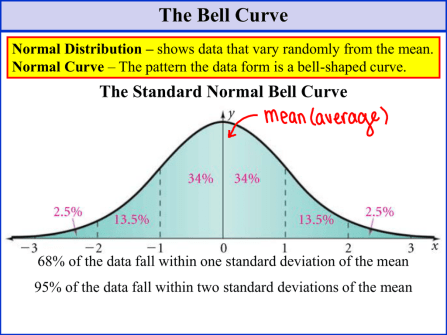
The idea was further developed by the next generation of mathematicians. French mathematician Abraham de Moivre discovered a pattern to the probability of outcomes, now known as normal distribution and represented graphically as the bell curve.
Bell Curve

[Bell Curve: Normal distribution] – When certain values (such as height) are plotted against the number of occurrences of that value (how many people are of a specific height), the result is often a bell-shaped curve – the normal distribution. The most common value, at the peak, is the mean (average).

British mathematician and clergyman Thomas Bayes took de Moivre’s ideas further with his theorem of conditional probabilities, which makes it possible to calculate the probability of a particular event occurring when that event is conditional on other factors and the probabilities of those factors are known. Bayes’ work was further developed by Pierre-Simon Laplace, a French mathematician and astronomer whose application of Bayes’ theorem to real cases led to a new field of study: statistics.

Detecting patterns

The pioneering work in statistics was done by de Moivre, who used data about death rates and rates of interest to devise a theory of annuities, which enabled insurance companies to compile tables of risk for life assurance based on scientific principles. This application of mathematics to data in records was at first known as “political arithmetic”, and, as patterns emerged in collections of data, research began into their underlying statistical laws. To begin with, statistics was concerned with social issues, and advances in sociology and criminology were made by the Belgian mathematician Adolphe Quetelet, who introduced the concept of the “average man”. He also believed mathematics lay at the heart of every science, and statistical analysis could be applied to data of all kinds. Perhaps the area where this had greatest effect was medicine, where an important new study, epidemiology (occurrence of disease in populations), developed from medical statistics.

As more practical use was made of probability theory and statistics, the mathematics behind them was developed by various mathematicians, including the Frenchman Adrien-Marie Legendre, the German Carl Friedrich Gauss, and the Russian Andrey Nikolaevich Kolmogorov, whose systematic approach to the subject forms the basis for much of modern probability theory.

Modern statistics

Statistics plays a key role in much of modern life. Governments collect and analyse a wide range of personal data to detect patterns that can help shape policies. Businesses use market research to gather information about potential customers and apply statistical methods to analyse the data. In science, statistics and probability are central to subjects such as quantum theory and are also essential to many other subjects, from psychology and economics to information science.

Data Samples

In practice, the data used for statistical analysis must be sound for it to produce useful results. The data must be collected using a valid method that measures what is intended, and the data must be accurate. It is also essential that the set of data is large enough and constitutes a representative sample. For example, in general public opinion polls the right questions must be asked in an unambiguous, neutral way; sufficient numbers of people must be polled; and, as a whole, the respondents must be representative of the population (for instance, in age and gender).

Applications
Coxcomb2

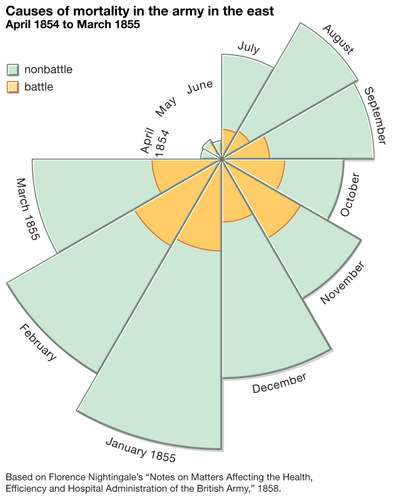
Florence Nightingale’s “coxcomb” graph – This graph devised by Florence Nightingale shows the relative causes of death among soldiers in one 12-month period during the Crimean War (1854-56).

. Coxcomb graphs – Working as a nurse for British troops during the Crimean War, Florence Nightingale kept records of troop deaths and later used the information to create what are now called “coxcomb” graphs. These highlighted the number of deaths that were not directly caused by combat but by factors such as wound infection and disease.

. Computerised Modelling – The development of probability and statistics gave scientists new ways to analyse and conceptualise the physical world.

Many natural systems are influenced by numerous factors and exhibit chaotic behaviour. For example, influences on the weather include air, land, and sea temperatures, winds, sea currents, humidity, and the amount of sunlight. Minute changes in any one of these factors can have a profound effect on the weather. Because of this, weather forecasting relies on numerical models in which statistical methods are used to arrive at predictions that have various degrees of probability of being correct.

. Quantum Theory – The currently accepted theory of the nature and behaviour of matter at the subatomic level, quantum theory uses probability as one of its fundamental tenets. For example, according to quantum theory it is impossible to know precisely the location and momentum of subatomic particles such as electrons “orbiting” the nucleus of an atom; it is only possible to specify regions – known as clouds – where particles may be located with the highest probability.

Appendage

Early Censuses

The earliest known census dates from ancient Babylonian times, about 3800 BCE, and recorded the human population and agricultural data.

Many of the other ancient civilisations also regularly recorded population numbers, often for the purposes of taxation. In the Middle Ages, probably the best-known census is the Domesday Book, which was instigated by William I of England in 1086 to tax the recently conquered population. These early censuses were simply records of numbers because mathematical techniques for analysing data had not yet been developed.
Standard
Health, Medical, Science

Health: Blood Pressure

HYPERTENSION

high-blood-pressure-stat-2019

As blood circulates through the body, it exerts varying degrees of force on artery walls; this is known as blood pressure. According to the World Health Organisation, between 10 and 30 per cent of people throughout the world have blood pressure that is too high – or hypertension. In its early stages, high blood pressure is symptomless, so many people do not realise they have a potentially life-threatening disease. If the condition goes unchecked, it will damage the heart and blood vessels and can lead to a stroke, heart attack and other serious consequences.

In about 5 per cent of cases, there’s an underlying cause for high blood pressure; for example, a narrowed kidney artery, pregnancy, an adrenal gland disorder or a drug side effect. Most often, however, there is no identifiable cause, and this is referred to as primary, or essential, hypertension.

Blood pressure rises when the body’s smallest arteries, narrow or constrict, requiring the heart to beat more forcefully in order to pump blood through them. Increased blood volume, often caused by the body’s tendency to retain excessive salt and fluids, raises blood pressure; so do high levels of adrenaline and other hormones that constrict blood vessels.

With age, blood pressure rises somewhat; no one fully understands precisely what leads to hypertension, although a combination of factors, especially salt intake, seems to be involved. It tends to run in families, so inherited susceptibility is suspected. Obesity is known to increase risk. Stress prompts a surge in adrenal hormones and a temporary rise in blood pressure; some researchers believe that constant stress may play a role in developing hypertension. Other contributors include smoking, excessive alcohol and a generally sedentary lifestyle.

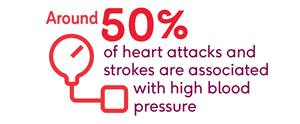
Proper control of high blood pressure and cholesterol can halve the risk of heart attacks. It seems that the death rates from different forms of cardiovascular disease, have been steadily declining since the 1960s, thanks largely to lifestyle changes and improvements in hypertension treatment.

Diet and hypertension

Diet plays a role in both prevention and treatment of high blood pressure. Simple things can help to keep your blood pressure in check.

Limit your salt intake. A high-salt diet also contributes to the condition in people who have a genetic tendency to retain sodium. In these individuals, restriction of salt, from an early age, reduces the risk of developing hypertension. A portion of the population, including older people and people with diabetes, appear to be particularly sensitive to sodium and may benefit significantly from eating low-salt foods. Experts agree that most people should aim to consume no more than 6g of salt each day. The best way to reduce intake is to avoid adding salt, and to avoid processed foods, which are usually loaded with sodium. Check labels carefully – look for the term ‘sodium’ to find hidden salt. It may be a good idea to switch to a potassium-based salt substitute, as potassium lowers blood pressure.

Keep your weight down. Being even slightly overweight contributes to hypertension; losing excess weight is often all that is needed to return blood pressure to normal. Even a modest weight loss will cause a drop in blood pressure.

Eat less fat. A high-fat diet not only leads to weight gain but may also contribute to high blood pressure. Limit fat intake to 30 per cent or less of total calories, with 10 per cent or less coming from saturated fats. This means cutting back on butter and margarine; reading food labels to check the saturated fat content; switching to skimmed milk and other low-fat dairy products; choosing lean cuts of meat and grilling instead of frying.

Reduce alcohol and caffeine consumption. Although a glass of wine or other alcoholic drink daily seems to reduce the chance of a heart attack, consuming more than this will negate any benefit and may increase the risk of hypertension. Too much caffeine can also raise blood pressure. Older adults with hypertension may be more sensitive to the effects of caffeine and should limit their intake.

Boost your mineral intake. Some nutrients may protect against high blood pressure. Potassium, an electrolyte that helps to maintain the body’s balance of salt and fluids, helps to ensure normal blood pressure. Potassium is found in fruit (especially bananas) and vegetables, dairy products, beans and pulses.

A few US studies have linked calcium deficiency to hypertension and have suggested that increased intake of low-fat dairy products may be beneficial.

Get more garlic. Other research appears to suggest that garlic can help to lower blood pressure. The amount of garlic necessary to lower blood pressure, however, can cause other problems, especially unpleasant breath and body odour. Although garlic is available in odourless pills, it is not known if these pills produce the same benefits as eating real garlic.

Other lifestyle changes

While a proper diet is instrumental in maintaining normal blood pressure, it should be combined with other lifestyle changes. One of the most important is regular aerobic exercise, which lowers blood pressure by conditioning the heart to work more efficiently. If you smoke, you should give up, because nicotine raises blood pressure. Giving up smoking can reduce blood pressure markedly – apart from the other health benefits.

Use medications with caution. Non-prescription cold, allergy and diet pills can raise blood pressure. In some women, birth control pills, or hormone replacement therapy, can cause high blood pressure.

Reduce stress. Experts continue to debate the role of stress in hypertension. There is no doubt that stress temporarily raises blood pressure, and some experts think that it may have a long-term effect. Meditation, yoga, biofeedback training, self-hypnosis and other relaxation techniques may help to lower blood pressure. Studies have found that people with pets have lower blood pressure than people who don’t own pets.

Drug therapy. Doctors usually recommend about six months of lifestyle changes to see if mild to moderate hypertension returns to normal levels. If not, drug therapy is often instituted. There are dozens of antihypertensive drugs and doctors can usually find one or a combination that lowers blood pressure with minimal adverse side effects. The most widely used drugs are diuretics, which reduce salt and fluid volume by increasing the flow of urine. Some classes of drugs reduce the heart’s workload by helping to widen the arterioles to increase blood flow; other drugs can slow the pulse.

Check it out

All adults over 40 should have their blood pressure checked annually. Just one blood pressure measurement is, however, insufficient to diagnose hypertension unless the reading is in the severe range. Some people also have ‘white coat’ hypertension, in which their blood pressure rises whenever they are in a doctor’s surgery but is normal at other times. To diagnose hypertension, several measurements are needed – taken at different times and, perhaps, even in different places.

Understanding blood pressure measurements

Blood does not flow through the body in a steady stream; instead, it courses in spurts. Thus, blood pressure is expressed in two numbers, such as 120/80. The higher number indicates the systolic pressure, the peak force when the heart contracts and pumps a small amount of blood into the circulation. The lower number, the diastolic reading, measures pressure exerted when the heart is resting momentarily between beats. The units of blood pressure measurement are millimetres of mercury; basically, this measures how high the pressure of the blood can push a column of mercury in an evacuated tube.

Doctors usually use a stethoscope and a sphygmomanometer to measure blood pressure. The cuff is tightened to stop blood flow, and as pressure is released, they listen for the sounds that indicate systolic and diastolic pressures. If your resting blood pressure is consistently 140/90 or higher, you have high blood pressure. Normal adult blood pressure is defined as below 120/80.

Did you know?

. Current guidelines suggest you should keep your salt intake below 6g per day. Expressed as sodium (the way salt content is often listed on food labels) that means no more than 2.4g a day. To convert sodium to salt, multiply by 2.5.

. According to research that was presented to the American Heart Association in November 2003, eating a half-cup of dry-roasted soya nuts may reduce blood pressure readings as much as some prescription blood pressure medications.

In summary:

Eat plenty of

. Fresh vegetables, fresh and dried fruit, beans, pulses for potassium

. Oily fish for omega-3 fatty acids

. Low-fat dairy products

Limit

. Canned and other processed foods with added salt

. Fatty foods, especially saturated fats

Avoid

. Pickled and very salty foods

. Excessive alcohol and caffeine

Standard
Arts, History, Science

Quantum Leaps: Henry Cavendish

1731–1810

Cavendish

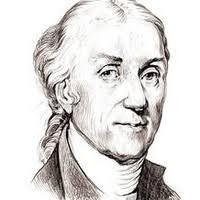
Henry Cavendish was a British natural philosopher, scientist, and an important experimental and theoretical chemist and physicist. Cavendish is noted for his discovery of hydrogen or what he called “inflammable air”.

BIOGRAPHICAL NARRATIVE

IF ever a person were to fit the stereotypical image of a wacky, eccentric scientist, Henry Cavendish would be that man. Born of the English aristocracy and inheritor of a huge sum of money mid-way through his life, Cavendish used his wealth to indulge his unusual behaviour. He built private staircases and entrances to his homes in London so he would not have to interact with his servants, and only communicated with them through written notes. He never spoke to women, doing all he could to avoid having to look at them, and only usually appeared in public for the purposes of attending scientific meetings. His love of solitude did, however, offer him plenty of time to work on the experiments which would advance science, despite his equally eccentric approach to the publication of his work.

Prompted by curiosity

Cavendish’s main motivation was not scientific acclaim, but curiosity, and it is because of this that he failed to put many of his discoveries into print. He conducted meticulous experiments in both physics and chemistry, but it is largely for his work in chemistry that he is best remembered, since he did publish several papers in this field.

Of the most famous were his 1766 Three papers Containing Experiments on Factitious Airs (gases made from reactions between liquids and solids). In these he demonstrated how hydrogen (inflammable air) and carbon dioxide (fixed air) were gases distinct from “atmospheric air”.

Joseph Black is credited with making similar discoveries with fixed air, but it is Cavendish who is acknowledged as being a pioneer in distinguishing and understanding inflammable air. He managed to develop reliable techniques for weighing gases and, in further experiments undertaken around 1781, he discovered that inflammable air, mixed with what we know as oxygen (from atmospheric air) in quantities of two to one respectively, formed water. In other words, water was not a distinct element, but a compound made from two parts hydrogen to one part oxygen (as now famously expressed as H₂O).

Due to his typical tardiness in publication – he did not declare his findings until 1784 – his claim to this discovery became confused with similar observations subsequently made by Antoine Lavoisier (1743–94) and James Watt (1736–1819). The important point is that water was proved not be a distinct element – a view held since the time of Aristotle.

In the same paper, Cavendish also explained his discovery that air (whose composition remained constant from wherever it was sampled in the atmosphere) was composed of approximately one part oxygen to four parts nitrogen. In these experiments – performed to decompose air by “exploding” it with electrical sparks – he also found that there was always a residue of about one per cent of the original mass which could not be broken down further. This “inert” gas would not be studied again for a century, when it was named argon. In the same series of experiments, Cavendish also discovered nitric acid, by dissolving nitrogen oxide in water.

Ahead of his time

Potentially, Cavendish could have been remembered as a great physicist as well, since some of his experiments and discoveries were considered to be more than half a century ahead of their time. Almost all his work in this arena remained unpublished until the late nineteenth century however, when his notes were found.

The scientist James Clerk Maxwell (1831–79) dedicated himself to publishing Cavendish’s work, a task he completed in 1879. But by then, Cavendish’s potential breakthroughs, significant at the time, had been surpassed by history. Cavendish had undertaken significant work with electricity, anticipating laws later named after their “discoverers” Charles Coulomb (1736–1806) and Georg Ohm (1749–1854), as well as some of Michael Faraday’s (1791–1867) later conclusions. In the absence of any other appropriate device and in keeping with his eccentric tendencies, he even resorted to measuring electrical current by grabbing electrodes and estimating the degree of pain it caused him!

The density of the earth

One physical experiment for which Cavendish was acclaimed in his time (and which is now named after him) was working out the density of the earth. The experiments involved a torsion balance and the application of Newton’s theories of gravity. In 1798 he concluded that the earth’s density was 5.5 times that of water, a figure almost identical to modern estimates.

Timeline

1731 – Cavendish is born in Nice, France, to an English aristocratic family

1753 – Leaves Cambridge University without taking a degree

1798 – Publishes his estimate of the density of the earth, an estimate almost precisely what it is now believed to be

1871 – The endowment of the famous Cavendish Laboratory was made to Cambridge University, by Cavendish legatees.

Standard