
Britain, Government, Middle East, Politics, Society, Syria

A moment of danger as well as opportunity

SYRIA

ON paper, the fall of a brutal tyrant, especially one who tortured and gassed his own people, should be a cause for unqualified celebration in the free world.

In practice, we know from bitter experience that when such despots are deposed, fresh chaos and tyranny all too often follow in the immediate aftermath. Elation over the horror of Saddam Hussein and Colonel Gaddafi quickly turned to intense fear as Iraq and Libya were consumed by anarchy and civil war.

So, following the abrupt fall of Bashar al-Assad, the world is asking with some trepidation: What comes next for Syria, the wider Middle East, and the West?

Not for the first time in this volatile and unpredictable region, Western intelligence agencies were blindsided by the speed and intensity of the Islamist rebel offensive.

After capturing Damascus, and forcing Assad into exile, the insurgents declared total victory. Most prominent among the militias is Hayat Tahrir al-Sham (HTS).

Its leaders may be preaching moderation right now, but they have their roots in ISIS and Al-Qaeda. Extremism and vengeance lurk behind the façade.

The various rebel factions have little in common except their hatred of Assad. Will they manage to unite to form a government – or plunge into a bloody power struggle?

The collapse of the regime is unquestionably a humiliation and a major strategic blow for Iran and Russia, its staunchest allies. Iran, because it uses Syria in funnelling weapons to its proxy Hezbollah in Lebanon; Russia, because it has military bases in Syria that it will wish to protect.

The British PM welcomed the toppling of Assad’s “barbaric regime” and called for peace and stability, but with radical Islamists now in charge he risks looking naïve. Events in Syria represent a profound challenge to the West.

Undoubtedly, the renewed violence and instability in Syria will almost certainly trigger fresh waves of refugees heading for Europe and the UK. Strong political leadership and coordination in the West is now an imperative.

One of the many unanswered questions is what will happen now to the 50,000 former ISIS militants currently held by Kurdish forces in north-east Syria.

If these brutal jihadis are released or fight their way out of the camps, the repercussions could be deadly in Europe as well as the Middle East.

And the warning given by ex-MI6 chief Sir Alex Younger of a “serious spike” in the threat posed this country by foreign and home-grown extremists that could be inspired by a resurgence of Islamic State is deeply alarming. We know from atrocities committed here in the past just how murderous and hard to predict these fanatics can be.

The current UK terror threat is at level 3 – “substantial” – but may well be elevated in the light of unfolding events. Extra-vigilance will now be needed by our security services, police, and the Border Force.

The world also awaits to see what kind of regime the rebels will create in Assad’s place. Whatever Hayat Tahrir al-Sham is saying publicly, the West must remember that it as an offshoot of al-Qaeda, and so its leaders are unlikely to be fans of Western democracy.

The UK has announced £11 million in foreign aid for Syria. We must be very careful where that money goes. As Foreign Secretary David Lammy rightly reminded the House of Commons, HTS remains a proscribed terrorist organisation.

Jubilation over the fall of a dictator should not blind us to the risks of what comes next. As Mr Lammy said: “This is a moment of danger as well as opportunity.”
Standard
Arts, Books, Literature, Syria

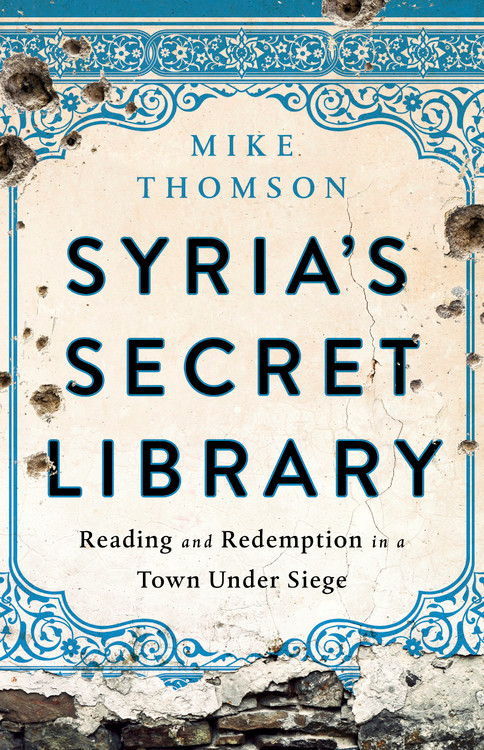
Book Review: Syria’s Secret Library

LITERARY REVIEW

Syria Secret Library

Intro: Secret Library that made Syrians feel alive again

THE civil war in Syria is one of the undoubted horrors of our times. Hundreds of thousands of people have been killed and billions of dollars of damage has been done, essentially to keep President Bashar al-Assad in power.

His face is one which gives himself away. It’s the face of a weak man, promoted well beyond his gifts, compelled to become a bloodthirsty tyrant purely out of fear of the alternative. Does he sleep at night?

Mike Thomson is a widely travelled BBC correspondent who has often reported in war zones looking anxiously worried. His book is about the Syrian town of Daraya, which Assad decided harboured dangerous revolutionaries and so it attacked it with all the weaponry he had.

Most of the population left, but a few thousand remained and stuck it out. The siege lasted for several years before Assad’s superior firepower prevailed.

Astonishingly, Thomson didn’t ever actually go there. He wouldn’t have been able to – it was in lockdown and as tight as a drum. But war in the 21st century isn’t like previous wars. The availability of the internet and mobile phones changes the way things are analysed and reported. Daraya had almost no food or medical supplies, its electricity supplies at best intermittent and fresh water had long been cut off. Those who remained in Daraya rigged up makeshift aerials, allowing at least a rudimentary contact with the outside world.

Thomson made several friends and acquaintances through this method and what these people did was, by any measure, extraordinary. They went around abandoned houses and rescued as many books as they could, then created a secret library in the basement of a ruined building. This was an incredibly dangerous thing to do.

Snipers were everywhere and no one carrying a huge pile of books was going to be moving very fast. Astoundingly, no one was killed. Of even more surprise, Assad’s soldiers never worked out what they were up to.

The Secret Library became a haven for the peacefully inclined to come and read books and feel alive again. It was presided over by a 14-year-old who called himself Chief Librarian and rarely left the building.

There are several photographs of people sitting on sofas, quietly reading of worlds far beyond their own.

Thomson writes breezily of dreadful things, although much of the detail is fascinating.

One woman, whose family lived far away, dared not try to contact them directly, but showed them that she was still alive by changing her Facebook photo image every day.

As food supplies dwindled, one man acquired a small quantity of sheep’s liver. He invited a few friends around to share it and they cooked it slowly to savour the wonderful smell.

Unfortunately, they all left the room at the same moment and, when they came back, they found that the sheep’s liver was gone, and the cat was licking its lips with satisfaction.

If this book has a weakness, there’s not actually very much in it about the Secret Library and some readers may finish it feeling obscurely cheated.

However, the story of Daraya is nonetheless hugely stirring: of people refusing to give in against impossible odds and the appalling consequences of one man’s palpable weakness.

– Syria’s Secret Library by Mike Thomson is published by Weidenfeld, 320pp

Standard
Arts, Books, Medical, Society, Syria

Book Review – War Doctor: Surgery On The Front Line

MEMOIR

Syria, 2012 – Location: Atmeh. A woman was rushed to the operating theatre with severe bomb damage to her leg.

Dr David Nott, a trauma surgeon, clamped the artery to prevent her from bleeding to death and gently pressed a finger into the gaping hole above her knee joint. He felt an object. It was probably some kind of shrapnel, but it was strangely smooth and cylindrical.

Dr Nott grabbed it with his fingers – “very carefully”, he recalls – and pulled it out. Once extracted he held it up to examine it. His Syrian helper took one look and went visibly pale; he obviously knew what was being presented and blurted out, “Mufajir!” before turning tail and leaving the room.

Nott and the anaesthetist locked eyes in panic. Was this some kind of bomb? The room fell silent, bar the hiss of the patient’s ventilator. The anaesthetist backed away and Nott felt his hand begin to shake so vigorously, he was in danger of dropping the thing.

Then the Syrian helper rushed back in with a bucket of water and motioned for Nott to place the metal object carefully into the bottom of it. He later learned that “mufajir” means “detonator” and it could have blown off his hand.

The woman was injured when a bomb her husband had been making in their kitchen had prematurely detonated, killing him instantly.

You can sense Dr Nott’s frustration and anger at the speed with which the Syrian civil war escalated. It had begun in March 2011, when a peaceful protest against the oppressive regime of Bashar al-Assad was met with shocking brutality.

By chance, Nott had met al-Assad in the early 1990s, when the dictator-in-waiting was working as an ophthalmic senior house officer at the Western Eye Hospital, London.

“He seemed very pleasant and respectful,” recalls the surgeon who would later treat Assad’s victims, including a heavily pregnant woman whose unborn child had been shot through the head by a sniper.

In his devastating memoir of more than two decades volunteering his services in some of the world’s most dangerous places, Nott doesn’t speculate on what changed al-Assad’s attitude to his fellow human beings.

He does, however, pinpoint the precise moment that a shy boy from rural Wales realised he wanted to become a “war doctor”, his epiphany occurring in 1985 when he first qualified as a surgeon. His parents took him to the cinema to see The Killing Fields (Roland Joffe’s 1984 drama about the civil war in Cambodia).

Nott’s father, also a doctor, was born in Burma and Nott had endured racist bullying as a child.

“The film lit a torch in me,” he says. “I could relate to its themes of innocent people being bullied, pushed around or dismissed. It gave a vivid depiction of the horrors of war. But, more than that, the film depicted the incredible power of human love in the face of unimaginable adversity.”

Some eight years later, Nott was standing over an operating table in Sarajevo. He had taken a month’s unpaid leave from the NHS to volunteer for the French aid organisation Médecins Sans Frontieres. The Bosnian civil war opened his eyes to a new medicine, in which decisions had to be made quickly, without the diagnostic tests and specialist equipment on which he had come to depend.

“I had never seen injuries like the ones that were coming in every hour.”


THE damage inflicted by bombs and high-velocity bullets was of an entirely different order from those received in even the most catastrophic trauma car accidents.

Multiple limbs were often missing. Many patients were dead on arrival, accompanied by relatives begging for help that Nott could not provide.

When he could attempt surgery, the hospital generators would often fail, and the team would have to wait until a porter brought in a wheelbarrow full of car batteries to get the theatre functioning again.

When bombs fell on the hospital itself, Nott’s team fled, leaving him alone in the dark, his hands around the failing heart of a teenage boy.

Stumbling from the room, soaked in his patient’s blood, Nott felt angry and betrayed. But he soon learned that, as an aid worker, his first duty was to keep himself alive so that he could help more people.

It was the first of many difficult moral choices he would have to make in Afghanistan, Sierra Leone, Chad, the Ivory Coast, Libya, Gaza, the Democratic Republic of Congo, Iraq and Pakistan.

In his scrubs, would you defy the Taliban policeman forbidding you to treat a woman bleeding to death in childbirth? Would you save the life of an ISIS fundamentalist likely to kidnap you on recovery? Would you give money to the children of dead patients?

Dr Nott had to make all these calls under extraordinary pressure.

He describes numerous near-death experiences and there was some terrible emotional fallout.

After returning from one mission, Nott found himself unable to bear the complaints of a British patient fretting about her “unsightly” thread veins and began a screaming, feigned sciatic attack until she left his consulting room.

He also had a panic attack when invited to a private lunch with the Queen. Overwhelmed by the contrast between the luxury of Buckingham Palace and the desolation he had seen in Syria, Nott found himself unable to answer Her Majesty’s questions.

As visions of limbless children filled his head, she placed her hand gently on his and encouraged him to pet her dogs. “There,” she said. “That’s so much better than talking, isn’t it.”

These days, the 63-year-old medic still travels the world to help victims of disaster. But his priorities changed after meeting his wife, Elly, at a charity event for Syria Relief in 2013.

The relationship came as a “bolt from the blue” to the man with a “monastic existence”. But, before they could arrange a first date, Nott made a trip to Gaza, where he elected to stay in the operating theatre to save the life of a little girl called Aysha, even though he had been ordered to evacuate the hospital because an airstrike was expected in minutes.

It was a story that Dr Nott told on Radio 4’s Desert Island Discs in 2017, reducing listeners to tears as he described how he still treasures the photograph he has of her, smiling as she recovered.

David married Elly in 2015 and welcomed daughter Molly the same year. Elly – an Oxford graduate with an MA in international relations – was the chief executive of the David Nott Foundation (a charity training surgeons to work in conflict zones) until the beginning of 2019.

Although as a husband and father, Nott tries harder to avoid danger, he finds it hard to be optimistic about the situation in Syria.

But he remains committed in continuing to train doctors working there.

On the final page of his book, Nott quotes the Koran: “Whoever saves a life, it shall be as though he had saved the lives of all mankind.”

– (Memoir) War Doctor: Surgery On The Front Line by David Nott is published by Picador for £18.99, 304pp

Standard