Arts, Books, Human Rights, Society

Book Review: Our Bodies Their Battlefield


Christina Lamb

From award-winning war reporter and co-author of I Am Malala, this is the first major account to address the scale of rape and sexual violence in modern conflict.

WAR

IN this devastating book, foreign correspondent Christina Lamb stares into the face of one of the world’s great hidden evils.

Deeply unsettling to read – and no-doubt traumatic to write – it is a global chronicle of mass-rape in war: a brutal and shocking indictment of man’s inhumanity to woman in the frenzied aftermath of battle. The most dreadful thing about it – apart from the physical injuries and the ruining of hundreds of thousands of women’s lives – is that all too often it happens with impunity.

Deeply embedded in the human psyche there seems to be a belief that rape is an acceptable side-effect of conflict, permissible because the circumstances of war are extraordinary. Some perpetrators have even talked as if by committing rapes they were being chivalrous, because they were not killing the women. Heinous. The horrific accounts from the survivors to whom Lamb interviews are clearly there to see.

With the violence done to their bodies, and the lack of justice for the perpetrators to bring closure, these women feel as good as dead.

Even by speaking out, they are being heroic. Once the secret is out, these people are in danger of becoming outcasts. But in order for anything to change, the stories need to be told. The reader should brace themselves for a profoundly distressing tour of war-torn countries and refugee camps, and for ordeals you will not be able to forget.

Naima was an 18-year-old Yazidi girl in Iraq when ISIS came to her town in 2014. The women and girls were herded into the Galaxy Cinema and sorted into “ugly” and “beautiful”. Their ISIS captors then “passed us around like sweets”, she said. They put the girls’ names in a bottle, almost like a lucky dip. Naima was sold on and on as a sex slave to 12 men, each of whom raped her several times a day.

Lamb was shown a typical ISIS “Certificate of Ownership”, with two thumb prints of seller and buyer, date, and a price of $1,500. No name for this “product”. Just “Age 20, with hazel green eyes, thin and short, height 1.3m”.

“They took something from me I can’t get back,” says Turko, who was traded on the internet forum called “Caliphate Market”, along with PlayStation consoles. She was raped three times a day by her “owners”.

This male rape-lust has nothing to do with desire, apparently. It’s all about total power: “pure violence”, as Anthony Beevor describes it.

In the Spanish Civil War, Fascist troops were given two hours after the capture of any village to “enjoy” the women.

Lamb meets a pair of elderly ladies from the Philippines who were two of the 200,000 “comfort women” (dreadful euphemism) for Japanese soldiers during World War II. They didn’t dare speak out about it until the 1990s and were rejected by their own families when they did.

Rape, Lamb writes, is the only crime in which society is more likely to stigmatise the victim than punish the perpetrator. There are some glimmers of light in this appalling story. The brave Tutsi rape victims who did dare to speak out, helped to bring the first conviction for rape as a war crime: in 1988 Rwandan Mayor, Jean-Paul Akayesu, was sentenced to life imprisonment for atrocities against the Tutsi ethnic group, including rape.

Heroes shine out of Lamb’s journey: she meets Dr Mukwege, who has treated 35,000 rape victims in his hospital in the Democratic Republic of Congo, where he’s a virtual prisoner in fear of his life; Christine Schuler Deschryver, who runs a haven of rescue and help for rape victims in that country; and Abdullah Shrim (“the Beekeeper of Aleppo”), who rescued 265 Yazidi girls captured by ISIS.

But the real heroes are the women who have experienced unfathomable cruelty and dared to speak out.

Our Bodies Their Battlefield by Christina Lamb is published by William Collins, 432pp

Standard
Arts, Books, Environment, Nature

Book Review – ‘Greenery: Journeys In Springtime’

NATURE

Tim Dee

ONE of the most joyous sights of spring is the return of the swallows, swooping and diving in the air, their forked tails slicing through the sky.

Few of us give much thought to the journey that brings them back to Britain each year. Tim Dee, who lives part of the year in “the last-but-one house from the southwestern tip of Africa”, is watching swallows in January when it strikes him that these birds will soon set off on their epic migration across Africa to Europe.

Scientists have calculated that a swallow flies at about 50 kilometres a day.

Coincidentally, the isotherm – the line on a map connecting points with the same temperature – moves across Europe from the Mediterranean to the Arctic Ocean at roughly the same speed in the period between the winter and summer solstice. Swallows are, almost literally, travelling with spring. Dee, a writer and broadcaster, decides that he will follow the swallows’ progress north and reap the benefits of a prolonged spring.

“Buds, blossom, songs, nests and eggs… who wouldn’t, if they could, try a little time-travel in search of more of the right time, trading the notional middle of winter for some early spring?” he asks.

He starts his travels in the Sahara Desert, where the few trees he sees harbour birds pausing on their journey northwards – birds that will soon be in Europe. A few weeks after leaving the desert, in chilly Bristol, he is excited to spot a white wagtail, a species he last saw hopping around crocodiles in Chad, “as busy on the snow as it had been on the sand”.

He marvels: “Every migrant arriving in the spring is already a seasoned voyager, every one is already a survivor.”

Travelling to Gibraltar, he observes that the birds are exhausted by the desert crossing; some species have made the 2,000-km journey in one non-stop, 60-hour flight.

Like lazy tourists, they hang around Gibraltar gorging themselves and putting on weight before the next stage of their journey.

In Sicily, he and his wife Claire hike up a mountain and he notices that spring turns back to winter the higher they go: “As we climbed, we travelled against the season and back in time: to baby leaves unfolding, to blossom, to buds, to bare winter branches.” May Day finds him producing a radio broadcast from Somerset, spending the night crouched at the edge of a reedbed listening to the “stirring and throat-opening” of the birds as they wake up.

At this time of year, the dawn chorus moves rapidly across the northern hemisphere. “Every minute, about 21 more kilometres of the Earth’s surface are lit up and come alive with bird song.”

In June, close to the summer equinox, Dee travels to Iceland. Unable to sleep in the permanent daylight, he and his wife walk the hills at night.

“At one o’clock in the morning I came alongside an estuary and woke a sleeping red-necked phalarope – a bird I’d last seen at the other end of the Atlantic in Cape Town sewage works,” he writes.

Greenery’s genre is best classified as part memoir, part nature guide and part travel book – though annoyingly it doesn’t have a map. Tim Dee’s writing is suffused with literary allusions: rather too many, actually.

Readers might be inclined at times to shout, “Get on with the nature stuff, Tim!” Because, when it comes to chronicling the natural world, his writing and attention to detail is a delight, both elegant and evocative.

Watching a group of Bewick’s swans flying overhead, he comments memorably that they look like “a washing line of creamy sheets in the northern sky.”

This charming, meandering and occasionally frustrating book ends with a completely unexpected double whammy, one in which could have you wiping away tears and then smiling in delight.

It’s a reminder that, however grim things look, there is always the freshness and rebirth of spring to look forward to.

– Greenery: Journeys in Springtime by Tim Dee is published by Jonathan Cape, 355pp

Standard
Arts, Books, Literature, Second World War

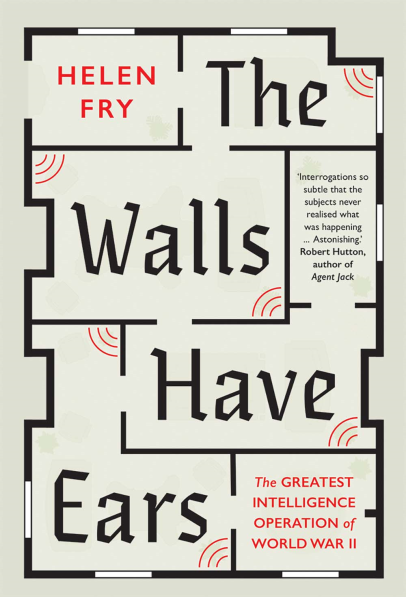
Book Club: The Walls Have Ears

LITERARY REVIEW

Fry16

Book Club16

REVIEW

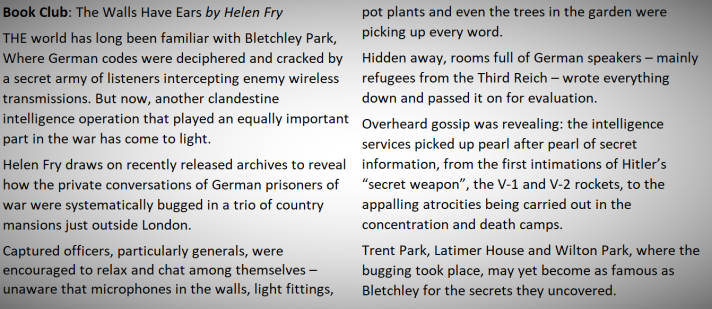
DURING World War II, captured German generals and other senior officers were taken to Trent Park, a mansion house in North London.

On arrival, they were greeted by a one-legged Scottish aristocrat named Lord Aberfeldy. He was, he told them, their welfare officer and a second cousin of the king, who was very concerned that they should be treated well.

But this was all an elaborate charade. Aberfeldy was no royal relative – he was an intelligence officer called Ian Munro, who also happened to be a very good actor. So enthusiastically did he throw himself into this role that, according to a colleague, “he became too grand to talk to any of us” and “expected orderlies to address him as Your Lordship”.

His job was to butter up the generals and keep them happy. While Aberfeldy flattered them and brought them treats, they were less likely to notice what was unusual about Trent Park, which was that everything that could be bugged was.

Hidden microphones were everywhere: in the light fittings, in the fireplaces, under the floorboards in the generals’ bedrooms. There were even some hung in the trees in the grounds. The whole place was wired for sound and, in rooms hidden from view, secret listeners tuned in to everything the Germans said.

This was one of the most effective intelligence operations of the war, yet probably the least known. Its records have been declassified only over the past 20 years, and Helen Fry’s remarkable and insightful book throws new light on its workings.

It was run by Thomas Joseph Kendrick, a man with 30 years’ worth of experience in the secret services behind him.


WHILE working as a British passport officer in 1938, he became the “Oskar Schindler of Vienna”, arranging for hundreds of Jews to leave Austria after the Nazi takeover. He was arrested, interrogated by the Gestapo and expelled from the country for espionage.

Returning to London, he was the ideal commander for a new unit setting up a special bugging operation in the Tower of London. When war was declared, and the first German prisoners of war (PoWs) arrived – most Luftwaffe pilots and U-boat officers – Kendrick was ready.

Early results were promising, although, very occasionally, one of the shrewder prisoners became suspicious. Wilhelm Meyer, a pilot shot down over the Thames in November 1939, asked a cellmate: “Do you think listening apparatus are built in here?” But even Meyer finally decided he was being over-cautious.

Most were blithely unsuspecting as Kendrick’s team recorded every word they said.

As the war went on, and more and more PoWs arrived, Kendrick expanded his work. Three more sites, including Trent Park, were fitted with cutting-edge recording technology shipped over from the Radio Corporation of America in New York. With Allied victories in North Africa, more senior German officers were taken captive. (There was, of course, a huge influx of high-ranking Wehrmacht personnel after D-Day.)

As operations grew, Kendrick needed extra listeners. His interview techniques could be terrifying for candidates.

He once handed a would-be recruit a pistol across his desk. “If you ever betray anything about this work,” he said, “here is the gun with which I expect you to do the decent thing. If you don’t, I will.” His original listeners were British-born, but fluent in German. Soon, because of the variety of accents and dialects they were encountering, he needed native German-speaking emigres, most of them driven into exile by the Nazis.

They were the “King’s Most Loyal Enemy Aliens”, as one man sardonically described them.

Kendrick also used “stool pigeons” – fake fellow prisoners who joined real PoWs in their cells and subtly encouraged them to talk. One of these, a fluent German speaker, was the father of singer and actress Olivia Newton-John.

Another, whose name has never been revealed, was a former inmate of Belsen, imprisoned for his political views. After release, he had been conscripted into the German army and then captured by the British.

Unsurprisingly, his loyalty to the Nazi regime was non-existent. He was one of the first to reveal the horrors going on in the camps. But Kendrick’s greatest successes were with the generals at Trent Park. The more senior they were, the more they knew (and could unwittingly reveal) about the German war effort.

Most of them were eccentric, arrogant parodies of the Prussian officer class. One, Lieutenant-General Gotthard Frantz, wore a monocle at all times, even under sunglasses, and went to bed with all his medals on.

Another was heard to exclaim in utter bafflement, “We have the best generals and we are losing the war!”

As Fry wryly comments: “Clearly, talking too much within earshot of the hidden microphones may have had something to do with that (the loose talk).”

Others, however, more sensitive and intelligent, became severe critics of the Nazis – although toasts were still raised on Hitler’s birthday. “Pity it has to be English beer,” remarked one of the generals.


RIVALRIES developed at Trent Park between pro-Nazis and those utterly disillusioned with the progress of the war.

Kendrick’s methods of dealing with the generals was unusual, to say the least. As well as listening in on their every conversation, he took to wining and dining them. There were even lunch trips to Simpson’s on the Strand.

When Winston Churchill found out about this, he was furious and had them stopped – so Kendrick relocated the lunches to The Ritz.

Helen Fry likens the atmosphere at Trent Park to a traditional London gentlemen’s club.

Living a life of relative luxury, with their egos stroked and sense of self-importance encouraged, they relaxed – and played straight into Kendrick’s hands.

However unorthodox his operation, it worked. His listeners never set eyes on a single German PoW, but eavesdropped on more than 10,000.

They picked up enormously valuable intelligence on the secret weapons programme that produced the V1 and V2 rockets; on battle plans and troop positions; and on U-boat bases and new aircraft technology.

“You have done a Herculean task,” Kendrick was told towards the end of the war.

It was on a par with the better-known work at Bletchley Park and the cracking of the enigma code.

Helen Fry’s richly researched book, packed with surprising and fascinating detail, will bring the covert listeners of the time some of the attention they deserve.

– The Walls Have Ears: The Greatest Intelligence Operation of World War II is published by Yale, 320pp

Standard