
Arts, Books, Legal, United States

Book Review: ‘The Innocent Man’…

INTRO…

The Innocent Man, John Grisham’s first piece of non-fiction work, is a well-researched book primarily on account of Ron Williamson, who was wrongly convicted of murder in 1998, and who spent twelve years on Oklahoma’s ‘H’ death row before advances had been made in DNA technology which eventually proved him innocent. Grisham tells a startling and disturbingly true story about America’s justice system gone terribly wrong, the deplorable and totally unacceptable living conditions on Oklahoma’s death rows, and the often sadistic guards employed to watch these inmates. Convicted, also, to the blindness of injustice was another innocent man, Dennis Fritz, although Fritz wasn’t sent to McAlester’s death row. Fritz was later released, too, once DNA was unable to support his original conviction. Throughout, Grisham offers great insight and sharp direction to the miscarriages of justice of these two men.

NON-FICTION…

THE STORY starts by telling of a promising small town high school athlete and baseball player, Ron Williamson, who signs a contract with the infamous Oakland A’s in 1971. Grisham chronicles well his festive send-off, elucidating his failure in meeting the discipline and skill level needed for the “big league”, and Williamson’s bouts with bipolar depression and schizophrenia after his release from first the A’s and later the Yankees sporting club who had, too, been interested in his sporting potential.

By 1982, Williamson, is unemployed, living back with his parents in Oklahoma, and spending most of his days sleeping on the couch. When not at home, often in the evenings and early hours, he’s wandering the neighbourhood acting “strangely” or drinking loudly in the local bars. When neighbour, Debbie Carter is brutally murdered, Ron becomes one of the “usual suspects” – but, at the exclusion of some fundamental and routine police work. Continually dogged by police harassment and provocation, Ron Williamson confesses to a crime he did not commit. Five years after the murder of Debbie Carter, Williamson is arrested for the murder.

John Grisham’s first work of nonfiction, an exploration of small town justice gone terribly awry, is his most extraordinary legal thriller yet.

John Grisham’s first work of nonfiction, an exploration of small town justice gone terribly awry, is his most extraordinary legal thriller.

The prosecution’s case against Williamson is riddled with errors. The state exercises coercion, the use of false and inappropriate witnesses, and overlooks and suppresses evidence, not to mention the defendant’s deteriorating mental state and wellbeing. Still, he is convicted on circumstantial evidence and sentenced to death.

The reader is taken on a journey of utter despair; the frightening and unhealthy living conditions of death row, and the appalling abyss by which Ron Williamson descends into deeper madness. Only after eight years in prison, and just five days away from the death chamber, does he receive notification of a retrial. Eighteen months later, after intense scrutiny and thousands of hours of labour by his pro-bono law team, he is released after DNA testing excludes him from the evidence found at the murder scene. His exoneration touched-off a frenzy of media attention.

In the small town of Ada, Oklahoma, from which Williamson had sprung, the townsfolk were always left pondering the guilt and original conviction passed upon him. It is evidently clear that after reading John Grisham’s testimonies, Ron Williamson had always been innocent. DNA aside, exculpatory evidence, which could have been used in proving innocence, was ignored because the police and state prosecutor “had their man”. So much of the evidence that should have been produced at the original trial had been excluded and, as such, Williamson had been denied a fair trial, an assumption that has always underpinned the US justice system. Williamson’s twelve years on death row was a travesty of justice, to put things mildly.

Unfortunately, Williamson was not to enjoy his freedom for long. He died of cirrhosis of the liver just five years after his release. Upon his release and newly found freedom Ron had turned heavily to drinking.

AFTERWARD…

IN his afterward, Grisham says he was unaware of the Williamson case until he read Ron’s obituary in the New York Times. Intrigued with the story, he then spent five years talking to Ron’s sisters, lawyers, fellow inmates, jailors, and neighbours, before delivering his first work of non-fiction.

The Innocent Man is a compelling and convincing account of American justice gone awry. Much similar to Sister Helen Prejean’s 1994 novel, Dead Man Walking, it makes the reader question the justice in America’s death penalty statutes. Although it tends to drag a little around mid-story, with no fictionalised suspense to hold the reader’s interest, the reversal and subsequent acquittal, and the drama surrounding it, more than make up for this lull.

Standard
Arts, Books

Book Review: ‘Alone In Berlin’…

AN ACCOUNT OF RESISTANCE

Intro. More than six decades on this account of a couple’s doomed efforts to sabotage the Nazi regime remains powerful testimony.

HANS FALLADA led the kind of life that is measured in shots. Shots of every kind. At the age of 17 Rudolf Ditzen, to give him his birth name, shot one of his closest friends dead in a bizarre suicide pact, staged to look like a duel. As a result he was committed to a psychiatric institution.  This spared him the ordeal of being tried and punished for his offence, but on the downside it ushered in a life increasingly governed by drink, morphine, marital breakdown, mental illness and the Nazis.

In 1944, having already endured two separate stints in prison for petty offences committed in pursuit of his drug habit, Fallada fired a gun at his first wife in a drunken incident. The couple had recently divorced. He was briefly jailed again and spent most of the rest of his life in and out of hospitals until he died of heart failure in February 1947, aged 54. Remarkably, the last 30 months of Fallada’s life yielded some of his most powerful and enduring works, among them Jeder Stirbt Fur Sich Allein (Everyone Dies Alone), first published in 1947, but only now available in English under the title Alone in Berlin.

Despite his formidable demons, Fallada was astonishingly productive. He enjoyed literary acclaim, and a rare spell of mental stability, following the publication of his 1932 novel Little Man, What Now? , which was made into a Hollywood film. But the rise to power of Hitler triggered the first in a series of breakdowns that marked his slow, painful decline.

Alone In Berlin: Hans Fallada has emerged with a novel that remains powerful 60 years after the Resistance to sabotage the Nazi regime. Berlin, 1940, and the city is filled with fear. At the house on 55 Jablonski Strasse, its various occupants try to live under Nazi rule in their different ways.

Alone In Berlin: Hans Fallada has emerged with a novel that remains powerful 60 years after the Resistance to sabotage the Nazi regime. Berlin, 1940, and the city is filled with fear. At the house on 55 Jablonski Strasse, its various occupants try to live under Nazi rule in their different ways.

Fallada’s relationship with the Nazis was complex. Having been branded an “undesirable author” in the early days of the regime, he was later favoured by Joseph Goebbels following his 1937 novel Wolf Among Wolves, for its negative portrayal of the Weimar republic. The following year he made plans to flee the country, aided by his British publisher, George Putnam, but lost his nerve at the crucial moment. Wary of being blacklisted again, or worse still confined to one of the Nazis’ notorious mental institutions, he was forced to bargain with the regime he despised in order to continue publishing.

Crazed killer, alcoholic, morphine addict and Nazi collaborator: Hans Fallada was always going to be a hard sell outside his native country. So it is to Penguin’s credit that it has taken the long overdue step of commissioning this English translation of his final work. It is a necessary step, too, for Fallada invokes an aspect of the Second World War that is in danger of being forgotten: the grinding horror of life in a totalitarian state.

..

ALONE IN BERLIN is the story of a couple, Otto and Anna Quangel, who wage a doomed campaign of resistance against the Nazis. Otto Quangel is a foreman at a furniture factory in Berlin, a man who demands nothing from society beyond a living wage and the freedom to live as he pleases.

At the start of the novel Fallada introduces us not just to the Quangels, but to everyone in their block of flats on Jablonski Strasse: the die-hard Nazi clan, the Jewish widow on the top floor, the petty thieves hanging around the entrance. Fallada expertly weaves the stories of this disparate cast of characters, creating a clever cross-section of a society under siege.

The Quangels are no blameless innocents: they have supported the Nazis in the desperate days of the early thirties, and for many years close their eyes to the atrocities just around the corner. Otto Quangel chooses not to dwell on the sudden disappearances of workers from his factory floor or the pervasive rumours about what happens in the concentration camps. But as the crimes of the state mount up, such silent complicity is unsustainable. The turning point comes in the shape of two events. First, they receive news that their son, Otto, has been killed on the front – on the same day Germany’s triumph over France is announced, prompting an outburst of celebration among their Nazi neighbours. A few days later, their Jewish neighbour, under provocation from the same family, throws herself to her death from her top-floor window.

..

NO LONGER able to ignore the regime’s disregard for human life, the Quangels begin a futile campaign of resistance that leads to their arrest, trial and death. Quangel’s method of subversion is almost pathetic in its lack of impact: every Sunday he writes a handful of postcards denouncing the Nazis and deposits them in stairwells. When he is arrested, he learns that all but 18 of his cards have been handed to the police unread: his two-year crusade has reached, at most, a handful of people. And he pays for it with his life.

There are no tricks or unexpected twists in Alone In Berlin. It reads like a whodunit in reverse, an account of a murderous state clenching its fist around another victim. Fallada’s style is straightforward, often crude (he is said to have written the novel in a “white heat” of 24 days, under failing health), with only the occasional descriptive flourish. The power – and the horror – of the novel is rooted not in the grotesque spectacle of the Holocaust, but in the commonplace brutality that underpinned it.

The Quangels’ situation is hopeless, but Fallada offers them redemption in their refusal to succumb to the Nazis’ dehumanising crusade. It is portrayed as an assertion of the primacy of human life, vindicated by the demise of the regime in the closing chapter. As Anna Quangel puts it, “The main thing … is that we never allow ourselves to be made into them, or start thinking as they do.”

– ALONE IN BERLIN, Hans Fallada [transl. Michael Hofmann], is published by Penguin Classics at £20.

Standard
Arts, Books, Britain, History

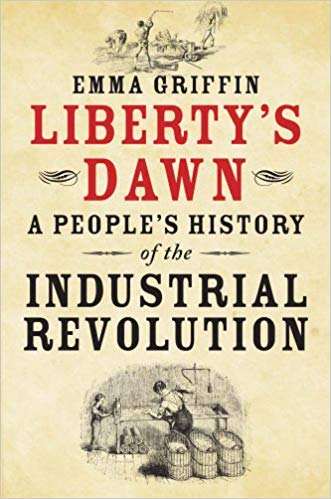
Book Review – Liberty’s Dawn: ‘A People’s History of the Industrial Revolution’…

LITERARY REVIEW

THIS recently released book by Emma Griffin, published by Yale University Press for £25, describes how life wasn’t all trouble at the mill prior to the Industrial Revolution. History books have led us to believe that the working classes had a thoroughly rotten time of it during the turbulent years of the Industrial Revolution. A picture is often painted of people being uprooted from their picturesque rural hovels, crammed together in filthy factories where they either wheezed themselves into early graves, or else became hideously entangled in a life that revolved entirely around the Spinning Wheel.

Emma Griffin, though, doesn’t see it like this. She perceives the Industrial Revolution as having been a tremendous boom to a lot of working class people: they earned far more than they had done before, escaped lives of crushing poverty and destitution and, for the first time, began to exert some measure of control over their lives.

Reviewers’ might be tempted to dismiss Griffin’s work as the ravings of a particularly cranky historian desperate to make a splash – except that Ms Griffin has lots of anecdotal evidence to back up her claims. This was the age, we should remember, in which large numbers of working men and women learned how to read and write.

Remarkably, their self-confessed testimonies, or ‘autobiographies’, as Griffin calls them, have been sitting largely untouched in county archives for the past 200 years.

It is apparent that Emma Griffin has stumbled on an enormous treasure trove. The writer suggests that our ancestors, faltering at first, but later with increasing confidence, describe their daily lives with vivid clarity.

Just a generation earlier they would have been illiterate. Now, with the world changing at a furious and fast pace all round them, they sought to set down their experiences for the benefit of their children and for future generations.

One man recalling the seven years he spent working in a Lancashire factory in the early 19th century wrote: ‘I was never as happy as I was then.’

Continue reading

Standard