Afghanistan, Britain, Iraq, Society, United States

20 years after the ‘War on Terror’, abandonment leaves a bitter legacy

ESSAY

THE scene is a familiar one. On the dusty and sandy plains of Afghanistan, a trail of refugees’ head for the beleaguered capital. On the streets of Kabul itself, frequent car bombs are killing members of the government along with innocent bystanders.

In the western city of Herat, people huddle in their homes as enemy rockets pound down. And in the southern province of Helmand – where hundreds of British servicemen lost their lives in recent years – dozens of civilian bodies lie rotting on the country roads.

Such is the lawless state in Afghanistan, where the resurgent Taliban have made extraordinary territorial gains in recent days. Across much of the country, their white flag now flies unchecked.

The situation in Afghanistan now is as serious as it has ever been. It’s a quarter of a century since the Taliban swept to power claiming vast swathes of land, imposing a hideously oppressive Islamist regime that treated women as slaves and banned films, TV, music and dancing.

Perhaps more significantly, in just a few weeks it will be exactly 20 years since the terrorist attacks of September 11, 2001, in New York and Washington.

It was in reaction to these atrocities that Tony Blair and George W. Bush launched Operation Enduring Freedom, promising to dismantle the al-Qaeda training camps, overthrow the Taliban and usher the Afghan people into a brave new world of democracy.

‘Operation Enduring Freedom’. How darkly ironic that mission sounds today.

For the Afghan people, the cause of freedom now hangs by a thread. Ever since the spring, when President Joe Biden announced that the last U.S. personnel would leave at the end of this month, the Taliban have swept across much of the country again.

Only a few weeks ago, U.S. intelligence analysts reportedly warned that without Western intervention, the government in Kabul might have just six months left. And now, with an estimated 85,000 Taliban fighters pressing towards the capital, that bleak prognosis looks decidedly optimistic.

Yet this is merely part of a bigger picture.

Twenty years after the War on Terror began, it’s time that we took a long, unsparing look at what it really achieved.

To revisit reports from 2001 feels like entering a different world. At the Labour Party conference, Tony Blair tells his delegates and party members that he intends to fight for freedom “from the deserts of Northern Africa to the slums of Gaza, to the mountain ranges of Afghanistan.”

“Let us re-order this world around us,” he says grandly, as if there are no limits to his ambitions. A few weeks later, his close friend Bush appears before the U.S. Congress, pledging to dismantle an “Axis of Evil” that threatens the peace of the world. He names three regimes in particular: Iran, Iraq and North Korea.

How arrogant, how criminally naïve this sounds today. The regime in Iran is more hard-line, its position apparently as secure as ever. North Korea, too, remains stubbornly defiant, having built an estimated stockpile of some 40 nuclear weapons.

As for Iraq, that desperately sad story has become only too familiar. However you measure it, the carnage since the Anglo-American invasion of 2003 has cost at least 150,000 lives, and perhaps more than a million according to some estimates.

I say ‘has cost’, rather than ‘cost’, because Iraq is still not at peace. It has never been at peace. Even now, the Baghdad government and its Western sponsors are fighting a low-level Islamist insurgency, with bombings and killings almost every single day. What, then, is the verdict on the so-called War on Terror?

There’s no doubt that some of its progenitors, at least, had noble motives. When Blair says he genuinely wanted to export Western freedoms to Afghanistan and Iraq, it’s not hard to disbelieve.

But the verdict must be utterly damning.

How can this naïve, undefined, unachievable crusade go down in history as anything other than a catastrophic failure?

Take the cost in lives first. Some 456 British servicemen and MoD civilians were killed in Afghanistan, and a further 179 in Iraq. And for what?

As the Taliban surge towards Kabul, many of the bereaved must be asking themselves: was it all in vain?

Then there’s the financial cost. In June this year, the Ministry of Defence admitted that the war in Afghanistan cost British taxpayers a staggering £22 billion, with the campaign in Iraq estimated to have cost a further £10 billion.

The grim irony, of course, is that our politicians blew all that money just before the financial crisis of 2007-08, from which the Western economy has never fully recovered. And given that Britain was about to be plunged into a long period of economic austerity, many will argue that we should have saved it for other things.

One of the greatest costs of all, though, is much harder to measure. It’s the price in moral capital and political credibility, which Britain and the U.S. are still paying to this day.

Remarkably, the invasion of Afghanistan was much closer in time to the end of the Cold War than it is to us today. The U.S. was the world’s unchallenged “hyper-power”, the march of democracy seemed unstoppable, and some American thinkers were even proclaiming the “end of history”.

The events of the last two decades, however, turned that story on its head. For the Iraqi people, the Allied invasion brought a living nightmare. For the people of Afghanistan, meanwhile, it brought a gruelling, apparently interminable campaign, which now seems likely to end as it began – with the Taliban as masters of their native land.

No wonder, then, that America’s image abroad has plummeted over the last 20 years. According to the respected Pew Research Centre, people in almost ever major Western country now have an unfavourable impression of the U.S.

In Japan, its popularity has dropped by 30 per cent since 2001. In France, too, it has fallen by 30 per cent, in Germany by almost 50 per cent. And what of faith in democracy – the one thing for which Blair and Bush claimed they were fighting?

According to an extensive international study by Cambridge University, satisfaction with democracy has never been lower. In almost every country on earth, faith in the Western capitalist model has plummeted in the last 20 years – especially among the young, to whom the wars in Afghanistan and Iraq are simply incomprehensible.

And here’s another brutal irony. At the very point when Britain and the U.S. were wasting huge sums of money and with so many lives expended on their Middle Eastern misadventures, the real threats to Western democracy were hauling themselves off the canvas and preparing to rebuild.

The winners of the War on Terror were not the British and American people, and still less the natives of Afghanistan and Iraq. They were Vladimir Putin and Xi Jinping, the authoritarian strongmen of Russia and China, who watched with undisguised satisfaction as the Western powers discredited their own values.

That is the real legacy of the past 20 years: a shattering reversal of Western progress, for which we will be paying – quite literally – for the rest of our lives.

But perhaps it would be wrong to end by talking about ourselves. After all, the greatest casualties of the last two decades came among the people of Afghanistan and Iraq themselves, who have never known a single day of peace since the War on Terror began.

Nobody can say how their lives would have turned out if we had left well alone. No doubt they would have endured more than their fair share of tragedies anyway. Afghanistan has always been a turbulent and war-torn country.

What can be said, however, is that they have paid a terrible price for our politicians’ hubris and folly. And if we fail to learn that lesson, it would be the greatest betrayal of all.

. Appendage

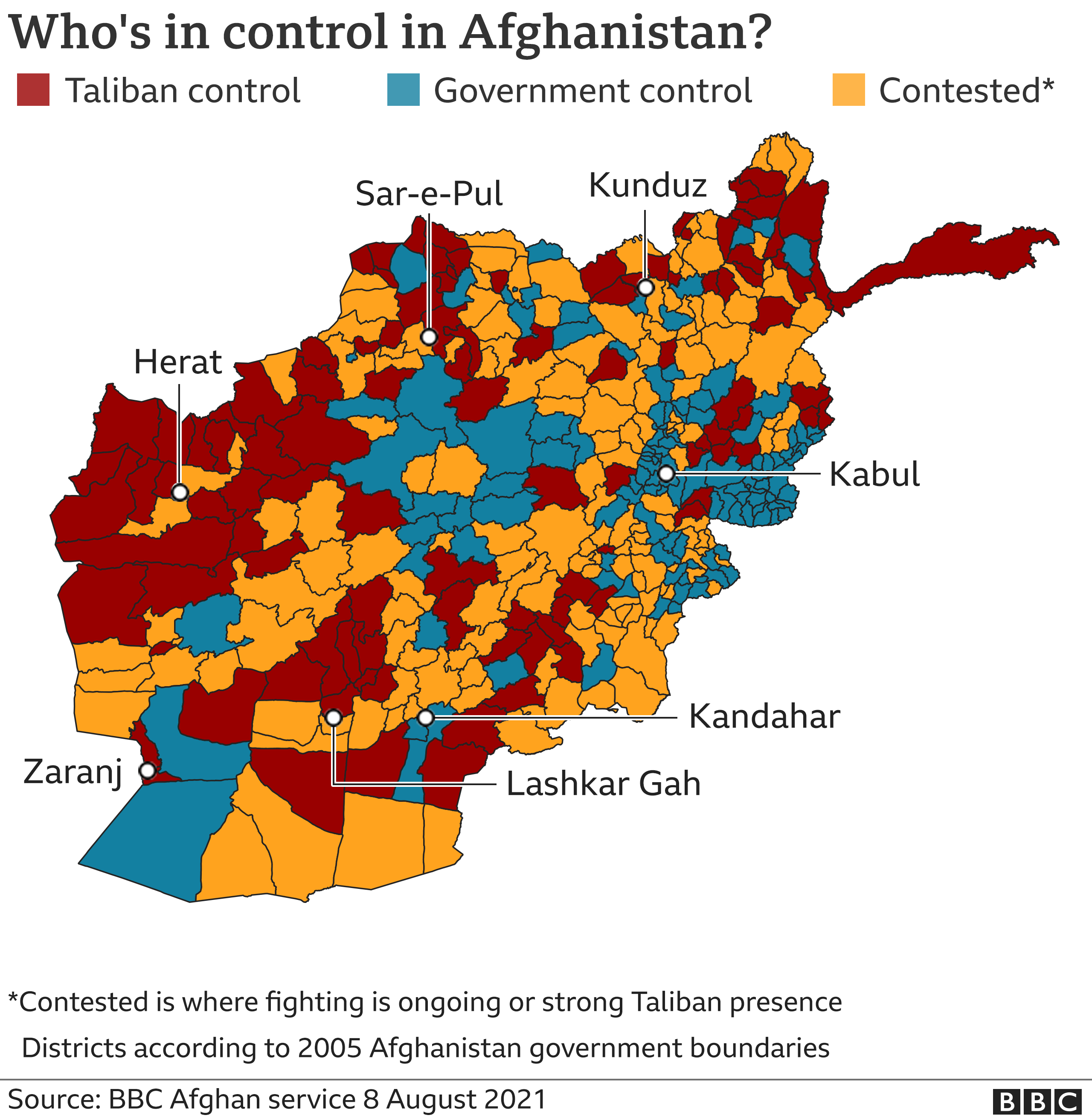
Map highlighting who controls Afghanistan. Map Source: BBC
Standard
Afghanistan, China, Middle East, Politics, Society

China preparing to capitalise in Afghanistan

ESSAY

Intro: Just days after the U.S. and its Coalition partners prepare to leave Afghanistan, China is preparing to gain a direct route to the riches of the Middle East. With billions in the Chinese war chest, just where will China’s ambitions end?

THERE is a reason why Afghanistan is known as “the graveyard of empires”. Every few decades this beleaguered nation emerges from obscurity to remind an apparently invincible invader that his army is not the first to bite the bitter dust there. Afghanistan is littered with examples of invading armies sent into retreat and heavy defeat. 

In 1842, the first of Britain’s four Afghan wars ended in catastrophe. Only one man survived from a force of about 4,500, plus 10,000 or so camp followers, linguistic interpreters, and local allies – and he was set free only so he could recount the scale of the defeat and the dire end of his comrades.

After ten years of brutality trying to convert Muslim Afghans into ‘modern’ communists, the once mighty Red Army found itself in humiliating defeat from Afghanistan in 1989. It would mark the beginning of the rapid fall of the Kremlin’s dominoes from Eastern Europe to Moscow itself.

Today, we see the U.S. and its coalition partners leaving Afghanistan in defeat after almost 20 years; the superpower discovering that Afghanistan’s fragmented tribal culture masks an unbreakable resilience. President Joe Biden, a recent convert to the cause of ending what he has described as a “forever war”, has set a deadline of September 11 for the last American troops to leave.

It is, of course, a highly symbolic act that marks 20 years since the 9/11 attacks by Al-Qaeda – which had its training camps in Afghanistan – that destroyed the World Trade Centre in New York.

Within two months of the invasion in October 2001 by the U.S.-led Coalition forces, Al-Qaeda’s leader, Osama bin Laden, had fled to Pakistan and the fundamentalist Taliban routed. But the mission soon lost its way, at a cost of thousands of military and civilian lives.

Now the U.S. cannot get out fast enough, abandoning its huge airbase at Bagram overnight on 2 July. Today, the situation around the capital Kabul is chaotic, its population in panic, and the Taliban is sweeping back into territory it had been forced to flee by Coalition forces.

Afghan soldiers loyal to the fragile Western-backed Kabul government are being routed. After clashes with newly strengthened Taliban units, an estimated 1,600 have fled and dispersed across the border into neighbouring Tajikistan.

Others have abandoned their weapons and uniforms to return to their homes or switched to fight with the Taliban, which is also taking territory it did not hold prior to the Coalition’s arrival.

Despite more than $2.3 trillion spent waging a war against a badly armed and underfed ragtag of rebels, the Americans leave their enemy in better shape than ever before.

But this will not deter the world’s newest superpower – China – which is waiting patiently in the wings. The Dragon of China will soon enter the fray.

In a development that should strike fear through Western capitals, Beijing scents an unrivalled opportunity to extend its influence in the region and gain strategic territorial and economic advantage that could rewrite the geopolitical map in its favour.

For President Xi Jinping’s Marxist government, Afghanistan is a prize beyond measure. It offers a portal through which Chinese military might could access the Arabian Sea, via Iran or Pakistan.

And the war-torn country could provide two other things China desperately wants: overland access to Iran and the Middle East, and a route to the Indian Ocean and on to Africa.

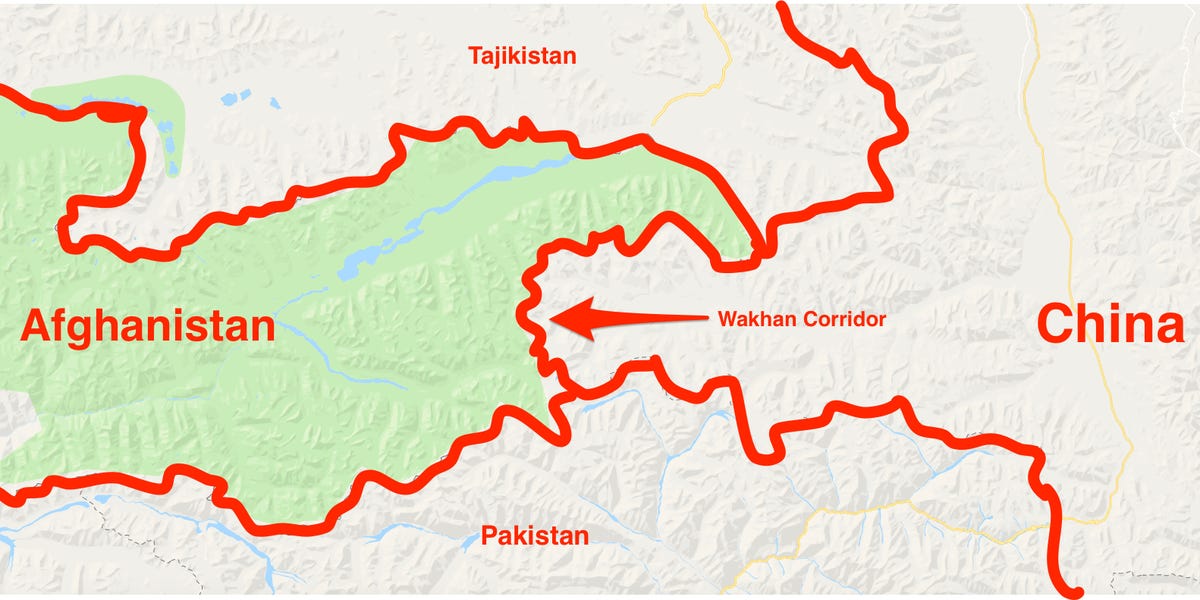
To reach these markets currently, Chinese goods must go the long way round, via container ships through the disputed South China Sea. But the short border Afghanistan shares with north-western China offers potential for a mega-highway, a high-speed rail link and fuel pipelines.

Beijing is confident that it can succeed where Whitehall, the Kremlin and the White House have failed over the centuries, for the simple reason that it is not interested in transforming Afghan society.

It has learned from the mistakes of the Russian communists. Chinese communists have no desire to remake Afghanistan (or anywhere else) in their own image.

Threat

Nor will its goals be achieved by brute force; President Xi has a far smarter plan. When the Kremlin occupied Afghanistan in 1979, it saw it as a steppingstone to dominating the oil-rich Middle East, but Soviet communism had little to offer compared with the wealth of modern China.

Xi prefers to use financial muscle as much as the threat of military power and, if reports that Beijing is prepared to invest $62 billion in Afghanistan are true, it is following a blueprint perfected in many countries from Malaysia to Montenegro.

Under a policy known as the Belt and Road Initiative (BRI), vast loans are offered to cash-strapped countries for infrastructure projects. In return, China gains access to new trade routes and ports, as well as banking hefty interest payments on its investment.

If the repayments are late, the Chinese could step in to reclaim land, mineral rights, or other collateral as compensation. It is a business plan more common in the underworld of gangsters and organised crime groups: victims are lured into a “debt trap” and forced to repay, one way or the other.

In return for its largesse, China will also expect the Taliban to ignore the “genocidal” oppression of their fellow Muslims, the 12 million Uighurs in China’s Xinjiang province, which sits close to the Afghan and Pakistani borders.

The last thing Beijing wants is an anarchic scenario in which a rise in Islamic fundamentalism on its border threatens domestic security in China.

But it has seen how indifferent strict Islamic regimes in the Middle East are to Uighur rights. The oil-rich Arab monarchies will much prefer doing lucrative deals with Beijing than bothering about its treatment of fellow Muslims.

Pakistan’s Prime Minister, the former international cricketer Imran Khan, who cynics argue has reinvented himself as a born-again Muslim to cement his political power base, has spoken up about the Uighurs – but only to defend China’s handling of them.

And even before Khan came to power, Pakistan’s generals saw the Taliban as a natural ally against their number one adversary, India. China, too, is at daggers drawn with India, so it will view an anti-India Taliban regime in Kabul as a possible ally.

Uncertain days lie ahead and as the remaining American troops gather to stockade the U.S. Embassy in Kabul and protect the dwindling band of Westerners there, there are many observers who recall evacuation of the U.S. embassy in Saigon in 1975. 

Similar humiliating scenes are likely in the coming weeks. Up to 1,000 U.S. troops are expected to be stationed at Kabul Airport to protect departing Western civilians.

Bleak

That will be little comfort to all those Afghans who have worked bravely with Coalition forces over more than two decades trying to improve life for their own people. Betrayed, their future is now bleak.

And, as for our pledges to women and girls – with the likely return to power in Kabul of the Taliban – they will lose those rights and freedoms that Allied intervention had brought.

China sees Afghanistan – even with the Taliban back in control – as one of the most crucial squares on the chessboard of world politics. And like a chess grandmaster, President Xi Jinping is not planning for a quick checkmate.

Historians will no doubt look back at what is happening now and see that China did indeed learn the lessons of history. Where Britain, Russia and America have failed, it may yet triumph, gaining the influence it seeks without having shed the same terrible price in blood and human sacrifice.

Appendage

– Afghanistan and China share a short 46-mile border. Afghanistan has huge strategic importance for China.
Standard
Banking, Economic, European Union, Greece

The Greek bailout: Athens is still being betrayed by the EU

ESSAY

AFTER several years in which Greece was kept afloat by the munificence of the eurozone countries, Athens was trumpeted by many media outlets this week as being free at last from an EU bailout programme worth 61.9billion euros (£55billion) in emergency loans. That was part of an eight-year rescue package worth £258billion.

Despite the reports of economic privation and the dark clouds over Greece finally lifting, the reality is that Greece is far from saved from pecuniary disaster. The harsh economic medicine forced on the country by the EU and Germany in particular as conditions of the bailout has resulted in death by a thousand cuts.

The country’s once elegant capital has become one of the most depressing and untidiest cities in Western Europe, a city that is now in terrible decay. Shops on once booming boulevards are shuttered, while heavy machines and cranes stand idle over the shells of unfinished buildings. Much of Athens is covered in ugly graffiti. Even the awnings around Greece’s most revered ancient site the Parthenon, on the Athenian Acropolis, is covered in unsightly painted drawings.

The hardships and deprivations are everywhere – all the more heart-breaking in that this downward spiral had been caused by European leaders who were masquerading as people bearing gifts. Most Athenians are struggling to make ends meet.


HOSPITAL doctors, for example, have seen their monthly pay cut to just over a thousand pounds a month. It is only through social conscience and the love of their country that has kept some of them in Athens.

Some 70,000 highly skilled professionals including doctors, dentists and pharmacists have left the country as part of a broader Grexodus of 500,000 people.

The best way for any country to emerge from financial crisis is to increase its national income so that tax revenues rise and global debts can be paid off. But during the last eight years, Greece has moved in precisely the opposite direction. National output has slumped by an astonishing 25 per cent. The result is adult unemployment of 20 per cent. Even more shocking and socially disruptive, some 40 per cent of 18 to 25-year olds are out of work.

Without any income for the young, it is now commonplace for three generations of the same family to be forced to live cheek by jowl in the same crowded apartments. The fact is that the austerity imposed by the eurocrats has ruined Greece and done nothing to relive it of its monstrous level of debt.

It has snuffed out entrepreneurship, as well as created a poisonous political legacy where a far-Left Marxist party headed by Alexis Tsipras rules with the support of fanatical politicians on the populist Right.

The end of the EU’s bailout programme may technically mean that Greece can return to the international markets to borrow again, but any notion that the world’s commercial bankers and financiers will be queuing at Athens’ overcrowded and dilapidated airport to lend – and pour good money after bad – is a fantasy.

After all, the country is still sitting on a debt pile of 289billion euros (£258billion) which the International Monetary Fund (IMF) puts at 191 per cent, or almost twice the nation’s total annual output.

To place that in context, it is more than two times the ratio of Britain’s national debt to output, which after a decade of UK cuts to public services and surging tax incomes as the economy has grown is now, thankfully, on a downward path.

Not only that, Greece’s stricken financial system is currently being kept afloat by short-term cash assistance of some 40billion euros (£35.6billion) per month from the Frankfurt-based European Central Bank. Without this help, which is akin to that provided by the Bank of England to the British banks at the height of the financial crisis a decade ago, the four biggest Greek lenders would be effectively bankrupt.

Together the bad loans on the books of these banks – Piraeus, Alpha, Euro Bank and National Bank of Greece – amount to 101billion euros (£90billion) or 50 per cent of the total, the highest level of any country in the European Union. Indeed the banks, the lifeblood of any Western economy, are so indebted that they cannot lend any more.


WHICH means the small and medium-sized enterprises that are the country’s business bedrock cannot get the finance they need to carry on and invest. Nor do ordinary consumers find it possible to obtain credit.

This desolate financial scenario is a direct result of the austerity conditions demanded by Brussels eurocrats and German central bankers. Over the last eight years successive Greek governments have been forced to attend no fewer than 95 meetings at which the most stringent measures have been imposed on them.

The results for the Greek people have been nothing short of catastrophic.

Yet in their determination to preserve the greater political project of the eurozone and the EU, and to keep Greece as their client state, Brussels and German politicians have been utterly ruthless.

In spite of personal appeals from the IMF’s euro-supporting managing-director Christine Lagarde to forgive Greece its debt burden and allow the country to be given a fresh start, the eurofanatics have been unrelenting in their determination to keep the debt anvil hanging around its neck.

Greece is in an armlock it cannot escape because of a combination of its debt burden and the fact that its membership of the eurozone means it can longer devalue its currency. And the EU and Germans are determined to keep it that way to save their precious euro.

So, despite the joyous and uplifting media reports about the bailout this week, be in no doubt that this Greek tragedy is very far from being over.


GREECE should ditch the euro as it emerges from eight years of austerity caused by punishing EU bailouts.

The country also should have been afforded the right to have gone bankrupt at the height of the eurozone crisis instead of having been forced into a strict rescue package dictated by Brussels and Germany.

The EU pushed the country into accepting massive loans to save German and French banks from collapse. Greece’s creditors effectively turned the country into a dead colony that had been left devastated by fiscal austerity, with citizens having endured years of pain and misery.

Greece has now existed the final stage of an eight-year, £258billion bailout programme, which has left Athens crippled by soaring unemployment.

On the face of it, what has really changed? Greece’s state debts have not become lower, but higher still. The state is still destitute, private citizens have become poorer, companies are liquidating at an unprecedented rate, and its gross national product has decreased by 25 per cent.

The bailout was intended only for German and French banks who had, against all reasonable logic, loaned vast sums of money to the Greek state and oligarchy. As for the Greek banks and state, they should not have been saved. The country should have been allowed in declaring insolvency, to have suffered the consequences but then being allowed to have picked themselves up and by moving on – something these huge bailouts prohibited.

In a television interview, Yanis Varoufakis, a former minister who served in the Left-wing Syriza government, said: “It was absolutely necessary that the country be prepared to return to its national currency”. Unable to pay its debts, Greece faced a so-called “Grexit” from the eurozone in the aftermath of the global financial crisis of 2008. The economy has now returned to modest growth, but one in five Greeks are unemployed, average incomes have dropped by more than a third and taxes have rocketed.

Critics have argued that Greece would have fared better outside the euro, enabling it to carry out a range of measures including devaluing its currency and lowering interest rates to make the economy more competitive.

EU figures have this week tried to paint the bailout programme as a success, with European Council president Donald Tusk saying: “You did it! With huge efforts and European solidarity, you seized the day.”

Rather, the EU put Greece into a permanent coma and prefer to call it stability.

Standard