
WALLACE COLLECTION
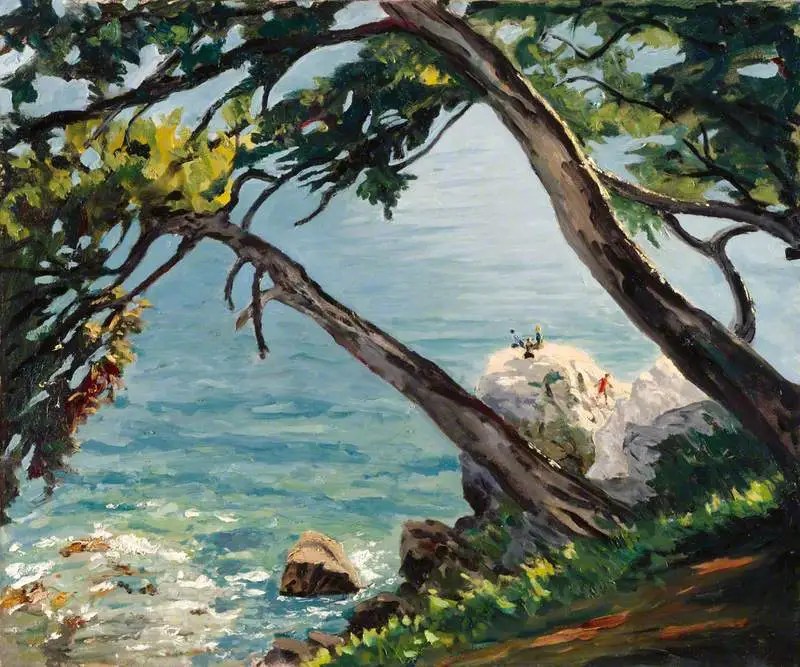
Xavier Bray, the director of the Wallace Collection, recently described the London gallery’s new exhibition of Winston Churchill’s paintings as “provocative”.
Churchill didn’t take up painting as a hobby until he was 40 years of age, perhaps to distract himself following the disastrous Dardanelle campaign of 1915 (for which, as First Lord of the Admiralty, he was held responsible), but he became besotted with the medium, and sought out artistic instruction from masters including John Lavery, Walter Sickert, and William Nicholson. Before his death at the age of 90 in 1965, Churchill produced more than 500 oil paintings.
Yet, astonishingly, there hasn’t been a British retrospective of his work since 1959. According to one commonly held view, this is because his “daubs”, as he described them, simply aren’t up to scratch.
He may have won the Nobel Prize in Literature in 1953 – writing was his main source of income for most of his life having authored dozens of books and penned countless journalistic pieces – but, surely, nobody in their right mind would honour his amateurish paintings, despite the enthusiasm with which he set about them while wearing a bespoke painting coat tailored by Henry Poole & Co. All of this done in his studio on Chartwell’s 80-acre estate, where he stored pigments in a cigar humidor presented to him by the Cuban government.
On the evidence, though, of Winston Churchill: The Painter, he was hardly as bad as all that. On occasion, he was even surprisingly decent, as demonstrated by a display of Moroccan landscapes, including a view of the Koutoubia Mosque in Marrakech that achieved £8.3m at auction when it was sold by Angelina Jolie in 2021.
Painted in 1943, it was the only canvas he produced during the Second World War. He gave it to his friend and fellow wartime leader Franklin D Roosevelt, whom he’d persuaded to accompany him on a trip to Marrakech immediately after the Casablanca conference – to, as he put it, “see the sunset on the snows of the Atlas Mountains”. According to Bray, Churchill often gifted his paintings to important people, including three consecutive American presidents, as a form of “soft power”.
You can tell that, like many artists before him, Churchill loved painting in North Africa, where, while working en plein air, he would attract a curious crowd. His Moroccan compositions may lack the blazing audacity of, say, those by Henri Matisse or others in the Fauvism movement, but their combinations of dusky pinks, cool lavenders and greens still satisfy.
While stick figures populate some of Churchill’s Moroccan views, Bray and his co-curator, Lucy Davis, wisely omit his paintings of people, which can appear ham-fisted. Instead, they prefer to present an attractive selection of about 60 of his still lifes and landscapes, including serene, sun-soaked vistas of holiday destinations in Italy and along the Côte d’Azur (as well as in Morocco).
This specific subject matter may reflect the fact that painting for Churchill was a way to relieve strain – which he wrote about brilliantly in his essay Painting as a Pastime. (He found similar solace in bricklaying.) His compositions in this mode are easy on the eye and inoffensive. The best examples are preoccupied with capturing complex reflections on the surface of water.
On occasions, there is a hint of warfare – although the exhibition sidesteps controversial talk about imperialism. A squat black Napoleonic cannon facing mainland Europe in the foreground of The Beach at Walmer is surely a sort of self-portrait, given the painting’s date of 1938. Otherwise, though, this is painting as escapism.
Sometimes, this means that Churchill’s pictures are insipid or banal. Too many appear like inexpert imitations of Post-Impressionist paintings, which he admired. Several are blighted by boring, unmodulated passages and feel stilted. With little to analyse aesthetically, the labels rely heavily on anecdotes (although this could invoke fun). A quarter bottle of Pol Roger is on show in the first gallery, alongside his spectacles. Supposedly, it contained the last bubbly he ever drank.
Yet, almost everything that Churchill brushed conveys his infectious passion for the art form and, occasionally, a painting by him really comes together. A view from about 1924 of sun-struck snow surrounding the Chartwell estate (which Churchill purchased in 1922 and loved dearly) is delicious.
A 1932 canvas of a goldfish pool fringed with greenery near the house – which Churchill often painted, possibly in homage to Claude Monet’s depictions of his water garden at Giverny – is enlivened with undulating curls and slivers of orange, like sinuous Wotsits, representing fish beneath its rippled surface.
Forget the august aura of the artist who produced it. Considered purely as a painting, it hits the mark.
– The Wallace Collection, London W1, runs until November 26

