
Art, Arts, Exhibitions, Second World War

Exhibition – Winston Churchill: The Painter

WALLACE COLLECTION

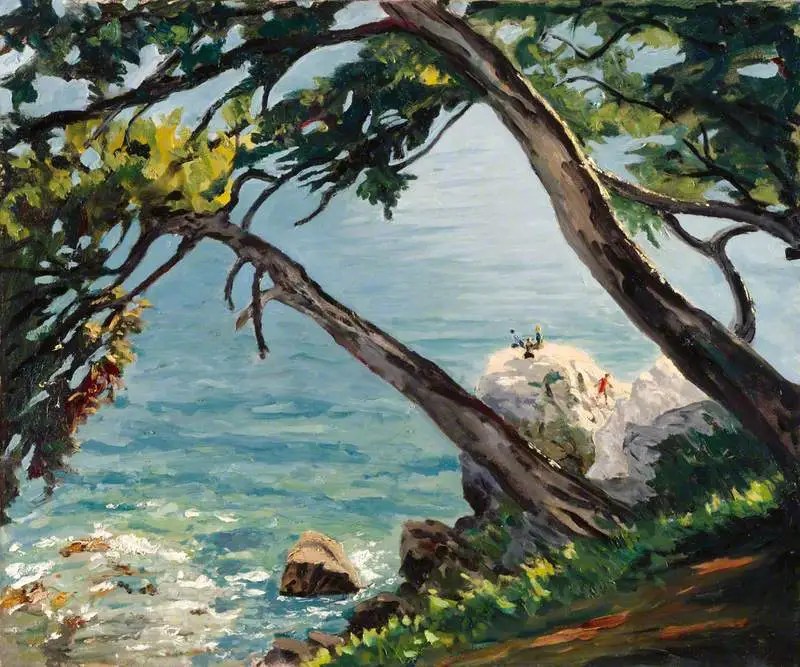
Serenity: Winston Churchill’s Cap d’Ail, Alpes-Maritimes (1952)

Xavier Bray, the director of the Wallace Collection, recently described the London gallery’s new exhibition of Winston Churchill’s paintings as “provocative”.

Churchill didn’t take up painting as a hobby until he was 40 years of age, perhaps to distract himself following the disastrous Dardanelle campaign of 1915 (for which, as First Lord of the Admiralty, he was held responsible), but he became besotted with the medium, and sought out artistic instruction from masters including John Lavery, Walter Sickert, and William Nicholson. Before his death at the age of 90 in 1965, Churchill produced more than 500 oil paintings.

Yet, astonishingly, there hasn’t been a British retrospective of his work since 1959. According to one commonly held view, this is because his “daubs”, as he described them, simply aren’t up to scratch.

He may have won the Nobel Prize in Literature in 1953 – writing was his main source of income for most of his life having authored dozens of books and penned countless journalistic pieces – but, surely, nobody in their right mind would honour his amateurish paintings, despite the enthusiasm with which he set about them while wearing a bespoke painting coat tailored by Henry Poole & Co. All of this done in his studio on Chartwell’s 80-acre estate, where he stored pigments in a cigar humidor presented to him by the Cuban government.

On the evidence, though, of Winston Churchill: The Painter, he was hardly as bad as all that. On occasion, he was even surprisingly decent, as demonstrated by a display of Moroccan landscapes, including a view of the Koutoubia Mosque in Marrakech that achieved £8.3m at auction when it was sold by Angelina Jolie in 2021.

Painted in 1943, it was the only canvas he produced during the Second World War. He gave it to his friend and fellow wartime leader Franklin D Roosevelt, whom he’d persuaded to accompany him on a trip to Marrakech immediately after the Casablanca conference – to, as he put it, “see the sunset on the snows of the Atlas Mountains”. According to Bray, Churchill often gifted his paintings to important people, including three consecutive American presidents, as a form of “soft power”.

You can tell that, like many artists before him, Churchill loved painting in North Africa, where, while working en plein air, he would attract a curious crowd. His Moroccan compositions may lack the blazing audacity of, say, those by Henri Matisse or others in the Fauvism movement, but their combinations of dusky pinks, cool lavenders and greens still satisfy.

While stick figures populate some of Churchill’s Moroccan views, Bray and his co-curator, Lucy Davis, wisely omit his paintings of people, which can appear ham-fisted. Instead, they prefer to present an attractive selection of about 60 of his still lifes and landscapes, including serene, sun-soaked vistas of holiday destinations in Italy and along the Côte d’Azur (as well as in Morocco).

This specific subject matter may reflect the fact that painting for Churchill was a way to relieve strain – which he wrote about brilliantly in his essay Painting as a Pastime. (He found similar solace in bricklaying.) His compositions in this mode are easy on the eye and inoffensive. The best examples are preoccupied with capturing complex reflections on the surface of water.

On occasions, there is a hint of warfare – although the exhibition sidesteps controversial talk about imperialism. A squat black Napoleonic cannon facing mainland Europe in the foreground of The Beach at Walmer is surely a sort of self-portrait, given the painting’s date of 1938. Otherwise, though, this is painting as escapism.

Sometimes, this means that Churchill’s pictures are insipid or banal. Too many appear like inexpert imitations of Post-Impressionist paintings, which he admired. Several are blighted by boring, unmodulated passages and feel stilted. With little to analyse aesthetically, the labels rely heavily on anecdotes (although this could invoke fun). A quarter bottle of Pol Roger is on show in the first gallery, alongside his spectacles. Supposedly, it contained the last bubbly he ever drank.

Yet, almost everything that Churchill brushed conveys his infectious passion for the art form and, occasionally, a painting by him really comes together. A view from about 1924 of sun-struck snow surrounding the Chartwell estate (which Churchill purchased in 1922 and loved dearly) is delicious.

A 1932 canvas of a goldfish pool fringed with greenery near the house – which Churchill often painted, possibly in homage to Claude Monet’s depictions of his water garden at Giverny – is enlivened with undulating curls and slivers of orange, like sinuous Wotsits, representing fish beneath its rippled surface.

Forget the august aura of the artist who produced it. Considered purely as a painting, it hits the mark.

The Wallace Collection, London W1, runs until November 26                                                                                                                                                    

Standard
Britain, History, Military, Second World War, Society, United States

Dresden and the Allied bombings of World War II…

70 YEARS ON

Today, the blossoming of Dresden in the east of Germany stands in stark contrast to how the city looked from the ruins of the Allied bombings towards the end of World War II.

British and American bombers dropped 3,900 tonnes of explosives on the Saxony city during four raids on 13th-15th February 1945, killing an estimated 25,000 people and reducing the city to rubble.

The bombing, ordered by Royal Air Force marshal Sir Arthur ‘Bomber’ Harris, was widely criticised because of the indiscriminate and ‘blanket bombing’ which hit civilian areas as well as military targets – killing thousands of innocents.

Over two days and nights in February 1945, 722 heavy bombers of the British Royal Air Force (RAF) and 527 of the United States Army Air Forces (USAAF), turned the city into a sea of flames and rubble.

The resulting firestorm is said to have reached temperatures of over 1,500C (2,700F), destroying over 1,600 acres of the city centre.

The victims – mostly women and children – died in savage firestorms whipped up by the intense heat of 2,400 tons of high explosive and 1,500 tons of incendiary bombs.

It was initially claimed that up to 250,000 civilians lost their lives in the Dresden bombings but an official report released after the war showed the casualty figure was in fact closer to between 22,500 and 25,000.

A police report written shortly after the bombings showed that the city centre firestorm had destroyed almost 12,000 houses, including 640 shops, 18 cinemas, 39 schools, 26 public houses and the city zoo.

The destruction of Dresden has been subjected to much fierce debate in the 70 years since the war. No one has ever been charged over the bombings, but several historians both in Germany and former Allied nations hold the opinion that the bombing was a war crime.

British Prime Minister Winston Churchill, ultimately responsible for the attack, distanced himself from the bombing of Dresden shortly afterwards.

An RAF memo issued to airmen on the night of the attack said:

… ‘Dresden, the seventh largest city in Germany and not much smaller than Manchester is also the largest unbombed built-up area the enemy has got. In the midst of winter with refugees pouring westward and troops to be rested, roofs are at a premium, not only to give shelter to workers, refugees, and troops alike, but to house the administrative services displaced from other areas.

… At one time, and well known for its china, Dresden has developed into an industrial city of first-class importance…. The intentions of the attack are to hit the enemy where he will feel it most, behind an already partially collapsed front… and incidentally to show the Russians when they arrive what Bomber Command can do.’

Bomber Command, which suffered the highest casualty rate of any British unit, losing 55,573 of its 125,000 men, eventually gained a memorial in 2012, but sections of society in Britain were outraged and disgusted with public recognition being given to such attacks. It is the view of many that such a memorial should never have been authorised by the British Government because of the attacks on civilians and on non-strategic targets.

Standard
Arts, Britain, Government, History, Military, Science, Second World War

Britain: ‘RAF and the ‘Battle of the Beams’…

R.V JONES: ‘RADIO WAVES & ELECTRONIC JAMMING’

ON THE AFTERNOON of September 7, 1940, the first German bombers came rumbling up the Thames, to drop their bombs on London in the opening act of what became known as the “Blitz.” They were followed by a further 250 Luftwaffe bombers, unloading the first instalment of a massive payload of some 14,000 tons of high explosive that rained down on London until May of the following year.

The trial by fire that started more than 70 years ago is often depicted as a triumph of human resilience, a refusal by ordinary people to submit to terror. And so it was. But it was also a victory for a less known aspect of applied science, for, alongside the ferocious aerial combat another secret, electronic war was taking place, known to very few at the time and little appreciated since.

We rightly celebrate military victory in the Battle of Britain and civilian grit in the Blitz, but Britain’s astonishing scientific triumph in what Winston Churchill later called “the Battle of the Beams” has often been too easily overlooked. It saved countless thousands of lives, confused the German assault and helped to stave off the threat of invasion. This battle was fought, not with bombs and bullets, but radio waves. In the age of Shock and Awe, this covert scientific battle offers a timely reminder that ingenuity is just as important in war as brute force.

..

THREE MONTHS before the Blitz began, a 28-year-old scientist named Reginald Victor (R. V.) Jones was summoned to Downing Street to address the cabinet on the subject of radio beams. Churchill had become increasingly worried by intelligence reports suggesting that the Nazis had developed some kind of secret ray that could magically guide the Luftwaffe bombers to their targets, even when flying at night and in dense cloud.

Though outnumbered, heroic RAF pilots flying nimble and venomous Spitfires and Hurricanes saw off the Luftwaffe, their decisive victory finally coming on September 15, 1940.

An RAF officer working in technical intelligence, Jones had begun studying German radio navigation systems several months earlier and offered the Cabinet a most alarming conclusion: the Germans were using two narrow radio beams transmitted from separate locations in continental Europe to pinpoint strategic locations in Britain. In effect, the German bomber pilot could follow one radio beam until it intersected with the other beam and then drop his payload – directly over the target.

Night-bombing made bombers safer from interception by fighters and anti-aircraft systems, but finding a target in the blackout or bad weather using traditional navigation was tricky. German scientists, it seemed, had solved the problem: they codenamed it “Knickebein”, meaning “crooked leg”, a reference either to the shape of the intersecting beams or the bent appearance of the transmitting antennae. The Germans could never resist a hinting code-word – the German codename for their long-range radar system, for example, was “Heimdall”, after the Norse god with the power to see over vast distances. But the British were similarly addicted to code-wordplay. With admirable understatement, this threatening new German radio navigation system was given the codename “Headache”; the countermeasures required to defeat it were named, perhaps appropriately, “Aspirin”.


TO TACKLE the problem, R.V. Jones turned for help to medicine. Electro-diathermy sets were used in hospitals to destroy abnormal tissue and to cauterise wounds. Suitably modified, they also proved highly effective at jamming the Knickebein transmissions and were now deployed to send out a blizzard of radio noise over a wide range of frequencies.

Hermann Goering, the Luftwaffe chief, had given Hitler his personal pledge that the radio navigation system was invulnerable. He was far wide of the mark and so, increasingly, were his bombers. During the crucial months of September and October 1940, as the Luftwaffe night-raids mounted in intensity, Jones and his fellow scientists became ever more adept at jamming and diverting the radio beams, using more powerful radio transmitters to “inject” the Knickebein signals with confusing Morse code elements.

Deprived of reliable electronic direction, the Luftwaffe crews could become disorientated at night. One pilot was said to have landed in Dover, thinking he was back in France. Bombs intended for vital and heavily populated targets fell relatively harmlessly in fields and hills. According to some estimates, as much as 80 per cent of the German night bombs missed their target. Intercepted messages between German ground controllers and Luftwaffe pilots unable to locate their targets provided vital evidence that the beam-jammers were having the desired effect.

Even so, “Aspirin” was far from a cure-all remedy. The German bombers still caused appalling damage. London represented a target too vast to miss, even at night. A derivative of Knickebein radio navigation, known as “X Apparatus” was used to guide 400 Luftwaffe pilots to Coventry on November 14, 1940. Because of a technical error, the British jammer stations attacked the wrong frequency. The city was devastated, 568 people died, and Joseph Goebbels coined the term “Coventriert” to describe a particularly satisfactory level of destruction.

But how many more lives might have been lost, how many key military and industrial installations would have been destroyed and with what effect on the progress of war, if the Luftwaffe had been able to continue precise bombing under cover of darkness? Churchill was never in any doubt that science had played a pivotal role in blunting the Blitz. He dubbed R.V. Jones the “man who bent the bloody beams”.


R.V. JONES, who died in 1997, was a remarkable warrior, but one who believed in trickery and creativity as the antidote to savagery. In 1993, the CIA founded an intelligence award named in his honour, for “scientific acumen applied with art in the cause of freedom”. Yet, in this country, which he did so much to defend, so secretly, his is not a household name.

The Blitz and the Battle of Britain are synonymous terms that have left an enduring legacy of proud national stereotypes; the Spitfire pilot, the ambulance driver, the unbowed housewife sweeping up after the bombs had left their mark.

Just as important, although much less lauded, was the scientist in his lab, using a medical gadget to baffle and confuse Hitler’s bombers.

Standard