Intro: Trump’s trade wars have exasperated the Eurosceptic model, which is more outdated than ever
WHEN the transatlantic alliance was more functional than now, there was never a united view of China. Beijing has always been perceived as a commercial rival and potential security threat, and a common wariness has existed. For hawks in Washington, however, the idea of an alternative superpower closing in on economic and technological parity feels existential. More dovish Europeans have been openly compromising and readier to leaven caution with engagement.
Britain has veered between the two poles. In 2015, David Cameron promised a “golden era” of open trade with China. In 2020, under pressure from the US, Boris Johnson banned Huawei, a Chinese telecoms company, from UK 5G infrastructure.
In opposition, Conservative politicians have become increasingly hawkish against Beijing. Keir Starmer’s Labour government has tilted back towards cooperation. Several Labour ministers have visited China, including the chancellor. Other ministers, including the business secretary, will go there later this year, to revive a trade commission that has been dormant since 2018. Despite being manifestly frustrated with the Chinese owners of British Steel during the recent dash to keep Scunthorpe’s blast furnaces operating, the UK government has retreated from intimations of deliberate sabotage.
At some point, a reckoning has to be made. The pursuit of economic growth and investment will inevitably come into conflict with a national security interest in keeping China at arm’s length. The question is where to draw the line. The official line is that judgment is deferred pending a Whitehall “audit” of relations with Beijing. That is due in June.
A UK government decision is also imminent on China’s status under the foreign influence registration scheme – a system for keeping tabs on international organisations and companies exercising political influence in Britain. China is not expected to be named in the “enhanced tier” of risky states, alongside Russia and Iran, but some Chinese institutions might have that designation.
Calibrating these judgments – choosing when to prioritise security over commerce – is much harder with Donald Trump in the White House. What used to be a difference of emphasis between the US and Europe looks like an irreparable fracture in the west.
Trump has started a ferocious trade war with Beijing without a convincing strategic rationale. His officials have told Europeans they will have to choose a side when it comes to vital communications technology. Yet, what we see is a US president who has become routinely aggressive in his rhetoric towards the EU, dismissive of NATO, and reliably emollient towards Putin’s Russia.
From that pattern it is clear in Brussels and other continental capitals that Washington is no longer a reliable ally and the trajectory must be “strategic autonomy” for Europe. That is changing the calculus of risk and potential benefit from a more pragmatic China policy. The authoritarian character of Xi Jinping’s regime hasn’t changed, but it presents itself as a more predictable force in international affairs while US democracy declines in harsh and sporadic spasms.
Such changes illuminate a crisis of international orientation for Britain that has been building since Brexit. Economic detachment from Europe was promised on a model of the UK as a lone sovereign agent in an open, free-trading globalised world. That concept has aged very poorly, and it stands more of an outdated concept now than it ever has. Britain is not alone in struggling to navigate relations with China in the turbulent new geopolitical climate, but choosing loneliness and isolation in a world of rival continental blocks is making the struggle much harder.
Intro: China is braced for economic turbulence due to swingeing tariffs. But it sees an opportunity by taking the longer-term view: a decline in US hegemony
THERE can be no winners in Donald Trump’s ferocious trade war that he has unleashed, least of all among consumers and workers. In strongarm tactics, this has become a game of who can bear more pain. And because trade is at the heart of US ties with its biggest tariff target, China, the rest of the bilateral relationship is likely to deteriorate. That too is concerning.
Yet, paradoxically, despite the economic struggles of recent years, China may see a longer-term opportunity in the current crisis. Beijing’s response to the initial US tariff announcements was measured. Now it vows to “fight to the end” and has imposed an additional 50% tariff on US goods – taking total tax charges to 84% – in retaliation for reciprocated tariffs that Mr Trump now says will hit 125%.
Such an approach is unlikely to falter first. Any concessions would likely be taken as a sign of weakness, encouraging the US to ramp up the pressure even more. Xi Jinping is also a strongman who has dialled up nationalism as economic growth has slowed. Backing down would be humiliating, especially when the US vice-president, JD Vance, speaks dismissively of “Chinese peasants”.
Beijing is already allowing the yuan to weaken, but a major devaluation in the currency is thought unlikely. It has been preparing for this moment. China’s demographic boom is at an end, Mr Xi’s new vision for his nation, the impact of the pandemic, Donald Trump’s first term in office, and US bipartisanship have all turned against China in reshaping the world economy. But China has diversified in areas such as agricultural imports and found new markets for its goods – though exports to the US still account for just under 3% of its GDP. In recent weeks, it announced plans to “vigorously boost” domestic consumption, although previous action on that long-held ambition has not matched the rhetoric.
Mr Trump’s sudden announcement that he is suspending punitive tariffs on other countries for 90 days highlights an apparent underlying intention to make them distance themselves from China and stop them being used as a conduit for its goods. Still, if he goes ahead, high rates risk pushing them towards Beijing instead. Trump’s erratic policy may also reflect growing anxieties about the impact of those tariffs, not least among his own supporters. China is quietly confident that the U.S. will come under growing pressure to rethink from billionaire backers, ageing workers worried that their retirement funds are losing value, farmers, employees fearing for their jobs, and consumers contemplating higher prices in everyday consumables. A bilateral deal is not impossible, but sense needs to be restored.
Beijing does not like what lies ahead. But in the longer term, it has more confidence in its trajectory. It looks back to the 2008 financial crisis, when it “saved the world” with its massive stimulus package, and looks ahead now with emboldened self-assurance following its launch in January of its AI DeepSeek platform.
Above all, Beijing believes that when this storm has passed, few will regard the US as a dependable economic or security guarantor, with China becoming a more predictable and likeable partner. At February’s Munich security conference – where Mr Vance’s sneering attacks on European allies made the headlines – China’s foreign minister, Wang Yi, pledged that China would be “a steadfast constructive force” and “factor of certainty in this multipolar system”. Some countries may feel forced to live with Beijing’s own trade and investment restrictions, and its use of economic coercion for political purposes. But others may simply drift from America’s orbit.
China expects to suffer, but as it watches on it will not be entirely unhappy as the US advances its own decline.
This is a transformational moment in the global order.
Intro: Just days after the U.S. and its Coalition partners prepare to leave Afghanistan, China is preparing to gain a direct route to the riches of the Middle East. With billions in the Chinese war chest, just where will China’s ambitions end?
THERE is a reason why Afghanistan is known as “the graveyard of empires”. Every few decades this beleaguered nation emerges from obscurity to remind an apparently invincible invader that his army is not the first to bite the bitter dust there. Afghanistan is littered with examples of invading armies sent into retreat and heavy defeat.
In 1842, the first of Britain’s four Afghan wars ended in catastrophe. Only one man survived from a force of about 4,500, plus 10,000 or so camp followers, linguistic interpreters, and local allies – and he was set free only so he could recount the scale of the defeat and the dire end of his comrades.
After ten years of brutality trying to convert Muslim Afghans into ‘modern’ communists, the once mighty Red Army found itself in humiliating defeat from Afghanistan in 1989. It would mark the beginning of the rapid fall of the Kremlin’s dominoes from Eastern Europe to Moscow itself.
Today, we see the U.S. and its coalition partners leaving Afghanistan in defeat after almost 20 years; the superpower discovering that Afghanistan’s fragmented tribal culture masks an unbreakable resilience. President Joe Biden, a recent convert to the cause of ending what he has described as a “forever war”, has set a deadline of September 11 for the last American troops to leave.
It is, of course, a highly symbolic act that marks 20 years since the 9/11 attacks by Al-Qaeda – which had its training camps in Afghanistan – that destroyed the World Trade Centre in New York.
Within two months of the invasion in October 2001 by the U.S.-led Coalition forces, Al-Qaeda’s leader, Osama bin Laden, had fled to Pakistan and the fundamentalist Taliban routed. But the mission soon lost its way, at a cost of thousands of military and civilian lives.
Now the U.S. cannot get out fast enough, abandoning its huge airbase at Bagram overnight on 2 July. Today, the situation around the capital Kabul is chaotic, its population in panic, and the Taliban is sweeping back into territory it had been forced to flee by Coalition forces.
Afghan soldiers loyal to the fragile Western-backed Kabul government are being routed. After clashes with newly strengthened Taliban units, an estimated 1,600 have fled and dispersed across the border into neighbouring Tajikistan.
Others have abandoned their weapons and uniforms to return to their homes or switched to fight with the Taliban, which is also taking territory it did not hold prior to the Coalition’s arrival.
Despite more than $2.3 trillion spent waging a war against a badly armed and underfed ragtag of rebels, the Americans leave their enemy in better shape than ever before.
But this will not deter the world’s newest superpower – China – which is waiting patiently in the wings. The Dragon of China will soon enter the fray.
In a development that should strike fear through Western capitals, Beijing scents an unrivalled opportunity to extend its influence in the region and gain strategic territorial and economic advantage that could rewrite the geopolitical map in its favour.
For President Xi Jinping’s Marxist government, Afghanistan is a prize beyond measure. It offers a portal through which Chinese military might could access the Arabian Sea, via Iran or Pakistan.
And the war-torn country could provide two other things China desperately wants: overland access to Iran and the Middle East, and a route to the Indian Ocean and on to Africa.
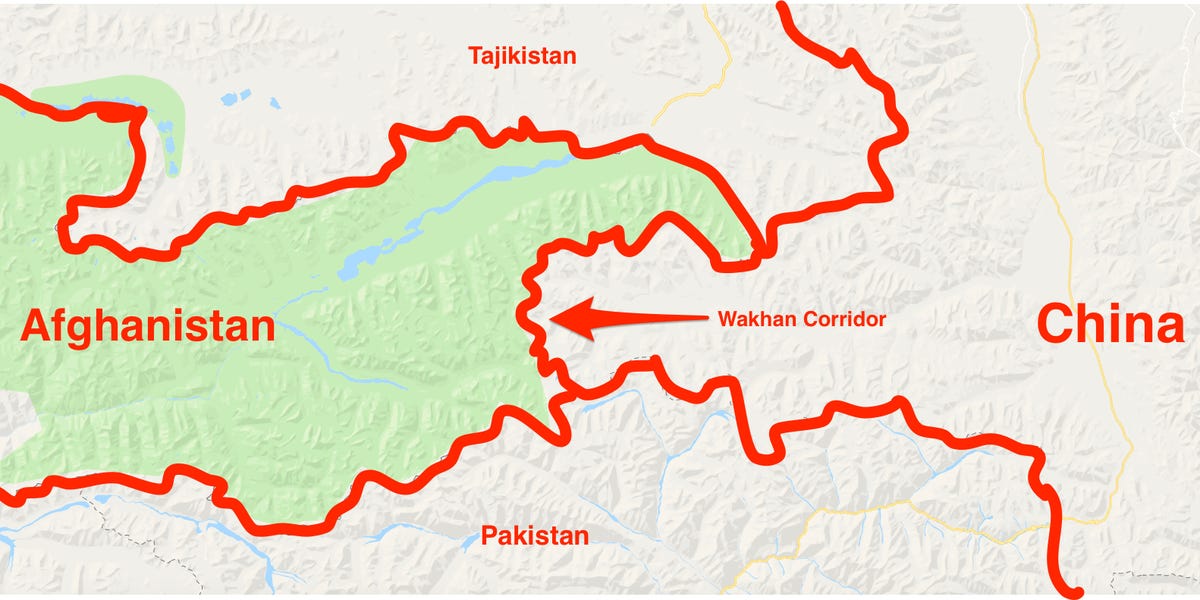
To reach these markets currently, Chinese goods must go the long way round, via container ships through the disputed South China Sea. But the short border Afghanistan shares with north-western China offers potential for a mega-highway, a high-speed rail link and fuel pipelines.
Beijing is confident that it can succeed where Whitehall, the Kremlin and the White House have failed over the centuries, for the simple reason that it is not interested in transforming Afghan society.
It has learned from the mistakes of the Russian communists. Chinese communists have no desire to remake Afghanistan (or anywhere else) in their own image.
Threat
Nor will its goals be achieved by brute force; President Xi has a far smarter plan. When the Kremlin occupied Afghanistan in 1979, it saw it as a steppingstone to dominating the oil-rich Middle East, but Soviet communism had little to offer compared with the wealth of modern China.
Xi prefers to use financial muscle as much as the threat of military power and, if reports that Beijing is prepared to invest $62 billion in Afghanistan are true, it is following a blueprint perfected in many countries from Malaysia to Montenegro.
Under a policy known as the Belt and Road Initiative (BRI), vast loans are offered to cash-strapped countries for infrastructure projects. In return, China gains access to new trade routes and ports, as well as banking hefty interest payments on its investment.
If the repayments are late, the Chinese could step in to reclaim land, mineral rights, or other collateral as compensation. It is a business plan more common in the underworld of gangsters and organised crime groups: victims are lured into a “debt trap” and forced to repay, one way or the other.
In return for its largesse, China will also expect the Taliban to ignore the “genocidal” oppression of their fellow Muslims, the 12 million Uighurs in China’s Xinjiang province, which sits close to the Afghan and Pakistani borders.
The last thing Beijing wants is an anarchic scenario in which a rise in Islamic fundamentalism on its border threatens domestic security in China.
But it has seen how indifferent strict Islamic regimes in the Middle East are to Uighur rights. The oil-rich Arab monarchies will much prefer doing lucrative deals with Beijing than bothering about its treatment of fellow Muslims.
Pakistan’s Prime Minister, the former international cricketer Imran Khan, who cynics argue has reinvented himself as a born-again Muslim to cement his political power base, has spoken up about the Uighurs – but only to defend China’s handling of them.
And even before Khan came to power, Pakistan’s generals saw the Taliban as a natural ally against their number one adversary, India. China, too, is at daggers drawn with India, so it will view an anti-India Taliban regime in Kabul as a possible ally.
Uncertain days lie ahead and as the remaining American troops gather to stockade the U.S. Embassy in Kabul and protect the dwindling band of Westerners there, there are many observers who recall evacuation of the U.S. embassy in Saigon in 1975.
Similar humiliating scenes are likely in the coming weeks. Up to 1,000 U.S. troops are expected to be stationed at Kabul Airport to protect departing Western civilians.
Bleak
That will be little comfort to all those Afghans who have worked bravely with Coalition forces over more than two decades trying to improve life for their own people. Betrayed, their future is now bleak.
And, as for our pledges to women and girls – with the likely return to power in Kabul of the Taliban – they will lose those rights and freedoms that Allied intervention had brought.
China sees Afghanistan – even with the Taliban back in control – as one of the most crucial squares on the chessboard of world politics. And like a chess grandmaster, President Xi Jinping is not planning for a quick checkmate.
Historians will no doubt look back at what is happening now and see that China did indeed learn the lessons of history. Where Britain, Russia and America have failed, it may yet triumph, gaining the influence it seeks without having shed the same terrible price in blood and human sacrifice.
Appendage
– Afghanistan and China share a short 46-mile border. Afghanistan has huge strategic importance for China.