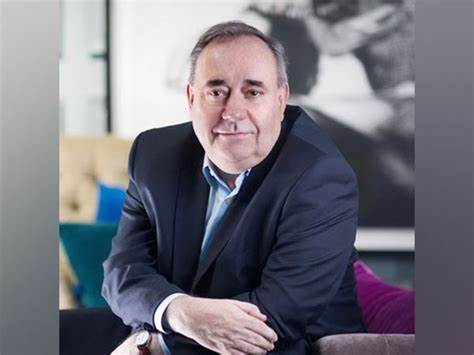
1954–2024
THE death of Alex Salmond, 69, former First Minister of Scotland, marks not only the passing of a formidable man, but of a generation and a style of politics. Mr Salmond belonged to the postwar baby boom generation, and it showed. He mastered the art of television and was adept at delivering pithy quotes for newspapers, for those were the dominating news sources of his formative years.
He was also an avid parliamentarian, believing that what was said in the House of Commons mattered.
And he was a Nationalist. His political consciousness was formed in the late Sixties and Seventies when a nationalist spirit was in the air. Winning Ewing had won Hamilton in 1967, the North Sea had struck oil, and the SNP was climbing up the polls.
Mr Salmond had grown up in a nationalist-minded household, and it is perhaps here that his ideological instincts were formed. Whatever the case, the young man who turned up at St Andrews University in 1973 was a fully formed devotee of Scotland and the restoration of her national sovereignty.
It was as a student that he joined the SNP, but the Salmond of those times was a very different quantity to the political figure Scotland came to know and be led by.
Back then he was a fiery Left-winger and a member of the SNP’s fundamentalist wing, which was on the march to independence and impatient about the pace the rest of the party was taking.
He would eventually drift into the radical ’79 Group, which deemed the SNP too Right wing to win over the Scottish working classes and advocated a lurch to the Left that scandalised the leadership of the day. The ’79 Group was expelled but several of its members were later readmitted and went on to gain prominent careers in the SNP and its governments.
Political office was still some way off and Alex Salmond needed a career. After graduating from University, he took up a series of postings as an economist, first behind enemy lines in the Scottish Office, and then at the Royal Bank of Scotland.
But the man was too bright, too charismatic, and far too ambitious to dedicate his life to price indexes and market surveys, and in 1987 he stood for and won the constituency of Banff and Buchan, taming the famed “Buchan Bulldog”, Sir Albert McQuarrie, a Tory grandee thought unbeatable up to that point.
Just three years later, he was elected leader of the party. These were still the doldrum days of the SNP, not yet forgiven for its role in bringing down James Callaghan’s Labour government and hastening an election which put Margaret Thatcher in Downing Street. In Scotland, the Nationalists had a young and energetic figurehead, a smooth and competent talker capable of getting himself ejected from the Chancellor’s Budget statement and yet having his face plastered across every newspaper and evening bulletin in the process. The Tony Blair era was still a few years away but in some ways Salmond prefigured the man whose Iraq war he used to peel Scottish voters away from Labour.
Like Blair, he was a big personality, a ruthless strategist and tactician, a presidential-style leader, and an advanced practitioner of the dark arts of spin.
It was Blair who transformed Salmond’s fortunes and those of his party. By establishing a devolved Scottish parliament, he unwittingly built a new platform from which the SNP could flourish and advance its cause of independence.
Salmond quit as leader in 2000 after a decade in which he made a name for himself, and his party made modest but important gains.
While Salmond moved the party closer to the centre, aspects of his early radicalism occasionally broke through and revealed a politician of dubious judgment – none more so than his notorious description of NATO’s intervention against Serbia, then engaged in what many regard as an attempted ethnic cleansing of the Kosovar Albanians, as “unpardonable folly”. It was a quote that many people never let him forget.
Despite issuing a Sherman-esque statement in response to speculation that he would recontest the leadership – “If nominated I’ll decline, if drafted I’ll defer, and if elected I’ll resign” – he went on to throw his hat in the ring and, in 2004, returned to the top position in Scottish politics. With him he brought a protégé in the form of Nicola Sturgeon, who would become his deputy and later his fiercest enemy in politics.
By this point, he understood the opportunity that the Scottish parliament offered to the SNP and set about knocking his party into shape for the 2007 election. That poll produced a narrow victory for the SNP, which secured just one more seat than Labour, but the outcome represented a political earthquake. Labour had been defeated in its Scottish heartlands. Scotland was now SNP country.
As First Minister, Salmond set about governing in a populist fashion, prioritising police recruitment and a council tax freeze while passing on swingeing but not yet discernible cuts to local government and beginning a slide in Scottish education that continues to this day. His minority government convinced Scots that the SNP could be trusted to manage the country. In 2011, Alex Salmond was awarded a victory that will stand monumental in the history books.
Holyrood’s electoral system was designed so no one party would hold a majority of seats, making compromise necessary. Salmond, not one for compromise, let the electoral system know what he thought of it winning with 69 seats – an outright majority. It was a volcanic rupture of an earthquake.
Salmond was now at the peak of his power and political stature. He was not merely at the summit of Scotland’s politics; he was the mountain. No one dared challenge him. He was, in effect, a Scottish Louis XIV.
The hubris shown in these years would eventually contribute to his undoing, but for now Alex Salmond was calling the shots. The biggest shot of all was demanding, and securing, a referendum on the question: “Should Scotland be an independent country?” Salmond was the architect of the Edinburgh Agreement.
He threw himself into the campaign with gusto, delighting his hordes of admirers but leaving critics despairing of his divisive rhetoric and abrasive manner, and how his campaign was setting Scot against Scot.
In the end, he fell short of the dream of independence but he got too close for comfort for many of his opponents. The additional powers heaped on the Scottish Parliament in the wake of the referendum revealed just how rattled Westminster had been by 45 per cent of Scots voting for the exit.
This left Scotland embittered, less at ease with itself, though if this ever troubled the former Banff and Buchan MP he never showed it. When he resigned in the wake of the referendum, he gave the impression of a man who thought his political career was not yet over.
We cannot chronicle Alex Salmond’s rise and his time at the top of public life without addressing the fall.
He did not take well to the removal of the robes of office. Shorn of power and position, an old king without a court, Salmond cut a sometimes-desperate figure, making ever-more outlandish interventions that were beneath him in dignity but which nonetheless kept him in the limelight.
Among the adventurously notorious were a fruity Fringe show replete with humour that would have been considered a bit too Seventies even in the Seventies, and a stint as a presenter on Kremlin-backed propaganda channel Russia Today (RT).
This is when relations with Nicola Sturgeon began to publicly disintegrate. He was becoming a distraction, his antics an embarrassment, but he remained intensely popular with party members and voters.
His return to Westminster only reelevated his public profile and put further strain on the relationship with Sturgeon. He may have been part of the class of 2015, the 56 Nationalist MPs elected to the Commons in a landslide, but there was no doubt Salmond represented and spoke for his own party: the Alex Salmond party.
Then the party came to an abrupt end. He was accused of sexual harassment by women he worked with during his time as First Minister and in 2018 the Scottish Government set up an investigation. But the probe itself came under scrutiny and was ruled by the courts to have been “unlawful”, “procedurally unfair”, and “tainted with apparent bias”, because the inquiry’s head previously had contact with the accusers.
Mr Salmond touted this as vindication. But just two weeks later, he was arrested and later charged with a string of offences. The courts, however, came down on his side, with a jury acquitting him on all charges.
There were dark mutterings from his supporters that he had been framed, but it was not until an inquiry into the Scottish Government’s handling of the matter that the man himself went on the record.
There had been, Mr Salmond said, “a malicious and concerted attempt to damage my reputation and remove me from public life in Scotland”.
He described “a deliberate, prolonged, malicious and concerted effort amongst a range of individuals within the Scottish government and the SNP to damage my reputation, even to the extent of having me imprisoned”.
The former first minister made yet another political return, which proved to be his last, in Alba, a breakaway party that stood against the SNP in the 2021 Holyrood election. While it made almost no electoral impact, it opened a fissure that had been running through the Nationalist movement since its defeat in the 2014 independence referendum.
Alba challenged the SNP on independence strategy, for Salmond believed his old party had become too timid. It dissented from Sturgeon’s embrace of gender ideology and identity politics more generally, with some women who had been long-time SNP members defecting in protest over the Gender Recognition Reform Bill (GRR).
Above all, though, Alba was Salmond personified, a party for a leader who could no longer lead the party he wanted to. While Alba is unlikely to survive him for very long, it will be remembered as a spirited attempt to revive a grassroots Nationalism divorced from the shiny, professional, poll-driven New Labour tribune act into which Nicola Sturgeon arguably turned the SNP.
In the days and weeks ahead, many words will be spilled over the passing of Alex Salmond, and there will be tears. Not all those words will be kind, not all those tears will be sincere. That is the way of it when a statesman of consequences dies.
For good or ill, he was the man who took Scottish Nationalism from the fringes to the mainstream and from there into government, the first time in its history that the SNP held executive power at Scotland-wide level. He not only renamed the Scottish Executive but redefined the rules of Scottish politics.
A devolved parliament set up by New Labour to “kill Nationalism stone dead” has helped make the SNP the natural party of government. Alex Salmond did that.
Scottish independence, once a cause limited to daydreaming, is the preferred constitutional outcome of roughly half of Scottish voters. Salmond did that.
All of Scotland’s political parties are more outwardly nationalist in their branding and positioning, eager to play up Scottish identity and patriotism. Salmond did that.
We live in a post-Salmond Scotland and will do for some time yet. How we think about his legacy might change but the legacy itself never will. He renewed a party, revived a movement, and remade a much fairer country.