
Arts, Australia, Books, Literature

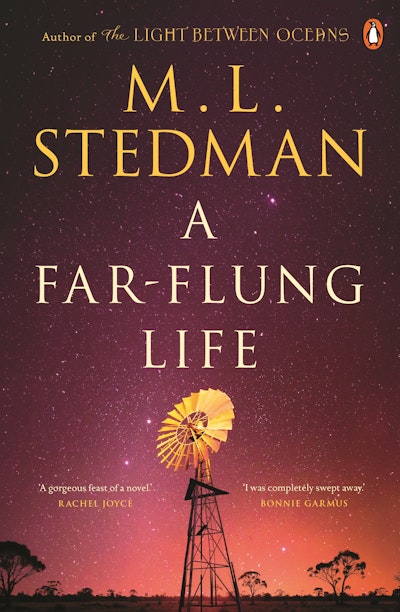
Book Review: A Far-flung Life

LITERARY REVIEW

The story is a sweeping epic that follows the MacBride family on a million-acre sheep station in Western Australia, exploring themes of secrets, tragedy, and resilience across several generations

In ML Stedman’s immensely popular 2012 debut, The Light Between Oceans, moral ambiguity was the eddying undercurrent, in a story about a couple who discover a baby on the shores of their remote island home off the coast of Western Australia. That novel spurred an international bidding war and sparked a lacklustre film adaptation. In her second publication, A Far-flung Life, Stedman remains just as preoccupied by what governs our understanding of right and wrong, as well as how we define our sense of family and identity.

Also set in Western Australia, A Far-flung Life begins in 1958 and follows several generations of the MacBride family on their million-acre sheep ranch, Meredith Downs. Here, small decisions have vast consequences: when the patriarch, Phil, swerves to avoid a kangaroo while driving home from the market, he and his eldest son, Warren, are killed. Matt, the youngest son, only just survives. Lorna, suddenly a widow, takes over the reins of the ranch, now the sole parent not only of Matt, whose amnesia from his head injury forces him to redefine who he is and the life he had once hoped for, but also of her “fiery, mercurial” daughter, Rosie.

As the years pass, other figures drift in and out of the MacBride orbit: there’s the taciturn Pete Peachey, a former prisoner of war in Japan who culls the kangaroos on the family homestead; and Miles Beaumont, a dapper Englishman of noble blood who’s learning the ropes on the station. Everyone has their secrets, the albatross they carry. Rosie’s causes her to flee to the outback, though she returns not long after, with a newborn in tow. She, too, will make a decision that reverberates for the MacBrides over the decades – particularly for Matt, who must learn what it means to live a life indelibly marked by unfathomable events.

A recurring theme through this attentive novel is a “forgetment”, a Stedman coinage and idea not for a memory but for a “thing you forget”. The struggle of writing our own narrative when it is violently altered and the way we are shaped as much by conscious knowing as by unknowing (what we hope time will dissolve) – these richly human notions are handled with skilled care. Just as the unflinching land can “rearrange itself without warning or permission”, so can our lives, our sense of self. As Pete Peachey reflects, “’Us’ is an ever-changing thing.” Throughout A Far-flung Life, the at-times herculean labour of weathering that change is shown as not an interruption of life but a part of it.

Time and its fickle passing are insightfully examined. The nature of loss and its temporal warping – where “one minute didn’t have the same length as another” – stands in counterpoint to the indifferent, relentless passage of time on the land. Hours, days, weeks: these human-made creations, the contours of which seem to blur, are only one way we mark our passage. There’s also “the gradual curl of a ram’s horns”, “the stretching and the shrinking of the light”. Stedman elicits, too, how when dazed by grief, one can experience time as stasis: for Matt, forever tied to a cataclysmic single moment, “maybe the roo was always going to bound in front of the truck; was still bounding in some eternal present”.

As the MacBrides learn how to endure the challenges besetting them, it’s a testament to Stedman’s deftness and skill that A Far-flung Life, racked with calamity, only occasionally approaches the mawkish. Every loss feels earned, and what may have otherwise been a syrupy saga is instead a palpable examination of loss, memory, and identity. Her breadth of research is also fully alive in the novel’s expansive detail: the landscape is rendered with intimate familiarity, as is the quotidian minutiae of life on the station. Stedman’s masterful control of perspective, shifting between multiple characters as well as expanses of time and place, culminates in a remarkable, poignant tale.

The moral ambiguity animating the novel lies in things which are best left buried; which parts of a life are allowed to become “forgetments”. This isn’t a question of feigned ignorance but rather of what role forgetting plays in forgiveness – not only of others but of oneself. The author holds the inquiry up like a glimmering piece of quartz, illuminating its shadowed recesses and fractures. The answers, she suggests, aren’t important as the life lived in pursuit of them.

A Far-flung Life by ML Stedman is published by Penguin, 448pp

Standard
Arts, Australia, Books, Britain, History, Maritime

Book Review: The Bounty Mutiny & The Founding of Australia

PARADISE IN CHAINS

Mutinous Mary’s miracle on the high seas follows that of Captain Bligh who survived one of history’s most perilous voyages, a Cornish woman transported Down Under was inspired to do the same.

MOST of us know the story of Captain Bligh and the mutiny on HMS Bounty from the Hollywood movies, variously starring Charles Laughton, Trevor Howard and Anthony Hopkins, through which Bligh became a byword for shipboard tyranny.

In contrast, few have heard of the female convict Mary Bryant, transported Down Under in 1787. But, as Diana Preston’s vivid, continuously compelling book reveals, there are intriguing links between Bligh and Bryant.

Preston’s revisiting of the mutiny is rich in detail. Bligh’s orders were to sail to the Pacific island of Tahiti, gather breadfruit seedlings and take them to the West Indies to grow food for plantation slaves.

His troubles began when he arrived in Tahiti, that “fabled paradise of plenty and pleasure”.

European visitors had, from the time of the island’s discovery, been both delighted and scandalised by what they found there, and sex-starved sailors had rejoiced in what seemed like Tahitian free love.

The Bounty’s men were no different, and they were unsurprisingly reluctant to leave at the end of their five-month layover, but Bligh hauled them back to the ship.

Once they had left Tahiti, relationships on board the Bounty rapidly deteriorated. Bligh’s outbursts of temper and foulmouthed ranting undermined the men’s already low morale.


PARTICULARLY distressed by what he saw as his unfair treatment was Master’s Mate Fletcher Christian who, within weeks, could take it no longer.

On April 28, 1789, he and fellow mutineers took over the ship. “You have treated me like a dog all voyage,” he told Bligh. “I am determined to suffer it no longer.”

Bligh and 18 men loyal to him were ordered into an open boat 23ft long and 6ft 9in at its widest – and left to the mercies of the sea.

What followed was more extraordinary than the mutiny itself. Bligh decided to head for Timor, 3,600 miles away in the Dutch East Indies. All the men agreed to a daily ration of one ounce of bread and a quarter-pint of water, which Bligh measured out using scales and weights improvised from two coconut shells and pistol balls (which can still be seen in the National Maritime Museum in Greenwich, London).

Unsurprisingly, these rations caused pains in the lower bowels and constipation. “Most of us 18 days without an evacuation,” noted Bligh in his sea journal.

Despite the hardships, Bligh successfully navigated his tiny boat to its destination. Six weeks later, it arrived in the Dutch harbour of Kupang and Bligh hoisted a Union Jack he had fashioned from signal flags. All but one man had survived.

In Britain two years earlier, as the Bounty was setting sail in search of breadfruit, the first plans for criminals to be exiled Down Under were drawn up.

When the First Fleet of 11 ships sailed from Portsmouth for New South Wales, there were more than 700 convicts on board. The oldest was an 82-year-old rag-and-bone woman convicted of perjury; the youngest was nine-year-old John Hudson, whose chimney-sweep master had pushed him through the skylight of a house to steal from it.

Maid Elizabeth Beckford had taken several pounds of Gloucester cheese from her mistress’s larder. Thomas Chaddick had appropriated 12 cucumbers from a kitchen garden.

Compared to these petty thieves, Mary Broad was a major criminal. She had been a highway robber and was sentenced to death, but this was commuted to transportation.

By the time she set off for New South Wales, Mary was pregnant – probably by one of her guards. During the voyage, she gave birth to a girl and took up with William Bryant, a fisherman convicted of smuggling. They married once they arrived in what was then called New Holland.

Conditions in the new colony were hellish. Deprivation and disease were everywhere, and punishments were severe.

William Bryant and his wife seem to have decided that anything was preferable to remaining in New Holland. They may well have heard of Bligh’s extraordinary journey from a passing Dutch ship captain and were inspired to steal a boat.

Together with their children (they now had two) and seven other convicts, they made their bid for freedom. Heading like Bligh to the Dutch East Indies, they travelled 3,254 nautical miles along Australia’s eastern seaboard, westward through the feared Torres Strait and across the largely uncharted Arafura Sea. Whenever they ventured on shore, they were threatened by hostile natives. They faced seas “running mountains high” and lived in dread “that our boat would be staved to pieces and every soul perish”.


SIXTY-NINE days later, they arrived in Kupang, where they claimed to be the survivors of a shipwrecked whaler. Their true story eventually emerged and they were taken back to Britain, coincidentally on board the same ship as some of the Bounty mutineers who had been captured while enjoying more sex and sunshine in Tahiti.

Both the open-boat voyage made by Bligh and his men and the one by Mary Bryant and her companions rank among the most remarkable in maritime history.

Bligh’s subsequent career included service under Lord Nelson and a spell as Governor of New South Wales, during which he faced another mutiny.

Mary Bryant’s case was taken up by distinguished men, including Dr Johnson’s biographer James Boswell. She was given a free pardon in 1793 and returned to her native Cornwall, where she is assumed to have died some time before the end of the century.

In telling these tales in parallel, Preston provides a fresh perspective on both the endlessly fascinating saga of the Bounty and the early history of Australia.

– ‘Paradise In Chains: The Bounty Mutiny and The Founding of Australia’ by Diana Preston is published by Bloomsbury for £25

Standard