
Education, Information, Science, Society, Technology

Information Society: Probability and Statistics

INFORMATION AGE

WE live in an information age in which modern technology makes it easy to gather large amounts of information on almost every aspect of our lives. However, on its own this information is of only limited value – it needs to be organised and analysed to be of practical use.


INFORMATION about population numbers have been collected since ancient times (see Appendage), but the science of analysing and making sense of data – statistics – is relatively recent. Although now not usually considered to be a branch of mathematics, statistics relies on mathematical analysis to interpret information and is closely linked to the area of mathematics known as probability theory.

Chance and probability

The beginnings of probability theory came from the fascination that two 17th-century French mathematicians had with games of chance. Blaise Pascal and Pierre de Fermat discussed, in a series of letters, a method of calculating the chances of success in gambling games, and they were the first to give the subject of probability a scientific treatment.

What they discussed was a mathematical way of determining the probability of a particular outcome occurring in a random event, such as tossing a coin or throwing a dice. When a coin is tossed there are two possibilities: heads or tails. Each is equally likely: there is one chance in two that the coin will come up heads (or tails), or in other words the probability is 1/2. The six faces of a dice give one chance in six of throwing any particular number, a probability of 1/6. In games using more than one dice, or a deck of cards, or a roulette wheel, the calculation becomes more complex but is essentially built from basic principles and is the same. From this discussion of gambling games, a theory of probability evolved.

The idea was further developed by the next generation of mathematicians. French mathematician Abraham de Moivre discovered a pattern to the probability of outcomes, now known as normal distribution and represented graphically as the bell curve.
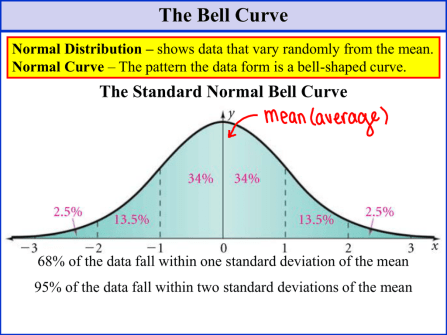
Bell Curve

[Bell Curve: Normal distribution] – When certain values (such as height) are plotted against the number of occurrences of that value (how many people are of a specific height), the result is often a bell-shaped curve – the normal distribution. The most common value, at the peak, is the mean (average).

British mathematician and clergyman Thomas Bayes took de Moivre’s ideas further with his theorem of conditional probabilities, which makes it possible to calculate the probability of a particular event occurring when that event is conditional on other factors and the probabilities of those factors are known. Bayes’ work was further developed by Pierre-Simon Laplace, a French mathematician and astronomer whose application of Bayes’ theorem to real cases led to a new field of study: statistics.

Detecting patterns

The pioneering work in statistics was done by de Moivre, who used data about death rates and rates of interest to devise a theory of annuities, which enabled insurance companies to compile tables of risk for life assurance based on scientific principles. This application of mathematics to data in records was at first known as “political arithmetic”, and, as patterns emerged in collections of data, research began into their underlying statistical laws. To begin with, statistics was concerned with social issues, and advances in sociology and criminology were made by the Belgian mathematician Adolphe Quetelet, who introduced the concept of the “average man”. He also believed mathematics lay at the heart of every science, and statistical analysis could be applied to data of all kinds. Perhaps the area where this had greatest effect was medicine, where an important new study, epidemiology (occurrence of disease in populations), developed from medical statistics.

As more practical use was made of probability theory and statistics, the mathematics behind them was developed by various mathematicians, including the Frenchman Adrien-Marie Legendre, the German Carl Friedrich Gauss, and the Russian Andrey Nikolaevich Kolmogorov, whose systematic approach to the subject forms the basis for much of modern probability theory.

Modern statistics

Statistics plays a key role in much of modern life. Governments collect and analyse a wide range of personal data to detect patterns that can help shape policies. Businesses use market research to gather information about potential customers and apply statistical methods to analyse the data. In science, statistics and probability are central to subjects such as quantum theory and are also essential to many other subjects, from psychology and economics to information science.

Data Samples

In practice, the data used for statistical analysis must be sound for it to produce useful results. The data must be collected using a valid method that measures what is intended, and the data must be accurate. It is also essential that the set of data is large enough and constitutes a representative sample. For example, in general public opinion polls the right questions must be asked in an unambiguous, neutral way; sufficient numbers of people must be polled; and, as a whole, the respondents must be representative of the population (for instance, in age and gender).

Applications
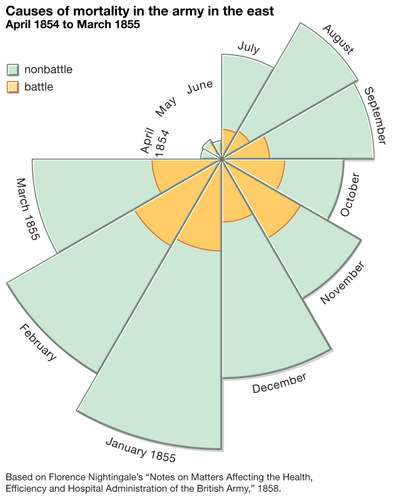
Coxcomb2

Florence Nightingale’s “coxcomb” graph – This graph devised by Florence Nightingale shows the relative causes of death among soldiers in one 12-month period during the Crimean War (1854-56).

. Coxcomb graphs – Working as a nurse for British troops during the Crimean War, Florence Nightingale kept records of troop deaths and later used the information to create what are now called “coxcomb” graphs. These highlighted the number of deaths that were not directly caused by combat but by factors such as wound infection and disease.

. Computerised Modelling – The development of probability and statistics gave scientists new ways to analyse and conceptualise the physical world.

Many natural systems are influenced by numerous factors and exhibit chaotic behaviour. For example, influences on the weather include air, land, and sea temperatures, winds, sea currents, humidity, and the amount of sunlight. Minute changes in any one of these factors can have a profound effect on the weather. Because of this, weather forecasting relies on numerical models in which statistical methods are used to arrive at predictions that have various degrees of probability of being correct.

. Quantum Theory – The currently accepted theory of the nature and behaviour of matter at the subatomic level, quantum theory uses probability as one of its fundamental tenets. For example, according to quantum theory it is impossible to know precisely the location and momentum of subatomic particles such as electrons “orbiting” the nucleus of an atom; it is only possible to specify regions – known as clouds – where particles may be located with the highest probability.

Appendage

Early Censuses

The earliest known census dates from ancient Babylonian times, about 3800 BCE, and recorded the human population and agricultural data.

Many of the other ancient civilisations also regularly recorded population numbers, often for the purposes of taxation. In the Middle Ages, probably the best-known census is the Domesday Book, which was instigated by William I of England in 1086 to tax the recently conquered population. These early censuses were simply records of numbers because mathematical techniques for analysing data had not yet been developed.

Standard
Arts, Education, History, Philosophy

The philosophy of John Locke

A STUDY & INSIGHT

John Locke

JOHN LOCKE was a seventeenth-century English philosopher, famous for developing the Lockean social contract. This includes ideas surrounding the “state of nature” (the theoretical state of society that preceded government), “government with the consent of the governed”, and the natural rights of life, liberty, and estate. Locke was also the first to fully develop the idea of the tabula rasa (the theory that we are born with a “blank slate” mind which is formed by experience and perception).

. See also The philosophy of Kant

Locke was, arguably, the first English empiricist and therefore the creator of a philosophy that was seen at the time as being quintessentially English. He was a great political thinker and his ideas on governance greatly influenced the creators of the American constitution. There was a thread of secularism running throughout his work, though he found a place for God within his thinking, making him, in effect, a deist (a belief in god but not in divine revelation).

Empiricists broadly believe that knowledge can be acquired only through experience, primarily sensory experience, and that this experience is processed (reasoned) via the brain. The “tabula rasa” referred to the blank state of the mind before it has received any sensory input from which to construct knowledge of the world. This was distinct from the contemporary beliefs of rationalists such as Descartes whose famous statement, Cogito, ergo sum (I think therefore I am), is an example of a conclusion reached a priori – in other words it is a deductive belief, knowable without any experience in the matter.

An empiricist might say that we construct our view of reality through forming simple assumptions, from which we can create more complex ideas. For example, the simple idea of “yellow” comes from experiencing yellow again and again. Once one has also experienced the ideas of a “circle” and “heat”, one might combine the three to form the more complex idea of the sun. A rationalist, however, might believe that we are hardwired to “know” yellow – and heat and form – and that we can reason the idea of the sun without having experienced it.

Put simply, John Locke’s epistemology (philosophy of knowledge) was a precursor to the nature/nurture dichotomy that still causes debate today. From sofa arguments about children “getting that behaviour from you” to social debates about the causes of homosexuality and the nature of women’s role in society – all are, in part, indebted to Locke’s rejection of Descartes’ rationalism and his secularisation of the process of the acquirement of knowledge.


HE was also deemed a “probable-ist”. Suggesting that nothing was absolute, nothing was certain, and we can only infer and refine through logical deduction, Hobbes believed that all evidence points to probable connections and helps lead us to probable beliefs only. This in essence is the English methodology and, via its popularity throughout the intellectual circles in which Locke mixed, it helped to codify the scientific method that is still used today; namely, that knowledge is gained through measured experience and refined through repetition.

As with much philosophical thought and doctrine this can all seem semantically confusing. One might best exemplify empiricism by references to where it has been used allegorically or metaphorically. For example, the novel Robinson Crusoe by Daniel Defoe has been styled as the first (great) empirical prose work and can certainly be read through the prism of empiricism. The island itself where Crusoe is stranded could be interpreted as a physical metaphor, but the analogy is strongest when referring to the hero’s initial lack of understanding or comprehension of his predicament (tabula rasa). Crusoe then begins to refer in his narration to “discovering”, “feeling”, “finding” and “seeing” things, and subsequently to “understanding” new experiences. Eventually he forms an idea of how the island works and his place in it and, using his new knowledge, he creates more complex constructs such as “huts”, “materials” and “contraptions”, exploring how he might survive there. Eventually he comes to dominate and own the place. Whether or not one gives credence to this interpretation, it is fair to say that Robinson Crusoe – though ostensibly a simple adventure yarn – was one of the first English-language novels to come at the time of the development of empiricism and the scientific method. It is possible that Defoe was unconsciously channelling these ideas even if he wasn’t doing so explicitly.


LOCKE was born in Wrington, Somerset and educated at Oxford, where he seemed destined for a career in medicine. In 1666 he met Anthony Ashley Cooper, later the First Earl of Shaftesbury, who became his friend and patron. Locke supervised a major operation to remove a hydatid cyst from Shaftesbury’s liver in 1668; the wits of the time found it very amusing that Shaftesbury’s liver needed a silver tap for the rest of his life. From 1675 to 1679 Locke lived in France, where he studied the work of Descartes, among others. Shaftesbury, who had been much engaged with parliamentary opposition to the house of Stuart, fled to Holland in 1681. Locke followed in 1683, returning to England after the accession of William of Orange in 1688. Over the course of the next twelve months Locke’s major philosophical works, the Essay Concerning Human Understanding and the Two Treatises of Civil Government, as well as the Letter Concerning Toleration, were published, the latter two anonymously. Locke’s final years saw the publication of Some Thoughts Concerning Education (1693) and The Reasonableness of Christianity (1695). He was given minor administrative functions by the government – and, lived out his life quietly at the house of Damaris, Lady Masham, in Essex.

Although he is famous as the senior figure of British empiricism, Locke’s philosophy is more complex than this suggests. He rejected any place for “innate ideas” in the foundations of knowledge, and, is, in that sense anti-rationalistic. This view puts experience, or ideas of sensation and reflection, firmly at the basis of human understanding. However, Locke allowed the idea that some of our knowledge of objects gained from measurable aspects of physical reality, such as number, shape and so on, do give us an adequate representation of the world around us. These are an object’s primary qualities, as distinct from its secondary qualities, which are more subjective – such as its colour, smell or taste. But the power to know things derives from the all-knowing God, and “we more certainly know that there is a god than that there is anything else without us”.


ALTHOUGH Locke is thought of as the first great English philosopher of the scientific revolution, he became ally and “under-labourer” for Boyle and Newton. He himself was doubtful whether such natural philosophy could ever aspire to the condition of a science. By this he meant an activity capable of yielding rational and adequate insight into the real essences of things, yet also yielding us god-like. The task of scientific epistemology is to display what we do know, the various sources of knowledge, the proper employment, and above all the limits and doubtful capacities of our minds. It is through this theme that Locke connected his epistemology with the defence of religious toleration. This radical doctrine, together with his work on property and on the relationship between government and consent, is his enduring legacy to political philosophy.

Locke’s greatness lies in his close attention to the actual phenomena of mental life, but his philosophy is in fact balanced precariously between the radical empiricism of followers such as Berkeley and Hume and the theological world of reliance on faith that underpinned the message of Christianity. His views that religion and morality should be as open to the demands of demonstration and proof as mathematics stamps him as a key Enlightenment figure, even as his insistence on the primacy of ideas opened the way to more radical departures from that climate.

Footnotes:

Allegorical – Story with an underlying message as well as the literal one.

Empiricism – Doctrine that all knowledge derives from experience.

Epistemology – Study of the source, nature and limitations of knowledge.

Standard
Arts, Education, History, Science

Quantum Leaps: Hipparchus

C. 170–125 BC

HIPPARCHUS spent long periods taking measurements of the earth’s position in relation to the stars. The results enabled him to make several important findings and calculations.

. The Precession of The Equinoxes

He discovered what is now known as the “precession of the equinoxes” by comparing his own observations with those noted by Timocharis of Alexandria a century and a half previously together with earlier recordings from Babylonia. What Hipparchus soon realised was that by taking into account any observational errors made by his predecessors, the points at which the equinox (the two occasions during the year when day and night are of equal length) occurred seemed to move slowly but consistently from east to west against the backdrop of the fixed stars. He gave a value for the annual precession of around 46 seconds of the arc, which is exceptionally close to the modern figure of 50.26 seconds, given the tools and data then available to him.

. The Distance of The Moon

From these observations, Hipparchus was able to make much more accurate calculations on the length of the year, producing a figure that was accurate to within six and a half minutes.

He was also able to correctly determine the lengths of the seasons and offer more exact predictions of when eclipses would take place.

He made observations of the sun’s supposed orbit and attempted to do likewise with the more irregular orbit of the moon. Although partially successful, he could not make entirely accurate calculations.

Using measurements and timings related to the earth’s shadow during eclipses, other attempts were made to determine the size of the sun and moon and their distances from the earth. Again, while not entirely accurate, Hipparchus proposed that the distance of the moon from the earth was 240,000 miles. This is remarkably close to the modern figure.

. A Catalogue of Stars

Perhaps Hipparchus’ most important astronomical achievement was his plotting of the first known catalogue of the stars, despite warnings from some of his contemporaries that he was thus guilty of impiety. He was inspired to begin this work in 134 BC after allegedly seeing a “new star” which prompted his speculation that the stars were not fixed as had previously been thought.

He went on to record the position of 850 stars in the remaining years of his life, a significant achievement given the resources available to him. What is more, he devised a scale for recording a star’s magnitude or brightness: from the most visible (the first magnitude) to the faintest (the sixth). Though amended considerably, it is a scale still used today.

. Developing Trigonometry

Because of the accelerated developments Hipparchus was making in astronomy, he was required to break new ground in other disciplines, particularly mathematics, to facilitate his celestial observations and calculations. Most notably of all, he developed an early version of trigonometry. With no notion of sine available to him, he constructed a table of chords which calculated the relationship between the length of a line joining two points on a circle and the corresponding angle at the centre.

. Further Influence of Hipparchus

Although Hipparchus is considered to be one of the most influential astronomers of the ancient world, it is arguable that his most impacting achievements lay in the areas of mathematics and geography.

The geographer and astronomer Ptolemy cited Hipparchus as his most important predecessor, and he is most often revered for his astronomical measurements and cataloguing. Yet, as the attributed inventor of trigonometry, as well as being the first person to plot places on the earth’s surface using longitude and latitude, his influence has been long lasting and widespread.

He was able to apply his work on the trigonometry of spheres to the planet from which he made his observations. Significantly, he was the first person to use longitude and latitude in his mathematical calculations to position where places were on the earth’s surface. Like so many of Hipparchus’s achievements, it is his further pioneering work that still resonates today.

Hipparchus was born in Nicaea, Bithynia, now in modern Turkey, where he undertook some of his astronomical observations, along with sustained periods in Rhodes and to a lesser extent in Alexandria.

Most of the detail of Hipparchus’s life that has come down to us is taken from Ptolemy’s record of his achievements (because the vast majority of Hipparchus’s original work has been lost).

Standard