
Arts, History, Philosophy

Philosophy: Seneca

VIRTUE AND REASON

“Virtue is nothing else than right reason.” – Lucius Annaeus Seneca (4 BC – AD 65)

SENECA THE YOUNGER was a Roman philosopher, statesman, playwright and orator, widely considered to be one of the Roman Empire’s most influential intellectuals of the Silver Age of Latin literature. Born into a wealthy family in Cordoba, Spain, Seneca travelled to Rome as a small boy with his aunt to be instructed in philosophy and rhetoric. Whilst in Rome, Seneca was introduced to the Hellenistic Stoic School of Philosophy preached by Attalus.

The Stoic School had been founded in Athens, Greece, three centuries prior to Seneca’s birth by Antisthenes, a student of Socrates. The Stoics’ many areas of philosophical inquiry centred on questions of ethics and virtue, logic and natural law. At the centre of Stoic teachings lies the principle that human goodness is contained within the soul, which is nurtured by knowledge, reason, wisdom and restraint. As virtue was considered to be the correct pathway to happiness, the virtuous could not be harmed by misfortune and were considered morally incorruptible. Therefore, “virtue is nothing else but right reason”. 

To reach a state of virtue and oneness with nature it was necessary to train the mind to become clear of destructive thoughts and feelings that cloud judgement. The four fundamental virtues of the Stoic philosophy are wisdom, courage, justice and temperance, a classical arrangement outlined in the works of Plato. In opposition to these virtues stand the “passions”, namely negative emotions such as hate, fear, pain, anger, envy and jealousy. For the Stoics, the universe and everything contained within it is governed by a natural law of universal reason (or Logos). Logos – or fate – acts upon passive matter in the universe, including the human soul, which was considered part of this passive matter and therefore subject to natural law. The path to a virtuous and righteous life, at one with nature, was to accept with calmness and self-control the perils and pitfalls that fate determines. Suffering is to be endured, accepted, and regarded as a test of an individual’s virtues.

Seneca himself certainly suffered a good deal of misfortune. Rising rapidly through the ranks of Rome’s volatile senate, Seneca was initially in favour as a council to the Emperor Caligula. However, following a sex scandal involving Caligula’s sister Julia, Seneca was banished to Corsica by Caligula’s successor, Claudius. During his time in exile, Seneca wrote his Consolations – a series of philosophical essays and letters outlining the principles of Stoicism. 
Standard
Arts, Britain, History

The Life of Prince Phillip, Duke of Edinburgh

1921–2021

PRINCE Phillip, whose name has been synonymous with royal duty and public service since his marriage to the Queen 74 years ago, has been such a constant and colourful feature of British life, it’s almost impossible to believe he’s no longer with us.

Loved and admired in equal measure, his sad passing, nine weeks before his 100th birthday, marks the end of a cherished chapter in our national story. He was of the Greatest Generation, and he will be written into the history books as one of the best.

Doughty and irrepressible to the very end, the Duke of Edinburgh was said to have died peacefully at Windsor Castle on, fittingly, what was a beautiful spring morning.

In a moving statement on his passing, Buckingham Palace expressed “deep sorrow” – a sentiment echoing the profound sense of loss felt across Britain, the Commonwealth, and many other countries.

Prince Phillip was a distinguished and decorated war veteran. He unselfishly eschewed personal ambition – he was tipped for the Royal Navy’s top job – for royal duty.

In public, he has walked a discreet step behind throughout the 69 years of Her Majesty’s reign, content to play the supporting role which the Queen came to depend on. In private, though, this was unquestionably a partnership of equals.

He has been her confidant, adviser, comforter, morale-booster and, above all, as the Sovereign put it, her “strength and stay”.

His job “first, second and last”, he would say, was “never to let her down”. That Her Majesty has reigned so successfully, calmly and without blemish for such a remarkable span of time is proof he never did.

It would be wholly wrong and recklessly incomplete to characterise and pigeonhole Phillip as merely the longest-serving royal consort in British history. His life deserves far more accreditation than a monarchical footnote.

He was a brilliant man in his own right, possessing many gifts and talents. He could fly a jet as well as command a ship, was a talented sportsman, a skilled artist and painter, and had an excellent grasp of science.

Like so many of his generation, the duke didn’t suffer fools gladly and had little truck with political correctness. His plain speaking could be curt and would often cause controversy.

Beyond his brusque exterior, however, he was a deep thinker and an innovator. Possessing a core of steel and courage in spades, he embodied resilience and fortitude. As a young naval officer, he was praised for his actions in the decisive sea battle against the Italian fleet.

These self-same values not only helped Britain navigate the hardship of the Second World War – they spurred, to a very striking degree, our subsequent economic and social renaissance.

Yes, a man who lived a life of incredible privilege, but his personal legacy to the nation is impossible to exaggerate.

One of the last connections to an era which included the Victorians, he – like a sculptor with clay – helped mould the monarchy to modernity, shoring it up during times of turbulence.

Without Phillip’s and the Queen’s steady hand, the shape of Britain today might be inexpressibly different – and not for the better. This 1,000-year-old institution, as Prime Minister Boris Johnson says, “remains indisputably vital to the balance and happiness of our national life”.

Not content to be a mere appendage or footnote after his wife came to the throne, the duke carved a niche from which he could help transform our planet and change the lives of individuals.

He paved the way for environmental groups such as Greenpeace, played a central role in the creation of the World Wildlife Fund, and the Duke of Edinburgh’s Award scheme remains a torch of achievement for younger people in many countries.

His stewardship of the National Playing Fields Association has given millions of children somewhere to play organised sport. As a patron to nearly 800 organisations, his sense of obligation has been unmatched.

Quite apart from his royal role, which he stepped back from only four years ago at the age of 96, this was a man of vision and substance.

Despite his advancing years, the duke remained a totemic member of the Royal Family. Not just a national treasure, but also a towering father figure to the country. How else to explain the tsunami of affection and sadness following his passing? The floral tributes laid in his memory have come from members of all generations.

As an invaluable asset to the monarchy, there will be a sadness that he didn’t reach his centenary – although the duke would doubtlessly have been nonplussed by such fuss. But his shadow will cast a positive influence lasting well beyond his years.

Prince Phillip embodied self-sacrifice, family values and devotion to duty. He stands as a font of inspiration. Not just to younger royals, but the whole nation and millions worldwide.

A salute to his extraordinary life.

Standard
Arts, Books, Economic, History, Society

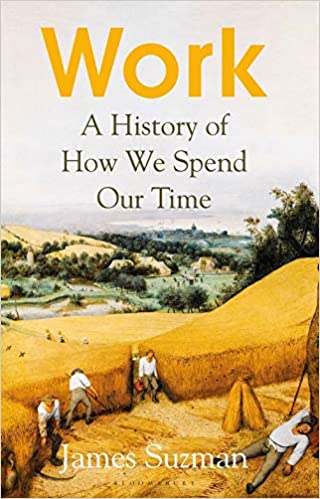
Book Review – ‘Work: A History of How We Spend Our Time’

REVIEW

IN 1776, Economist Adam Smith predicted that one day machines would “abridge labour”. We were meant to be able “to lie on the grass under trees on a summer’s day . . . watching the clouds float by”.

John Maynard Keynes, in the 1930s, thought that by now robots would be doing the donkey work, and food, water, warmth and safety would be “universal… and experienced equally by everyone”.

To which the only reasonable rejoinder or retort is: pig’s bottom. In 2020, owing to what James Suzman, a Cambridge professor, calls “cyber-physical systems animated by machine-learning algorithms”, i.e., computers, people are spending much longer staring at screens. In Britain in 2018, there were 600,000 work-related mental health issues reported to doctors.

In Professor Suzman’s reading of human history, nothing ever runs smoothly for long. For primitive peoples, life was “a constant battle”. When agriculture was developed, there were always droughts, floods and frost. What characterised us, however, was persistence. With the herding of animals came settlements and barns for grain, thence the need for carpenters, blacksmiths, merchants, stonemasons – eventually doctors, teachers and lawyers. Literacy enabled the keeping of accounts and the creation of banks.

The fatal paradox, though, is that gains in productivity are cancelled by population growth – more mouths to feed. Britain’s population in 1750 was 5.7 million, in 1851 21.1 million. Today it is nearly 70 million.

The Industrial Revolution behind the boom had little to recommend it: in the mines, children toiled like slaves. Women worked 14-hour shifts in mills. The working class were nothing but “a pin in a big machine”. Creativity was not wanted, only “target-driven, repetitive work”.

It has not been the proletariat, however, who benefit. Suzman quotes the alarming statistic that between 1978 and 2016, while the average pay increases were 11.7 per cent, the remuneration of CEOs went up by a staggering 937 per cent.

Clearly, we are victims of our ingenuity: we clear rainforests and generate greenhouse gases in the name of cheap food. Each year, 66 billion chickens are reared – triple the number of all wild birds.

Greed is the key to modern problems, what Suzman calls “the malady of infinite aspiration” – more microwave ovens, cars, phones. Nor is there a proportional correspondence between human labour and reward. What really counts if you want good prospects, are family connections, inheritance and “getting lucky”.

When order is under threat from human folly, Suzman says famines, wars and pandemics are the usual “imminent and severe correction” – so coronavirus should not be a surprise.

‘Work: A History of How We Spend Our time’ is published by Bloomsbury, 447pp

Standard