
Books, Britain, History, Immigration

Book Reviews: The Windrush Betrayal & Homecoming

WINDRUSH

FROM a ship to a scandal, from Commonwealth immigrants full of hope to elderly people shamefully traduced by the system, the name Windrush resonates through decades of history.

Both these valuable books give great voice to the families of those who travelled to Great Britain from the West Indies in search of a better life in the chilly place they had always been told was the “mother country” and which actually needed them.

Drawing on scores of first-hand accounts, Colin Grant (born in Britain of Jamaican parents) offers historical testimony at its finest, while Amelia Gentleman’s very different book is a chronicle to the dogged energy of one of Britain’s best investigative journalists whose anger at injustice spills on to the page.

We should all be familiar with those iconic pictures of serious, well-dressed black men in trilby hats, suits and ties, disembarking from the Empire Windrush at Tilbury Dock in 1948. But Colin Grant also remind us that “the popular image . . . has also reduced the story – not least because it excludes over 200 women who were also passengers.”

Significantly, he points out that it can get in the way of “the bigger picture of the impact of mass migration”, as “some 300,000 adventurers made their way to Britain” from all the West Indian islands over the next 15 years. Grant was spurred to record people “before their stories disappeared”.

His interviews reveal natural courage and style enough to face down even the vile racism encountered on the streets of Notting Hill in the 1950s and afterwards.

Soon after he began recording, “the British government gave a new twist to the story ensuring that the name ‘Windrush’ will now also forever be associated with scandal.”

Coincidentally, at the same time, prize-winning British journalist Amelia Gentleman was revealing the scandal of how the government’s “hostile environment” policy for illegal immigrants led to thousands of Windrush descendants being wrongly classified as living here illegally.

Many lost their jobs, some were deported, all were hurt and enraged by their appalling treatment at “the mother country”. One quotation encapsulates a bewilderment that can never be assuaged. “How do you pack for a one-way journey to a country you left when you were 11 and have not visited for 50 years?”

Whose fault was it? Gentleman paints a searing picture of a Home Office not fit for purpose and politicians who exist with a self-centred Westminster bubble of partisan party politics. It’s impossible to read her account of the step-by-step betrayal without feeling ashamed that it was done in your name.

But despite real admiration for this literary work, she and some readers are likely to part company on some of the broad strokes of her postscript. For example, she seems determined to see the scandal as symptomatic of widespread endemic racism rather than shocking bureaucratic bungling and negligence.

She does assert, however, that it suits the government to present what took place as “a small predicament affecting a niche-group of retirement-age Caribbean people who had no papers.”

Gentleman quotes a fellow journalist colleague: “It has yet to fully sink in that what was wrong for the Windrush generation is wrong for all immigrants.” Is it? All? Should peoples be lumped together in this way?

There were and are very real public concerns about the true extent of immigration to these shores – the latest projections suggest the population will hit 70 million by 2031 – and its effect on infrastructure.

These cannot be dismissed as “xenophobic, anti-immigrant conviction” and “a gradual withering of empathy.” Yes, the Home office was wrong, very wrong.

But what the Windrush generation should have taught us is that they shouldn’t be shoehorned into any wider debate on immigration that would arguably chip away at their very special status.

– The Windrush Betrayal by Amelia Gentleman is published by Faber, 336pp

– Homecoming by Colin Grant is published by Cape, 320pp
Standard
Britain, Europe, France, Government, History, Military, Society, United States

75th Normandy Commemoration

NORMANDY

SEVENTY-FIVE years ago, Britain had embarked on its most momentous military mission. Upon the outcome of D-Day, June 6 – the largest seaborne invasion the world has ever seen – hinged the very freedom of all Europe. Events this week in Normandy have been an impassioned reminder of the huge sacrifice and human cost of liberating Europe from the tyranny of Hitler and the Nazis.

Codenamed Operation Overlord, it was an endeavour of mind-blowing scale and complexity. Some 156,000 British, American and Canadian troops landed on French soil in a heroic push to prise Hitler’s choking grip from the Continent.

Few were highly experienced, meticulously trained military men. Most were plucked from loving families and ordinary jobs: Insurance clerks, shopkeepers, postmen.

Displaying unimaginable courage, they stormed the chaotic Normandy beaches. It was, undoubtedly, hell on Earth – wading ashore into a hail of bullets, with shells exploding, the sea red with human blood, and the piercing screams of the dying.

Quite easily, the enterprise could have foundered – leaving Europe caught in the death roll of Nazi dictatorship. But thanks to the tenacity and sacrifice of the selfless men who fought that tumultuous day in 1944, the attack succeeded – altering the course of the Second World War.

Yes, the human price paid was huge. On D-Day alone, around 4,400 Allied troops paid the ultimate sacrifice. But tyranny was conquered, and the Continent liberated.

This week, a dwindling band of military veterans were joined by royalty and world leaders in Portsmouth – an embarkation point for the battle – to commemorate the anniversary. To witness the intrepid warriors – all aged over 90 – wiping away tears for fallen comrades was moving and humbling.

Her Majesty the Queen commended the resilience of the “wartime generation”. The bravery of those who fought – and died – would never be forgotten, she said. They deserved the thanks of the whole free world.

Truly, the debt our heroes are owed cannot be repaid.


YET, what would these exemplary men, who stoically stared death in the face when barely out of short trousers, make of today’s intemperance and bigotry?

In attendance was Jeremy Corbyn, who aspires to be prime minister, but who invariably fraternises with our enemies. His contempt at President Trump being an honoured guest at the anniversary was visceral – even though American GIs died to preserve our liberty. The US, via NATO, has ensured peace in Europe ever since.

Earlier, he whipped his Marxist acolytes into such a frenzy of hate an NHS worker ignorantly shrieked “Nazi scum” in the face of a Trump supporter.

Welcome, then, to the new intolerance of the hard-Left. Anyone failing to share their bigoted and hateful views is branded racist or fascist – even at events celebrating freedom.

Since these buffoons have clearly never read a history book, here’s a lesson: The Nazis murdered six million Jewish people, and stamped the evil of fascism across Europe. Someone who merely proffers a different opinion is not a Nazi.

Each time these screeching fanatics resort to such disgusting slanders, they cheapen the very ideals the veterans fought for.

250 giants of D-Day, now frail but burning with the valour that carried them to victory, returned to Normandy in an act of pilgrimage. They witnessed the inauguration of the first British monument on the coast of France to honour the 22,442 members of our Armed Forces killed there.

Seventy-five years ago, Britain had far more to worry about than the present political turmoil of Brexit. The future of the world was in the balance.

But even after we have untangled ourselves from the EU, Europe will remain our historical and geographical kin. In times of danger, Britain will resolutely defend the freedoms given to us by the band of brothers on D-Day.

Standard
Arts, Britain, France, History, Second World War

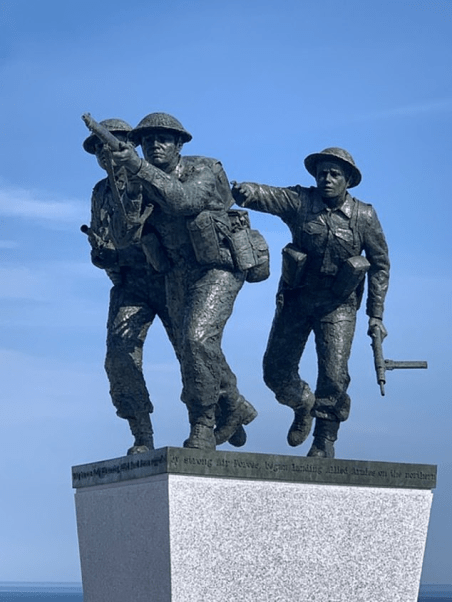
Normandy Memorial Statue

D-DAY MEMORIAL

Three British soldiers are depicted here charging up the beach and into the hellish unknown, their camaraderie beautifully captured in bronze.

THE dwindling band of brothers who took part in the greatest military operation of all time will, on Thursday, 6 June, have their first sight of the new monument to their 22,442 comrades who never came home. They have been waiting 75 years for this moment.

The monument has just been erected on the spot where so many young men charged ashore and gave their all. It will be formally unveiled on Thursday – the anniversary of D-Day – in front of veterans, bereaved families and world leaders including the Prime Minister and the French President.

The monument, which is beautifully captured in bronze, is a depiction of the camaraderie of three British soldiers charging up the beach and into the hellish unknown. Standing 9ft tall and weighing several tons, the three figures are not based on any individuals and deliberately carry no regimental markings or insignia. The great D-Day invasion of France on June 6, 1944 involved hundreds of thousands from all the Services and the Merchant Navy, too. The ultimate purpose of this colossal multinational endeavour, however, was to put Allied infantry on French soil and keep them there.

That is why the award-winning sculptor David Williams-Ellis has distilled the essence of D-Day into this powerful and dynamic study of that quintessential hero – the ordinary British soldier doing his duty.

“They are in standard battle dress and in my mind one is a lance corporal and the other two privates,” said Mr Williams-Ellis. He spent months researching every aspect of the invasion and talked to many veterans before embarking on this great undertaking.

“There is no rank on them, it’s just a suggestion. I wanted it to be a scene expressing camaraderie and leadership. I will leave the viewer to judge which is the lance corporal.”

Mr Williams-Ellis has also sought to represent the three main fighting components of a standard infantry section. One figure is armed with a Bren light machine gun, one has a Sten machine gun, with the other clasping the trusty Lee Enfield .303 rifle.

“He is just about to get the rifle into his shoulder and fire… I wanted to create something that really had energy.”

The statue is the first phase of a memorial that will not be completed for at least another year. Spread across a 50-acre site at Versur-Mer, overlooking a ten-mile stretch of sand codenamed “Gold Beach”, it will feature stone columns engraved with the names of every serviceman under British command who perished in the invasion and the subsequent 77-day Battle of Normandy.

Among the women honoured will be two brave nurses who were still tending to the wounded when their hospital ship, the Amsterdam, was sunk off Juno Beach.

Every other allied country involved in the landings has long had a national memorial on French soil. Not so Britain – until now. The omission has been a source of disappointment to the veterans who are still raising funds. For them, Thursday’s inauguration ceremony will be a very happy milestone.

Lord Dannatt, the former Chief of the General Staff and a trustee of the Normandy Memorial Trust, said: “Anyone who talks to the veterans and to the loved ones of those who fell can be under no illusion about how much this memorial means to them. Now it’s really happening.”

The project has been made possible thanks to a £20million grant from the Treasury’s Libor Fund (of penalty fines from errant banks) plus donations from the philanthropist Michael Spencer. Thousands have also been donated by readers of a British national newspaper. However, a further £7.5million is still urgently needed to complete it.

TO understand how the events of 1944, resonate to this day, just listen to some of the heartbreaking messages and testimonies on the memorial’s website. They include the stories of men like Squadron Leader Jack Collins DFC and Bar, from Newcastle, a Typhoon pilot who was killed leading 245 Squadron over Caen in 1944.

His son Mike Collins was four when he died. He talks movingly of his excitement, as a toddler, on seeing his father’s picture in the paper, not realising it was a report of his death. Like all the relatives of those who fell, Mike now cannot wait to see the memorial take shape and to see his gallant father finally included on the Roll of Honour.

Standard